
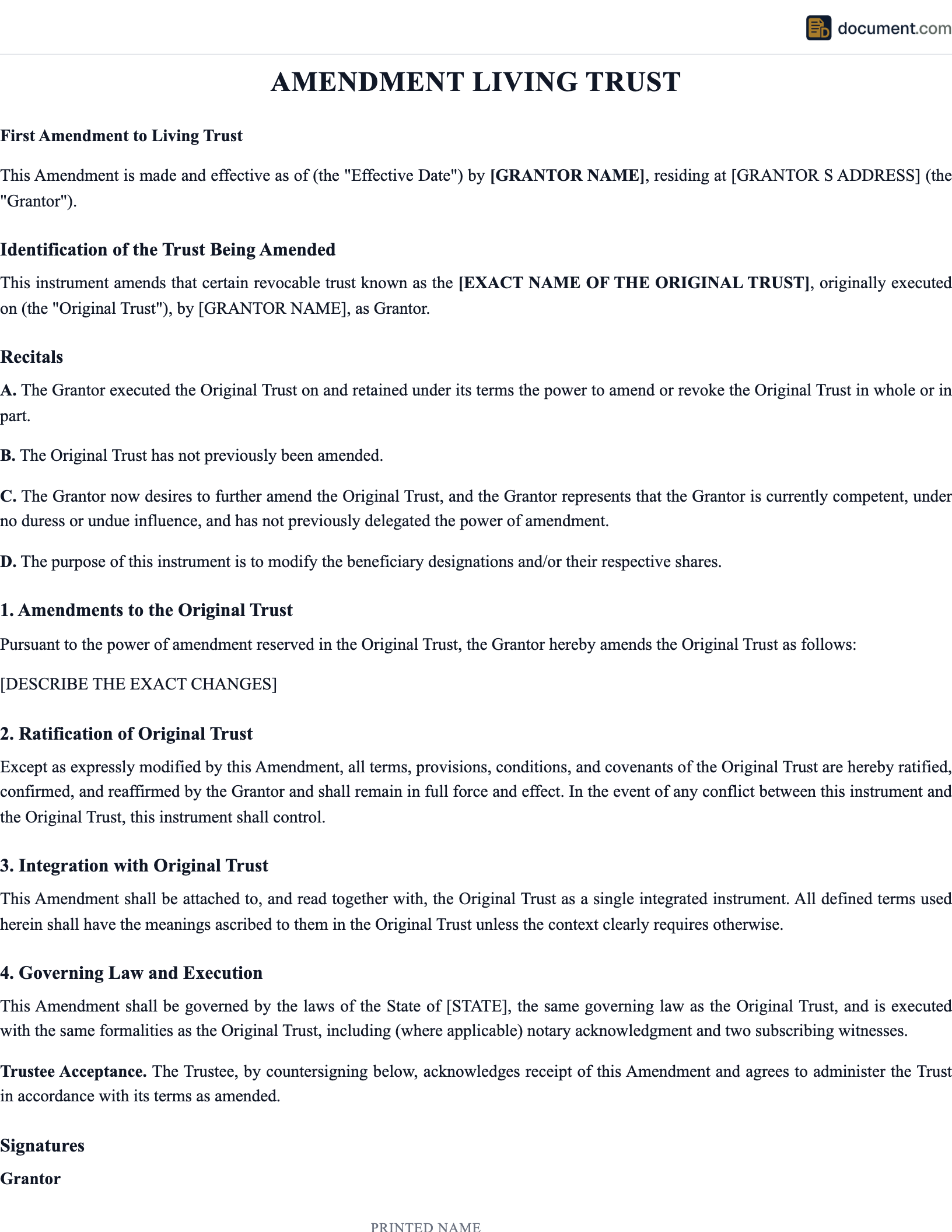



What Is a Living Trust Amendment?
A living trust amendment is a supplemental legal document that modifies specific provisions of an existing revocable living trust without replacing the trust agreement in full. The amendment operates alongside the original trust; the two are read together as a single instrument, and changes take effect immediately upon proper execution. Because revocable living trusts are designed to be modifiable by the settlor at any time during life under Uniform Trust Code § 602(a) and the parallel state statutes, amendment is the standard mechanism for keeping the trust current with changes in family, finances, and legal circumstances.
The legal authority to amend a revocable trust comes from two sources: the trust document itself, which typically contains an express amendment clause reserving the settlor's power, and state law, which provides default rules where the document is silent. California Probate Code § 15402 permits amendment by any writing delivered to the trustee unless the trust specifies a different method. Florida Stat. § 736.0602(3) similarly defaults to settlor amendment rights but allows the trust to override. UTC § 602(c) (adopted in 35 jurisdictions including Florida, Pennsylvania, Virginia, North Carolina, Tennessee, Wyoming, and New Mexico) provides three default methods if the trust is silent: substantial compliance with the trust's stated method, a later will or codicil that expressly refers to the trust, or any other method manifesting clear and convincing evidence of the settlor's intent.
Amendments are inappropriate for irrevocable trusts. The defining feature of an irrevocable trust is that the settlor has surrendered the power to modify it, and changes generally require court approval under UTC § 411 (modification by consent), § 412 (unanticipated circumstances), or § 413 (cy pres for charitable trusts); beneficiary consent under non-judicial settlement procedures of UTC § 111; decanting under state decanting statutes (Delaware Trust Code § 3528, Florida Stat. § 736.04117, New York EPTL § 10-6.6); or trust protector action where the trust expressly grants such authority. The amendment template on this page is designed exclusively for revocable living trusts.
Restatement vs. amendment
Like a codicil to a will, a trust amendment is best suited for narrow, discrete changes: a new trustee, a revised beneficiary, an updated distribution percentage. When changes become extensive, the cleaner alternative is a full restatement of the trust, which preserves the original trust's legal identity, creation date, EIN if any, and asset titling while replacing all the provisions with new language. Restatement is preferred after the second or third amendment, after divorce, after substantial beneficiary changes, or after relocation to a state with different default trust rules. Because the trust's identity is preserved through restatement, no re-funding of trust assets is required: real property, brokerage accounts, and bank accounts already titled in the trust's name remain so titled.
Formalities, capacity, and funding considerations
The settlor must possess legal capacity at the moment of amendment execution, measured by the same standard that applies to contract formation under Restatement (Third) of Trusts § 11: knowledge of the nature and consequences of the act. Capacity to amend a revocable trust is sometimes characterized as lower than testamentary capacity for a will (which requires knowledge of the natural objects of bounty, the property being disposed of, and the testamentary scheme), but most courts treat the standards as functionally equivalent. Formalities track the trust's amendment clause first and state default rules second. Florida requires two witnesses for amendments containing testamentary provisions under Fla. Stat. § 736.0403(2)(b); California permits any writing delivered to the trustee under Probate Code § 15402; New York requires acknowledgment before a notary under EPTL § 7-1.17. An amendment that affects funded assets (changing the beneficiary of a payable-on-death account previously funded into the trust, modifying the pour-over will's relationship to the trust) may require parallel changes to the asset titling itself; the amendment alone does not automatically refund or re-title assets.
Settlor Modifiable
Reserved amendment power under UTC § 602(a) and the trust's own clause
Narrow Changes
Trustee swap, beneficiary update, or distribution revision
No Re-Funding
Trust identity, EIN, and asset titling carry forward unchanged
Amendment vs. Restatement: Which to Use?
Both tools modify a revocable trust, but each is right for different circumstances. Use the table below to decide which fits the changes you have in mind.
| Factor | Amendment | Restatement |
|---|---|---|
| Best for | 1 to 2 narrow changes | Multiple or complex changes |
| Document length | Shorter | Full re-write |
| Preserves trust identity | Yes | Yes |
| Re-funding required | No | No |
| Risk of contradiction | Higher with each added amendment | None |
| Drafting cost | Lower | Slightly higher |
| Administrative simplicity | Lower | Higher |
| Ideal after divorce | No | Yes |
Common Reasons to Amend a Trust
Most living trust amendments fall into a handful of recurring categories. The scenarios below cover the bulk of real-world modifications.
Trustee Change
Replace the original trustee due to death, incapacity, resignation, or relationship change. The most common amendment trigger.
Beneficiary Update
Add a new grandchild, remove an estranged relative, or revise distribution percentages following marriage, divorce, or death.
Asset Distribution Revision
Modify how specific assets are distributed at the settlor's death: change a residence beneficiary, adjust cash bequests, or redirect investment accounts.
Successor Trustee Order
Update the order of successor trustees or add new alternates in case primary trustees are unavailable.
Distribution Standard Change
Switch between HEMS, fully discretionary, mandatory income, or unitrust distribution standards as beneficiary needs evolve.
Administrative Updates
Modernize administrative provisions: digital asset access, electronic notice, virtual representation, or trust protector authority.
Key Components of a Trust Amendment
Every properly drafted living trust amendment contains the same core elements, regardless of state.
Trust Identification
Full name of the trust, original execution date, and the settlor's full legal name.
Amendment Number
Sequential identifier (First Amendment, Second Amendment) so it is clear how this fits into prior amendments.
Authority to Amend
Reference to the trust's amendment clause or to state default rules confirming the settlor's power to modify.
Specific Changes
Article and paragraph references identifying exactly which provisions are revoked, modified, or added.
Republication Clause
Express statement that all unaffected provisions of the original trust remain in full force.
Settlor Signature
Signed in the manner required by the trust's own amendment clause, typically before a notary public.
How to Execute a Trust Amendment
A clean amendment depends as much on process as on language. Follow the six steps below to keep the trust internally consistent and the amendment enforceable.
Locate and review the original trust
Read the trust in full and identify every provision that may be affected. Find the trust's amendment clause and confirm the prescribed method; some trusts require notarization, witnesses, or delivery to the trustee.
Decide: amend or restate?
If the changes are narrow (one or two provisions), amend. If the changes are extensive or you already have prior amendments, restate the entire trust to keep administration clean.
Draft the amendment
Use precise article and paragraph references. State whether each change revokes, modifies, or adds language. Include a republication clause confirming all unaffected provisions remain in effect.
Sign in the prescribed manner
Follow the trust's amendment clause exactly. If it requires notarization, sign before a notary. If it requires witnesses, assemble them. Florida and a few other states impose statutory formalities even for revocable amendments.
Deliver to the trustee
If you are not the sole trustee, deliver a signed copy of the amendment to the acting trustee. California Probate Code § 15402 makes delivery the default activation event for amendments.
Store with the original trust
Place the executed amendment in the same secure location as the original trust agreement. Provide copies to financial institutions holding trust assets if the amendment affects trustee authority.
Form Preview
Below is the structural shell of a typical first amendment to a revocable living trust. Your final document will be customized to the original trust's amendment clause and the specific provisions you intend to change.
First Amendment to the
[Trust Name] Revocable Living Trust
I, [Settlor Name], the Settlor of the [Trust Name] Revocable Living Trust dated [Original Trust Date], do hereby make and execute this First Amendment to said Trust pursuant to the power of amendment reserved in Article ___ of the Trust.
Article I. Amendment. Article ___, Paragraph ___ of the Trust is hereby revoked in its entirety and the following is substituted in its place: [New language].
Article II. Republication. In all other respects, I hereby ratify, confirm, and republish my [Trust Name] Revocable Living Trust dated [Original Trust Date].
IN WITNESS WHEREOF, I have executed this First Amendment on this ______ day of __________, 20___.
_____________________________ Settlor
STATE OF __________ )
COUNTY OF __________ )
Subscribed and sworn to before me this ______ day of __________, 20___.
_____________________________ Notary Public (SEAL)
Sample Amendment Clauses
Common amendment language for the most frequent revisions. Each clause presumes a republication paragraph confirming that all other provisions of the original trust remain in effect.
Changing a Successor Trustee
"I hereby revoke the appointment of [Original Successor Trustee] and in his/her place appoint [New Successor Trustee] to serve as Successor Trustee, to act without bond."
Adding a Beneficiary
"Article IV, Paragraph 2 is hereby amended to add the following beneficiary: [Beneficiary Name], to receive [percentage or specific bequest] upon the death of the Settlor."
Restatement Recital
"The Settlor hereby amends and restates the Trust in its entirety. The original Trust dated [Date] continues in legal existence, and this Restatement supersedes all prior provisions and amendments. All assets currently titled in the name of the Trust shall continue to be held under the terms of this Restatement without need for re-titling."
Watch the trust's own amendment clause
A more demanding execution standard inside the trust controls over a less demanding state default. Always read the amendment clause before drafting; if it requires witnesses, a notary, or delivery to the trustee, the amendment is not effective until those formalities are satisfied.
Frequently Asked Questions
Common questions about trust amendments, restatements, capacity, and the interaction between revocable and irrevocable trusts.
Official Resources
Authoritative sources for revocable trust modification, amendment formalities, and state-specific execution requirements.
Uniform Trust Code (Uniform Law Commission)
Official text and adoption status for the Uniform Trust Code, including amendment rules under § 602
California Probate Code § 15402
California default rule for revocable trust modification by writing delivered to the trustee
Florida Statutes § 736.0602
Florida revocation and amendment of revocable trusts, including the two-witness rule for testamentary provisions
ABA Real Property, Trust and Estate Section
American Bar Association resources on trust amendment and restatement practice
Cornell Legal Information Institute - Trusts
Plain-English overview of trust law, capacity, and modification
Create your Trust Amendment in under 10 minutes.
Answer a few questions and download a compliant, attorney-drafted document ready for your state.