



What Is a Lease Extension Agreement?
A lease extension agreement is a legal document that extends the duration of an existing lease beyond its original expiration date while keeping all other terms and conditions of the original lease in full force and effect. Unlike a lease renewal, which creates an entirely new agreement and allows for renegotiation of all terms, a lease extension simply pushes out the end date of the current lease, preserving the existing relationship and obligations.
Lease extensions are one of the most common documents in residential and commercial real estate because they offer a simple, efficient way to continue a tenancy when both the landlord and tenant are satisfied with the current arrangement. Rather than drafting an entirely new lease agreement with all its provisions, disclosures, and addenda, both parties can sign a one-page or two-page extension that references the original lease and specifies only the new end date and any mutually agreed modifications such as a rent adjustment.
It is important to understand the distinction between an extension and a holdover situation. When a lease expires and the tenant continues to occupy the property without a written extension or renewal, they become a holdover tenant. Most states convert holdover tenancies to month-to-month arrangements at the existing rent, but some leases impose holdover penalties (often 150-200% of the base rent). A formal extension agreement eliminates this ambiguity and gives both parties certainty about the duration, rent, and terms of the continued tenancy.
While a lease extension keeps most terms the same, the parties can agree to specific modifications as part of the extension. Common modifications include a rent adjustment (increase or decrease), changes to the extension duration, updated maintenance responsibilities, or addition of a pet addendum. Any modifications should be clearly documented in the extension agreement and will supersede the corresponding provisions in the original lease.
Extension vs Renewal
Extension keeps same terms; renewal can change rent, rules, and conditions
Rent Adjustments
Optional rent increase or decrease can be included in the extension
Holdover Prevention
Avoid month-to-month uncertainty with a formal written extension
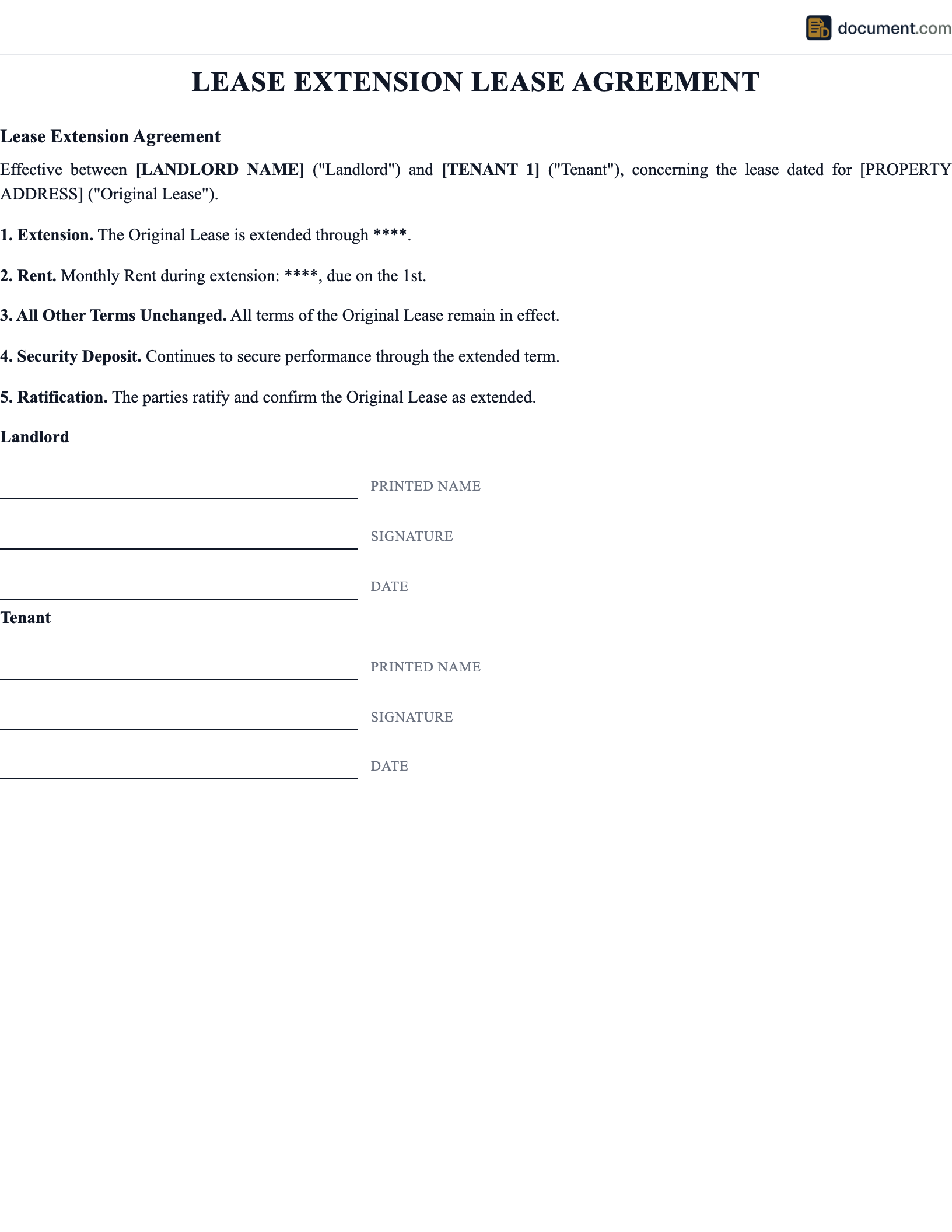
Lease Extension Agreement Form Preview
Our lease extension template includes all required fields for a legally valid agreement. Below is a preview of the key sections. Your customized document will reference your original lease and include any agreed-upon modifications.
LEASE EXTENSION AGREEMENT
Amendment to Residential Lease Agreement
PARTIES
Landlord: [Full Name]
Tenant(s): [Full Name(s)]
Property: [Address, Unit #]
ORIGINAL LEASE
Original Lease Date: [Date]
Current Expiration: [Date]
Current Monthly Rent: $[Amount]
EXTENSION TERMS
New Expiration Date: [Date]
Extension Duration: [Months]
New Monthly Rent: $[Amount] (if changed)
MODIFICATIONS (IF ANY)
[List any changes to original terms]
SIGNATURES
Landlord Signature: [Signature] Date: [Date]
Tenant Signature: [Signature] Date: [Date]
How to Write a Lease Extension Agreement
Creating a lease extension agreement is straightforward because it builds on the existing lease. Follow these steps to ensure your extension is legally valid and properly documented.
Review the Original Lease
Before drafting the extension, review the original lease for any provisions about renewal, extension, or holdover terms. Some leases include specific procedures for extensions, such as required notice periods, rent escalation formulas, or automatic extension clauses. Understanding the original terms ensures your extension agreement is consistent and does not conflict with existing provisions. Also note the original lease date, parties, and property address for reference.
Identify All Parties and Property
List the full legal names of the landlord and all tenants exactly as they appear on the original lease. Include the complete property address with unit number. If the landlord has changed (e.g., property was sold) or a tenant has been added or removed through a prior amendment, reflect the current parties. Reference the original lease by its date of execution to clearly link the extension to the correct agreement.
Specify the Extension Period
Clearly state the new expiration date and the duration of the extension. Include both the start date (typically the day after the original lease expires) and the end date of the extension period. Use specific dates rather than vague terms like "for another year" to prevent ambiguity. For example: "The lease is hereby extended from April 1, 2026 through March 31, 2027."
Address Rent and Financial Terms
If the rent will remain the same, explicitly state that the current monthly rent of $X will continue during the extension period. If the rent is changing, clearly state the new monthly rent amount and the effective date. Also address any changes to the security deposit (if applicable under state law), late fees, utility responsibilities, or other financial terms. If nothing is changing financially, a simple statement that all financial terms of the original lease remain in effect is sufficient.
Document Any Modifications
If any terms of the original lease are being modified as part of the extension, list them explicitly. Common modifications include updated pet policies, parking assignments, maintenance responsibilities, or guest policies. For each modification, reference the original lease section being changed and state the new provision. Include a clause stating that all other terms not specifically modified remain in full force and effect.
Include Holdover Provisions
Address what happens if the tenant remains after the extension period expires. Common options include automatic conversion to month-to-month tenancy, automatic extension for another fixed term, or required written notice to continue. Holdover provisions prevent uncertainty at the end of the extension period and protect both parties from ambiguous tenancy situations.
Have Both Parties Sign
Both the landlord and all tenants listed on the original lease must sign the extension agreement. Each party should receive a fully executed copy. Include signature lines with printed names and dates for each signer. While notarization is generally not required for a lease extension, some parties choose to notarize for additional security, particularly for commercial leases or high-value residential properties.
Key Components of a Lease Extension Agreement
A comprehensive lease extension agreement should include the following elements to be legally effective and clearly document the extended tenancy arrangement.
| Component | Description |
|---|---|
| Agreement Date | Date the extension agreement is signed by both parties |
| Landlord Name | Full legal name of the property owner or management company |
| Tenant Name(s) | Full legal names of all tenants on the original lease |
| Property Address | Complete rental property address including unit number |
| Original Lease Reference | Date and identification of the original lease being extended |
| Original Expiration Date | End date of the current lease before extension |
| New Expiration Date | New end date of the lease after the extension period |
| Extension Duration | Length of the extension period (months or years) |
| Rent Amount | Monthly rent during extension period (same or adjusted) |
| Modifications | Any changes to original lease terms (if applicable) |
| Continuation Clause | Statement that all other terms remain in full force and effect |
| Holdover Provision | What happens after the extension expires (month-to-month, etc.) |
| Signatures | Landlord and all tenant signatures with dates |
Legal Requirements for Lease Extensions
While lease extensions are relatively simple documents, they must meet certain legal requirements to be enforceable. These requirements vary by state and property type.
Important: Extension vs Automatic Renewal
Many leases contain automatic renewal clauses that activate if neither party gives timely notice before the lease expires. An automatic renewal may lock the tenant into a new full-term lease (often 12 months), which is different from a negotiated extension. Review your lease for auto-renewal provisions and understand the notice deadline to avoid an unintended commitment.
Written Agreement Required
- Statute of Frauds: Most states require lease agreements of one year or more to be in writing; a verbal extension may not be enforceable for long-term extensions
- Mutual Consent: Both landlord and tenant must agree to the extension; neither party can unilaterally extend the lease without the other's written consent
- Rent Control Compliance: In rent-controlled jurisdictions, any rent increase must comply with local ordinances regardless of whether the extension is mutual
- Fair Housing: Extension terms cannot discriminate based on protected characteristics; all tenants must be offered similar extension opportunities
Rent Adjustment Considerations
If the extension includes a rent increase, the landlord must comply with state and local regulations. In rent-controlled cities, increases are limited to a fixed percentage (often tied to CPI or a set cap). Even in non-rent-controlled areas, some states require advance written notice of rent increases (typically 30-60 days). The extension agreement itself may satisfy this notice requirement if signed sufficiently in advance of the effective date. Document the old rent, new rent, and effective date clearly.
Sample Lease Extension Agreement
Below is a sample lease extension agreement for a residential property. Your customized document will include state-specific language and any modifications you specify.
LEASE EXTENSION AGREEMENT
This Lease Extension Agreement ("Extension") is entered into on [Date] by and between [Landlord Name] ("Landlord") and [Tenant Name(s)]("Tenant").
WHEREAS, the parties entered into a Residential Lease Agreement dated [Original Lease Date] for the property located at [Property Address](the "Original Lease"), which is currently set to expire on [Current Expiration Date].
NOW, THEREFORE, the parties agree as follows:
1. The Original Lease is hereby extended through [New Expiration Date].
2. Monthly rent during the extension period shall be $[Amount].
3. All other terms and conditions of the Original Lease shall remain in full force and effect during the extension period.
4. Upon expiration of this extension, the tenancy shall convert to a month-to-month arrangement unless a new extension or renewal is executed.
Landlord Signature
Printed Name: _______________
Date: _______________
Tenant Signature
Printed Name: _______________
Date: _______________
Frequently Asked Questions
Find answers to common questions about lease extension agreements, renewals, rent adjustments, and holdover provisions.
Official Resources
Use these trusted resources for information about lease extensions, tenant rights, and landlord-tenant regulations in your state.
HUD Rental Resources
Federal guidance on rental agreements and tenant protections
CFPB Housing Resources
Consumer guides on renting, leases, and tenant rights
Nolo Renters' Rights
State-by-state landlord-tenant law guides and resources
USA.gov Housing Help
Government housing resources, complaints, and legal assistance
Related Lease Documents
These related documents may be useful when managing lease extensions and rental agreements.
Lease Agreement
Complete residential rental lease agreement
Notice to Vacate
Formal tenancy termination notice for landlords or tenants
Rent Increase Notice
Formal notice of rent adjustment for tenants
Sublease Agreement
Subletting agreement when tenant needs temporary coverage
Lease Termination
Mutual agreement to end lease before expiration
Lease Amendment
Modify specific terms of an existing lease agreement
Create your Lease Extension Lease Agreement in under 10 minutes.
Answer a few questions and download a compliant, attorney-drafted document ready for your state.