



South Carolina Commercial Sublease Agreement Overview
South Carolina has no dedicated commercial sublease statute. Commercial sublease arrangements are governed entirely by contract law and the terms of the prime lease between the original tenant and the landlord. This gives the parties broad flexibility but provides no statutory safety net for subtenants who fail to negotiate adequate protections into the sublease agreement before signing.
South Carolina's commercial sublease market is driven by multiple economic forces. Charleston's post-pandemic office market has seen significant sublease availability as companies rationalized footprints in the downtown district, King Street corridor, and the West Ashley area. Columbia's state government and university anchors provide a relatively stable office base, but private sector tenants in the Vista and downtown office market have contributed to sublease supply. The Greenville and Spartanburg Upstate markets have strong industrial and manufacturing activity that generates sublease activity when production contracts shift or facilities become surplus. In all of these markets, subtenants bear the fundamental risk that the prime lease could be terminated if the original tenant defaults, and managing that risk through the sublease agreement is the central challenge of any South Carolina commercial sublease transaction.
The no-privity principle is the most important rule governing South Carolina commercial subleases. The subtenant's contractual relationship is with the original tenant, not with the landlord. This means the subtenant cannot enforce the landlord's obligations directly and the landlord cannot pursue the subtenant directly for rent. When the original tenant's business fails, the subtenant faces displacement even if it has met every obligation under the sublease. A non-disturbance agreement negotiated with the landlord at the outset is the standard tool for managing this risk in South Carolina commercial transactions.
Per lease
Subletting default
Yes
Consent required
Yes
Tenant remains liable
No statutory
Deposit rules
South Carolina Commercial Subletting Framework
South Carolina commercial subleases are governed entirely by the prime lease and the sublease agreement. There is no statutory framework providing baseline protections for commercial subtenants. The following requirements address the key legal and practical rules that govern commercial sublease relationships in South Carolina.
Important: No Privity Between Subtenant and Landlord
A South Carolina commercial subtenant has no direct contractual relationship with the landlord. The subtenant's obligations run to the original tenant, and the landlord's obligations run to the original tenant only. If the original tenant's prime lease is terminated, the subtenant may lose occupancy rights even if all sublease obligations are current. Subtenants taking on significant space in Charleston, Columbia, or Greenville should negotiate a non-disturbance agreement with the landlord before executing the sublease.
Original Tenant (Sublessor) Requirements
- Obtain Landlord Consent: Most South Carolina commercial prime leases require written landlord consent before any sublease is effective. The landlord's discretion to refuse is generally unrestricted unless the prime lease expressly requires a reasonableness standard.
- Accept Full Continued Liability: The original tenant remains fully bound by every prime lease obligation for the entire remaining term after subleasing. The sublease does not reduce this exposure.
- Flow Down Prime Lease Terms: The sublease should incorporate the prime lease terms governing permitted use, alterations, insurance, and compliance obligations so the subtenant is bound by the same constraints as the original tenant.
- Address Security Deposit Terms: South Carolina imposes no statutory cap on commercial security deposits. Document the deposit amount, holding method, permitted deductions, and return timeline in the sublease agreement.
Subtenant Obligations and Protections
- Understand No-Privity Risk: The subtenant cannot enforce the landlord's repair obligations directly and cannot hold the landlord responsible for conditions in the space unless the sublease creates contractual rights for the subtenant to act through the original tenant.
- Review the Full Prime Lease: The subtenant's obligations and limitations are shaped by the prime lease. The subtenant should review every provision before committing, including use restrictions, permitted alterations, and insurance requirements that pass through the original tenant to the subtenant.
- Negotiate Non-Disturbance Protection: A non-disturbance agreement from the landlord protects the subtenant from displacement if the prime lease is terminated for reasons outside the subtenant's control. This is the primary risk mitigation tool available to South Carolina commercial subtenants.
- Consider Recording: Recording a memorandum of sublease at the county Register of Deeds provides constructive notice to future purchasers and lenders and can protect the subtenant's leasehold interest if the property changes ownership during the sublease term. South Carolina's 46 counties each maintain a separate Register of Deeds office.
How to Fill Out a South Carolina Commercial Sublease Agreement
A South Carolina commercial sublease has no statutory baseline protecting the subtenant, so the drafting process requires attention to privity, consent, and displacement risk that go beyond what a simple form can capture. Work through each step carefully.
Review the Prime Lease and Obtain Landlord Consent
Read the prime lease assignment and subletting clause to understand the consent requirement, any conditions the landlord may impose, and any recapture rights that might allow the landlord to take back the space instead of consenting to the sublease. Submit a formal written consent request to the South Carolina landlord that includes the proposed subtenant's business description, financial information, and intended use. Request a non-disturbance agreement as part of the consent process, particularly if the subtenant is committing to more than one year or investing in tenant improvements.
Draft the Sublease with Prime Lease Flow-Down
Identify all parties by full legal name: the sublessor (original tenant), the subtenant, and the landlord as a referenced third party. Attach the prime lease and incorporate it by reference so the subtenant is bound by its terms. Specify the subleased premises by floor, suite, and square footage. Set the sublease term, which must fall within the remaining prime lease term. Define base rent, any NNN or operating expense pass-throughs that apply, and the payment schedule. Include an explicit acknowledgment that the subtenant has no privity of contract with the landlord.
Address Security Deposit and Default Provisions
Set the security deposit with the understanding that no statutory cap applies to South Carolina commercial subleases. Document the amount, holding method, interest terms, deduction categories, and return deadline. Draft default provisions that address subtenant non-payment and what happens if the prime lease terminates for reasons outside the subtenant's control. If a non-disturbance agreement was obtained, attach it as an exhibit to the sublease. For subtenants in the Charleston market where coastal insurance pass-throughs under NNN prime leases can be substantial, confirm how those charges are handled in the sublease.
Execute the Agreement and Consider Recording
Both parties execute the sublease with all exhibits attached including the landlord's written consent and any non-disturbance agreement. Distribute executed copies to the sublessor, subtenant, and landlord. For subleases exceeding one year or covering significant square footage, consider recording a memorandum of sublease at the Register of Deeds office in the South Carolina county where the property is located. South Carolina has 46 counties with separate Register of Deeds offices: Charleston County for Charleston properties, Richland County for Columbia properties, Greenville County for Greenville properties, and so on.
South Carolina Commercial Sublease Key Terms
The table below summarizes the most important legal rules and practical considerations governing commercial sublease arrangements in South Carolina.
| Topic | South Carolina Commercial Rule |
|---|---|
| Governing Law | Contract law only; no dedicated South Carolina commercial sublease statute |
| Landlord Consent | Required under most prime leases; landlord discretion is unrestricted unless the prime lease expressly requires reasonableness |
| Original Tenant Liability | Continues in full for the entire prime lease term; subletting does not reduce the original tenant's exposure to the landlord |
| Subtenant Privity with Landlord | None; subtenant's obligations run to the original tenant only |
| Displacement Risk | Subtenant can be displaced if prime lease terminates; non-disturbance agreement from landlord is the primary protection available in South Carolina |
| Security Deposit | No statutory cap for commercial subleases; amount, holding, and return terms are fully negotiable |
| Recording | Optional; memorandum of sublease recorded at the county Register of Deeds (46 county offices in South Carolina) for constructive notice |
| Attorney Review | Strongly recommended given absence of statutory protections; typical South Carolina commercial sublease review ranges from $400 to $800 |
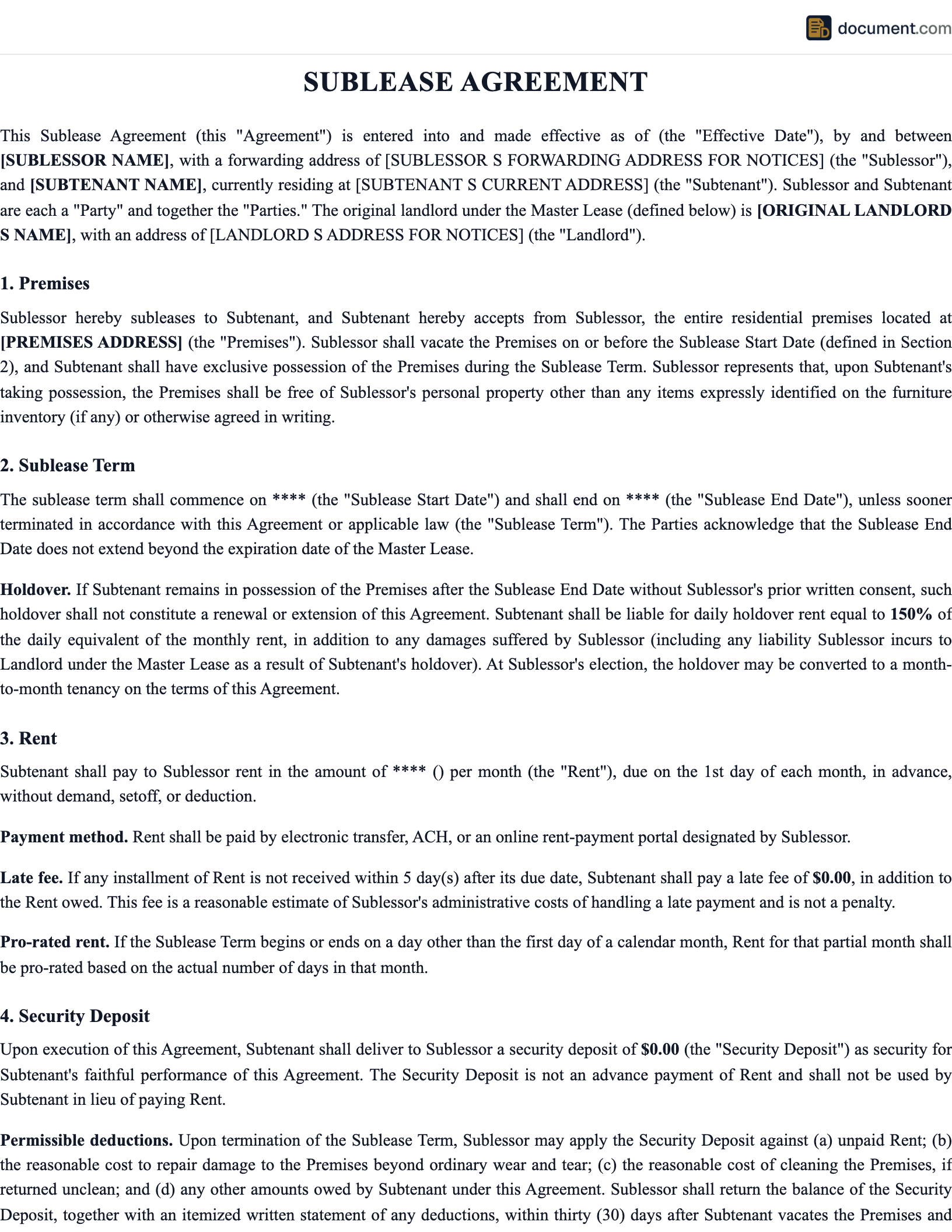
Sample South Carolina Sublease Agreement
Below is a preview of our South Carolina-specific sublease agreement. Your customized document will include all provisions required under SC law.
STATE OF SOUTH CAROLINA
SUBLEASE AGREEMENT
Residential Subletting Contract
SUBLESSOR (Original Tenant):
Name: [Sublessor Name]
Address: [South Carolina Address]
SUBLESSEE (New Occupant):
Name: [Sublessee Name]
Current Address: [Address]
SUBLEASE TERMS
Start Date: [Date]
End Date: [Date]
Monthly Rent: $[Amount]
Security Deposit: $[Amount]
South Carolina Sublease Agreement FAQ
Answers to common questions about sublease agreements in South Carolina.
Other South Carolina Lease Agreement Templates
Need a different type of lease agreement for South Carolina? We offer state-specific templates for every type of rental arrangement.
South Carolina Residential Lease
Standard rental agreements
South Carolina Month-to-Month Lease
Flexible short-term rentals
South Carolina Vacation Rental
Short-term vacation properties
South Carolina Commercial Lease
Business and retail spaces
South Carolina Roommate Agreement
Shared living arrangements
South Carolina Rent-to-Own
Lease with purchase option
South Carolina Equipment Lease
Equipment rental agreements
South Carolina Land Lease
Land rental agreements
South Carolina Room Rental
Individual room rentals
Create your South Carolina Sublease Lease Agreement in under 5 minutes.
Answer a few questions and download a South Carolina-compliant document, ready for the state agency.