



New Hampshire Sublease Agreement Overview
A commercial sublease in New Hampshire occurs when an existing commercial tenant, the sublessor, transfers possession of all or part of the leased premises to a subtenant for a period shorter than the remaining prime lease term. New Hampshire has no dedicated statute governing commercial subleases; the arrangement is governed entirely by the prime lease terms and the sublease agreement itself. Courts apply standard contract principles to resolve disputes between sublessors, subtenants, and landlords.
Commercial sublease activity in New Hampshire concentrates in the southern tier of the state, particularly in Manchester, Nashua, and along the Seacoast in Portsmouth and surrounding communities. Office tenants with excess space following downsizing and retail tenants seeking to offset rent obligations are the most common sublessors in these markets. The state's relatively low regulatory burden and lack of commercial rent tax make New Hampshire an attractive market for subtenants coming from higher-cost environments.
A properly structured New Hampshire commercial sublease addresses the prime lease consent process, defines what obligations the subtenant assumes versus what the sublessor retains, and allocates risk for landlord default or prime lease termination. The sublessor's continued liability under the prime lease is the central risk that both parties must account for in the structure of any commercial sublease agreement.
Allowed with
Subletting default
Yes
Consent required
Yes
Tenant remains liable
1 month's
Deposit rules
New Hampshire Commercial Sublease Requirements
Because New Hampshire has no commercial sublease statute, all requirements flow from the prime lease and the sublease agreement. Review the prime lease carefully before approaching the landlord for consent, and confirm whether any consent provision limits the landlord's ability to refuse or allows the landlord to impose conditions on approval.
Review the Prime Lease Consent Clause First
New Hampshire commercial landlords are not required by statute to act reasonably when withholding sublease consent unless the prime lease says so. Some leases require reasonable consent; others give the landlord absolute discretion. Before negotiating a sublease or committing resources to a potential subtenant, confirm exactly what the prime lease says about assignment and subletting consent. Proceeding without required consent can result in default and lease termination.
Sublessor (Original Tenant) Obligations
- Review prime lease consent requirements: Determine whether consent is required, whether the landlord's discretion is limited, and whether any profit-sharing or recapture rights apply
- Obtain written landlord consent: Submit a formal consent request with the proposed subtenant's business and financial information; obtain the landlord's written approval before executing the sublease
- Remain liable under the prime lease: The sublessor continues to owe rent and all other prime lease obligations even after a sublease is in place; the subtenant's default does not excuse the sublessor
- Vet the subtenant thoroughly: Review financial statements, business references, and intended use; confirm that the proposed use complies with both the prime lease permitted use and applicable zoning for the NH municipality
Subtenant Obligations
- Review the prime lease: Request and read the full prime lease before signing; the subtenant must comply with all incorporated terms even though there is no direct contract with the landlord
- Seek non-disturbance protection: A subtenant making significant tenant improvements at a Portsmouth, Manchester, or Nashua commercial location should request a non-disturbance agreement from the landlord to protect occupancy if the prime lease terminates
- Pay rent on time to the sublessor: The subtenant's rent payments flow to the sublessor, not directly to the landlord; late payments risk triggering a default chain up to the prime lease level
- Comply with permitted use restrictions: Use the premises only for the purpose defined in the sublease; unauthorized use can breach both the sublease and the prime lease simultaneously
How to Complete a New Hampshire Commercial Sublease
Completing a New Hampshire commercial sublease involves several preparation steps before a document is ever drafted. The consent process and prime lease review are as important as the sublease document itself.
Review the Prime Lease Consent Process
Read the assignment and subletting clause of the prime lease carefully. Identify whether landlord consent is required, whether discretion is limited to reasonable grounds, what information the landlord is entitled to receive about the proposed subtenant, and whether the landlord has any right to recapture the space instead of approving the sublease. Understanding these terms before approaching the landlord avoids missteps that could trigger a default.
Submit a Consent Request to the Landlord
Prepare a written consent request that includes the proposed subtenant's business entity information, a description of the intended use, financial statements or credit references, and a summary of the proposed sublease terms. New Hampshire landlords at Portsmouth waterfront, Manchester central business district, and Nashua commercial parks will typically want to verify that the subtenant's use is compatible with the building and other tenants. Allow reasonable time for the landlord to respond before proceeding.
Draft the Sublease Agreement
Use a New Hampshire commercial sublease template that identifies the prime lease and incorporates its relevant provisions, defines the subleased space precisely, states the sublease rent and term, addresses operating expense obligations, specifies what happens on subtenant default, and includes a governing law provision pointing to New Hampshire and the applicable county superior court. Attach the prime lease and the landlord's written consent as exhibits.
Execute and Distribute Copies
Both the sublessor and subtenant sign the agreement. If either party is a business entity, confirm signing authority. Provide fully executed copies to all parties, including the landlord as required by the prime lease. Record a memorandum of sublease at the applicable county register of deeds if the subtenant is making significant improvements or the sublease term is long enough to warrant constructive notice protection.
New Hampshire Commercial Sublease Key Terms
The framework below reflects how New Hampshire law and standard commercial practice address the core issues in a commercial sublease. None of these rules are fixed by statute; they represent defaults that can be modified by the terms of your prime lease or sublease agreement.
| Topic | New Hampshire Rules |
|---|---|
| Landlord Consent Requirement | No statutory default; governed by prime lease terms. Most commercial leases in New Hampshire require written landlord consent before a sublease can be executed. |
| Reasonableness Standard | No commercial reasonableness statute in New Hampshire. Whether the landlord must act reasonably when withholding consent depends entirely on the prime lease language. Check for a reasonableness qualifier before relying on it. |
| Original Tenant Liability | The sublessor remains in privity of contract with the landlord and is liable for all prime lease obligations throughout the sublease term. Subtenant default does not extinguish sublessor liability. |
| Privity of Contract (Subtenant to Landlord) | No direct privity exists between the subtenant and the landlord under a sublease. The subtenant's rights run through the sublessor and the sublease agreement, not through the prime lease directly. |
| Non-Disturbance Agreement | Not required by law but highly advisable for subtenants investing in tenant improvements at Manchester, Portsmouth, or Nashua commercial properties. A non-disturbance agreement from the landlord protects the subtenant's occupancy if the prime lease terminates. |
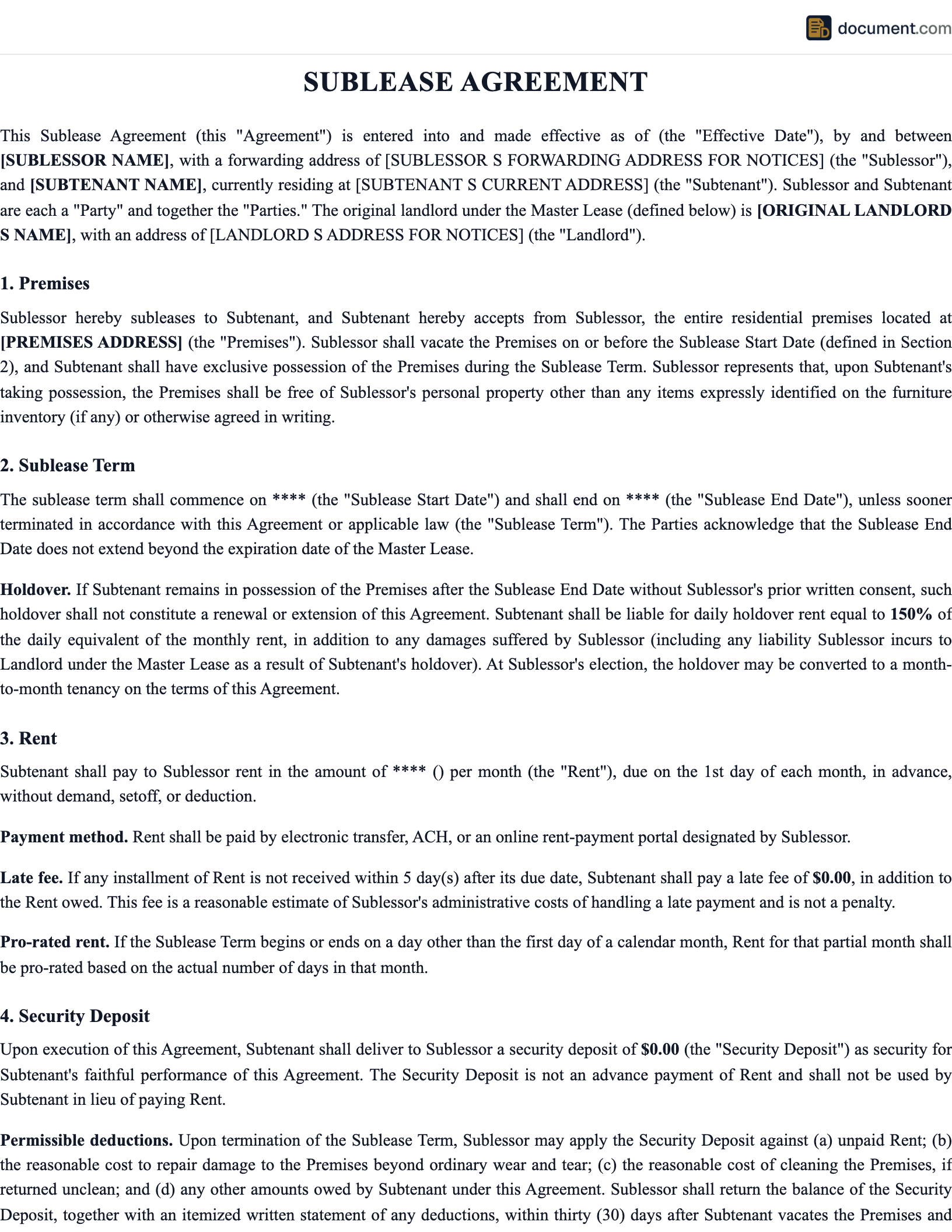
Sample New Hampshire Sublease Agreement
Below is a preview of our New Hampshire-specific sublease agreement. Your customized document will include all provisions required under NH law.
STATE OF NEW HAMPSHIRE
SUBLEASE AGREEMENT
Residential Subletting Contract
SUBLESSOR (Original Tenant):
Name: [Sublessor Name]
Address: [New Hampshire Address]
SUBLESSEE (New Occupant):
Name: [Sublessee Name]
Current Address: [Address]
SUBLEASE TERMS
Start Date: [Date]
End Date: [Date]
Monthly Rent: $[Amount]
Security Deposit: $[Amount]
New Hampshire Sublease Agreement FAQ
Answers to common questions about sublease agreements in New Hampshire.
Other New Hampshire Lease Agreement Templates
Need a different type of lease agreement for New Hampshire? We offer state-specific templates for every type of rental arrangement.
New Hampshire Residential Lease
Standard rental agreements
New Hampshire Month-to-Month Lease
Flexible short-term rentals
New Hampshire Vacation Rental
Short-term vacation properties
New Hampshire Commercial Lease
Business and retail spaces
New Hampshire Roommate Agreement
Shared living arrangements
New Hampshire Rent-to-Own
Lease with purchase option
New Hampshire Equipment Lease
Equipment rental agreements
New Hampshire Land Lease
Land rental agreements
New Hampshire Room Rental
Individual room rentals
Create your New Hampshire Sublease Lease Agreement in under 5 minutes.
Answer a few questions and download a New Hampshire-compliant document, ready for the state agency.