
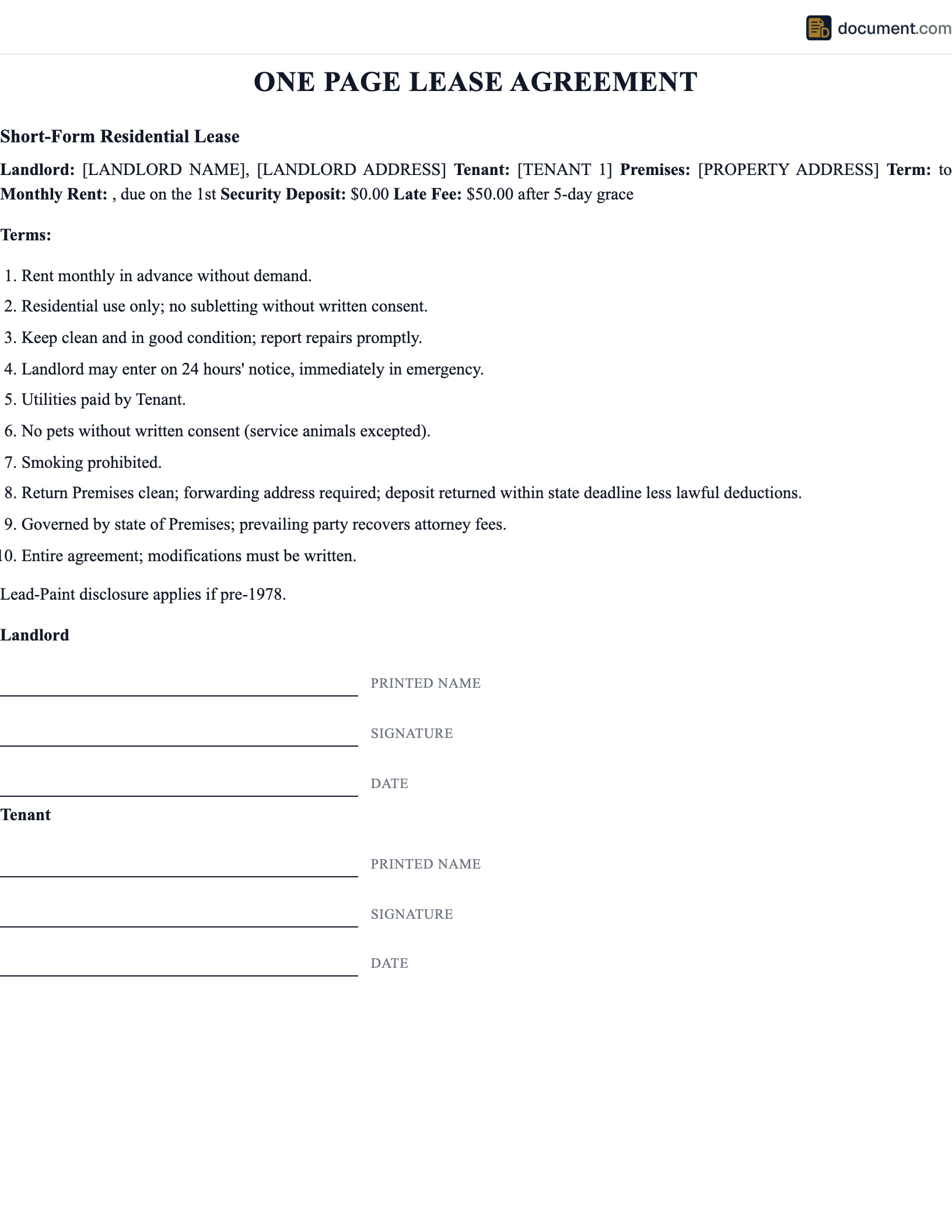



Indiana One Page Lease Overview
A one-page lease in Indiana is a streamlined rental agreement for essential tenancy terms. Indiana\'s landlord-tenant law is codified in Indiana Code Title 32, Article 31 (IC 32-31-1 through IC 32-31-9), which provides a balanced framework. Indiana is considered a moderately landlord-friendly state with no rent control, no mandatory grace period, and no statutory late fee cap, though it does impose some meaningful tenant protections including an implied warranty of habitability and a mold disclosure requirement.
Indiana is notable for its mandatory mold disclosure requirement (IC 32-31-8-5). Landlords must disclose to tenants any known presence of mold contamination in the rental unit, and tenants must notify the landlord of any mold discovered during the tenancy. This mutual disclosure obligation is unusual — most states do not have specific mold disclosure statutes. Indiana also requires that the lease acknowledge receipt of a copy if requested by the tenant.
The Indiana rental market centers on Indianapolis (the largest city), with significant markets in Fort Wayne, Evansville, South Bend, and the university towns of Bloomington (IU) and West Lafayette (Purdue). Indiana\'s relatively affordable housing costs and straightforward landlord-tenant laws make one-page leases practical for many situations, particularly month-to-month tenancies and simple residential rentals in suburban and rural areas.
No statutory cap
Deposit Limit
45 days
Deposit Return
Required
Mold Disclosure
Indiana Minimum Required Lease Terms
Under IC 32-31-2-1, a rental agreement governs the tenancy. Indiana\'s Statute of Frauds requires leases exceeding one year to be in writing and signed by the party to be charged. A valid one-page lease should include:
- Parties: Full legal names of landlord and all adult tenants
- Premises: Complete address including unit number, city, county, and zip code
- Rent: Monthly amount, due date, and payment methods
- Term: Start and end dates for fixed-term, or month-to-month designation
- Security deposit: Amount (no statutory cap) and return conditions; must be returned within 45 days
- Mold disclosure: Acknowledgment of known mold conditions or absence thereof (IC 32-31-8-5)
- Signatures: All parties must sign; no notarization required
Indiana Required Disclosures
Indiana requires specific disclosures with any residential lease. These can be attached as addenda.
- Lead-based paint (federal): Required for housing built before 1978 (42 U.S.C. § 4852d)
- Mold disclosure: Must disclose known mold contamination in the unit (IC 32-31-8-5)
- Landlord/agent identity: Name and address of the landlord and authorized managing agent
- Flooding/water damage: While not statutorily mandated, disclosing known flooding history is recommended best practice
- Smoke/CO detector notice: Must ensure functioning smoke detectors and carbon monoxide detectors are installed
Mandatory Mold Disclosure
Indiana\'s mold disclosure statute (IC 32-31-8-5) requires landlords to disclose any known mold contamination to prospective tenants. The tenant must also notify the landlord of any mold discovered during the tenancy. Failure to disclose known mold can expose the landlord to liability for health damages. This disclosure must be provided even with a one-page lease format — it can be included as a single line or as a separate addendum.
Enforceability and Default Rules in Indiana
Indiana recognizes an implied warranty of habitability through statute (IC 32-31-8-5) and case law. The landlord must maintain the premises in a safe and sanitary condition, including structural integrity, plumbing, electrical, heating, and compliance with applicable housing codes. The landlord must also provide functioning smoke detectors and carbon monoxide detectors.
If the landlord fails to maintain habitability, Indiana tenants may provide written notice specifying the issue. If the landlord fails to repair within a reasonable time, the tenant may pursue legal remedies including termination of the lease. Indiana does not have a broad statutory repair-and-deduct remedy, but tenants may raise habitability defenses in eviction proceedings. Courts have recognized that a landlord\'s failure to maintain habitability can be a defense to non-payment of rent.
Indiana\'s non-payment eviction process is relatively fast. There is no mandatory pre-filing notice period specifically for non-payment under state law (though the lease may require one). The landlord files a complaint in small claims court or circuit court. Month-to-month tenancies require 30 days\' notice for termination by either party (IC 32-31-1-1). Indiana does not have just-cause eviction requirements. The state prohibits retaliatory eviction under IC 32-31-9.
Key Financial and Legal Details
| Item | Indiana Rule |
|---|---|
| Security Deposit Maximum | No statutory cap |
| Deposit Return Deadline | 45 days after tenant vacates (IC 32-31-3-12) |
| Late Fee Cap | No statutory cap; must be reasonable |
| Grace Period | No statutory requirement |
| Termination Notice (M-to-M) | 30 days written notice (IC 32-31-1-1) |
| Non-Payment Process | No mandatory pre-filing notice; file in court |
| Mold Disclosure | Required (IC 32-31-8-5) |
| Rent Control | None statewide |
Official Indiana Resources
Other Indiana Lease Agreement Types
Need a more comprehensive lease for Indiana? Consider these full-length templates.
Indiana One Page Lease FAQ
Common questions about simplified one-page lease agreements under Indiana law.
Create your Indiana One Page Lease Agreement in under 5 minutes.
Answer a few questions and download a Indiana-compliant document, ready for the state agency.