
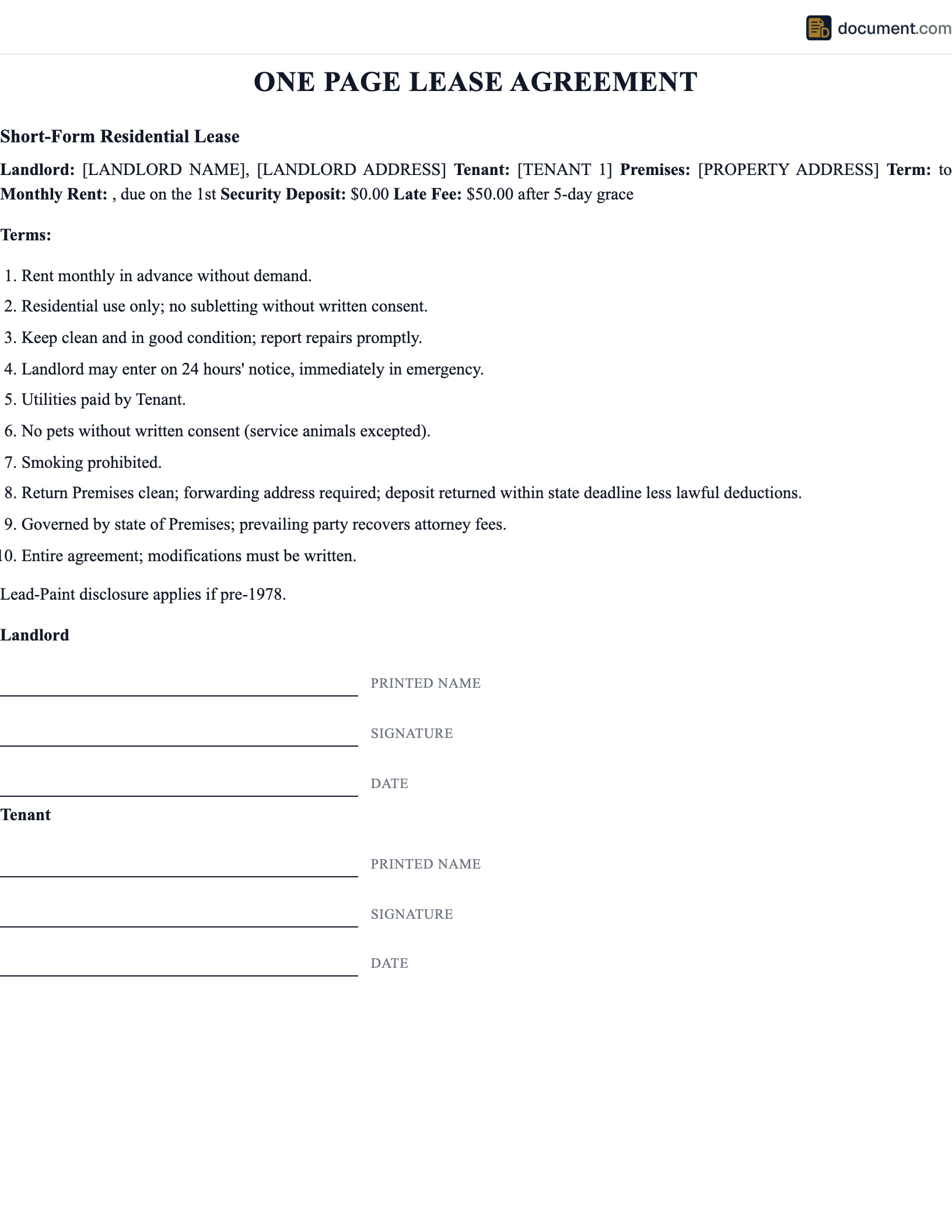



Idaho One Page Lease Overview
A one-page lease in Idaho is a concise rental agreement covering essential tenancy terms. Idaho\'s landlord-tenant law is codified in Idaho Code Title 6, Chapter 3 (§ 6-301 through § 6-324) and provides a basic framework that heavily favors landlords. Idaho has no rent control, no mandatory grace period, no statutory late fee cap, and one of the simplest disclosure regimes in the country. The security deposit has no statutory cap, giving landlords broad flexibility in setting terms.
Idaho\'s minimal regulatory approach means that the terms of the lease are especially important — what the lease says is largely what governs the relationship. Unlike states with robust statutory defaults (like California or Connecticut), Idaho provides fewer automatic protections for tenants when the lease is silent. Idaho does recognize an implied warranty of habitability (through Worden v. Ordway), but the standard is narrower than in many states, and tenants have limited statutory remedies for landlord non-compliance.
The Idaho rental market is growing rapidly, particularly in the Boise metro area (including Meridian, Nampa, and Caldwell) which has experienced significant population influx from California, Oregon, and Washington. This growth has driven rental prices sharply higher. Other significant rental markets include Idaho Falls, Pocatello, Twin Falls, and Coeur d\'Alene. One-page leases are commonly used for rural rentals, family arrangements, and simple month-to-month tenancies across the state.
No statutory cap
Deposit Limit
21 days (or 30)
Deposit Return
3 days
Non-Payment Notice
Idaho Minimum Required Lease Terms
Under Idaho Code § 6-302, a rental agreement governs the tenancy terms. Idaho\'s Statute of Frauds requires leases exceeding one year to be in writing. A valid one-page lease should include:
- Parties: Full legal names of landlord and all adult tenants
- Premises: Complete street address including city, county, and zip code
- Rent: Monthly amount, due date, and payment methods; Idaho has no mandatory grace period or late fee cap
- Term: Start and end dates for fixed-term, or month-to-month designation
- Security deposit: Amount (no statutory cap) and conditions for return; must be returned within 21 days (or 30 if stated in lease)
- Signatures: All parties must sign; no notarization required
Idaho Required Disclosures
Idaho has one of the lightest disclosure requirements in the country. These can be provided as addenda.
- Lead-based paint (federal): Required for housing built before 1978 (42 U.S.C. § 4852d)
- Landlord/agent identity: Name and address of the person authorized to manage the premises and receive notices
- Property condition: While not statutorily mandated, documenting the property\'s condition at move-in protects both parties for deposit disputes
Minimal Statutory Protections
Idaho provides fewer automatic tenant protections than most states. The lease terms are especially important because Idaho\'s statutory framework fills fewer gaps. If the lease is silent on maintenance, the landlord\'s obligations are limited. Tenants should negotiate key terms explicitly, and landlords should include clear provisions to avoid ambiguity — even in a one-page format.
Enforceability and Default Rules in Idaho
Idaho recognizes an implied warranty of habitability through case law (Worden v. Ordway, 1965), requiring landlords to maintain premises in a condition fit for human habitation. However, the standard is narrower than in states with comprehensive landlord-tenant acts. The landlord must maintain structural integrity, plumbing, heating, and electrical systems, but the tenant\'s remedies for non-compliance are more limited than in states that provide explicit repair-and-deduct or rent withholding statutes.
Idaho does not have a statutory repair-and-deduct remedy. If the landlord fails to make repairs after notice, the tenant\'s options are to pursue legal action (breach of implied warranty) or terminate the lease if conditions are truly uninhabitable. This makes it important for a one-page lease to address maintenance obligations explicitly — without lease provisions, the tenant\'s recourse is limited to court action.
Idaho\'s eviction process begins with a 3-day notice to pay or vacate for non-payment of rent (Idaho Code § 6-303). If the tenant fails to comply, the landlord can file an unlawful detainer action in Magistrate Court. The process typically takes 2-4 weeks. Month-to-month tenancies require 30 days\' notice by either party (Idaho Code § 6-306). Idaho does not have just-cause eviction protections — the landlord can terminate for any lawful reason.
Key Financial and Legal Details
| Item | Idaho Rule |
|---|---|
| Security Deposit Maximum | No statutory cap |
| Deposit Return Deadline | 21 days (or 30 if stated in lease) — Idaho Code § 6-321 |
| Late Fee Cap | No statutory cap; must be contractual |
| Grace Period | No statutory requirement |
| Termination Notice (M-to-M) | 30 days by landlord; 30 days by tenant (§ 6-306) |
| Non-Payment Notice | 3 days to pay or vacate (§ 6-303) |
| Landlord Entry Notice | 24 hours (reasonable notice recommended) |
| Rent Control | None statewide |
Official Idaho Resources
Other Idaho Lease Agreement Types
Need a more comprehensive lease for Idaho? Consider these full-length templates.
Idaho One Page Lease FAQ
Common questions about simplified one-page lease agreements under Idaho law.
Create your Idaho One Page Lease Agreement in under 5 minutes.
Answer a few questions and download a Idaho-compliant document, ready for the state agency.