
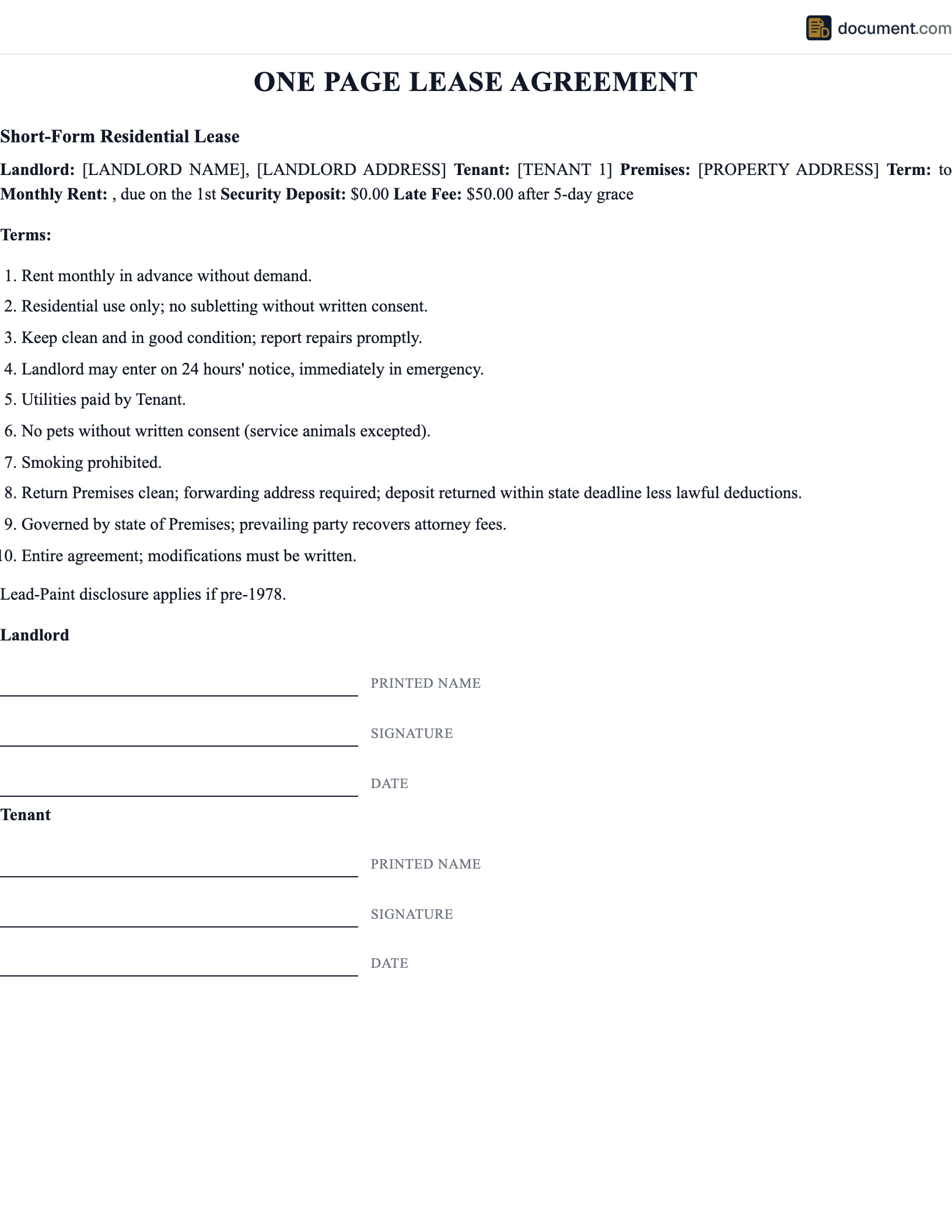



Georgia One Page Lease Overview
A one-page lease in Georgia is a concise rental agreement covering essential tenancy terms. Georgia\'s landlord-tenant law is governed primarily by the Georgia Landlord-Tenant Act (O.C.G.A. Title 44, Chapter 7) and supplemented by the Georgia Security Deposit Act (O.C.G.A. § 44-7-30 through § 44-7-37). Georgia is generally considered a landlord-friendly state with minimal statutory restrictions on rent amounts, deposit amounts, or late fees. There is no statewide rent control and no mandatory grace period.
Georgia is notable for having no statutory cap on security deposits — landlords can charge whatever amount the market will bear. However, landlords who own more than 10 rental units must place deposits in an escrow account and provide the tenant with written notice of the account location. All landlords must provide an itemized list of pre-existing damage at move-in or within 3 business days (O.C.G.A. § 44-7-33). This move-in inspection requirement is one of Georgia\'s unique protections and applies to all lease formats.
Georgia also has a distinctive flooding disclosure requirement. Under O.C.G.A. § 44-7-20, the landlord must disclose to the tenant if the premises have been flooded 3 or more times in the 5 years preceding the lease. This is particularly relevant in coastal areas (Savannah, Brunswick), the Atlanta metro floodplains, and other flood-prone regions. The Georgia rental market is dominated by the Atlanta metro area (which accounts for over half the state\'s population) with significant markets in Savannah, Augusta, Columbus, and Macon.
No statutory cap
Deposit Limit
30 days
Deposit Return
Required (3+ in 5 yrs)
Flooding Disclosure
Georgia Minimum Required Lease Terms
Under O.C.G.A. § 44-7-1, a tenancy is created when the landlord grants possession and the tenant accepts. Georgia\'s Statute of Frauds requires leases exceeding one year to be in writing. A valid one-page lease should include:
- Parties: Full legal names of landlord and all adult tenants; if the landlord has a management agent, include the agent\'s name and contact information
- Premises: Complete street address including city, county, and zip code; note whether common areas, parking, or storage are included
- Rent: Monthly amount, due date, and accepted payment methods; Georgia has no mandatory grace period or late fee cap
- Term: Start and end dates for fixed-term, or month-to-month designation
- Security deposit: Amount collected (no statutory cap); for landlords with 10+ units, specify the escrow account location
- Move-in condition: Reference to the move-in inspection checklist, which must be provided at or within 3 business days of move-in (O.C.G.A. § 44-7-33)
- Signatures: All parties must sign and date; no notarization required
Georgia Required Disclosures
Georgia requires specific disclosures that must accompany any residential lease. These are especially important for one-page leases where the format limits detail.
- Lead-based paint (federal): Required for housing built before 1978 (42 U.S.C. § 4852d)
- Flooding history: Must disclose if the premises have been flooded 3+ times in the preceding 5 years (O.C.G.A. § 44-7-20)
- Move-in inspection list: Landlord must provide an itemized list of pre-existing damage at or within 3 business days of move-in (O.C.G.A. § 44-7-33)
- Landlord/agent identity: Name and address of the owner or authorized agent (O.C.G.A. § 44-7-3)
- Security deposit escrow: For landlords with 10+ units: name and location of the escrow account holding the deposit
Flooding History Disclosure Required
Georgia uniquely requires landlords to disclose if the rental premises have been flooded 3 or more times within the 5 years preceding the lease (O.C.G.A. § 44-7-20). This is particularly relevant in coastal Georgia (Savannah, Brunswick), along the Chattahoochee River in metro Atlanta, and other flood-prone areas. Failure to disclose can expose the landlord to liability for damages. This disclosure must be provided even with a one-page lease format.
Enforceability and Default Rules in Georgia
Georgia recognizes an implied warranty of habitability through a combination of statute and case law. Under O.C.G.A. § 44-7-13, the landlord must keep the premises in repair and is liable for damages arising from defective construction or failure to repair after notice. However, Georgia\'s habitability standard is considered less rigorous than states like California or New York — the tenant must prove the landlord had actual or constructive knowledge of the defect and failed to repair within a reasonable time.
Georgia\'s non-payment eviction process begins with a demand for possession. While there is no statutory notice period before filing for eviction (unlike states that require 3, 5, or 7-day notices), most Georgia courts expect the landlord to provide some form of demand before filing a dispossessory affidavit in Magistrate Court. The eviction process is fast — the tenant has 7 days to respond after being served, and if no answer is filed, the landlord can obtain a writ of possession. The entire process typically takes 2-4 weeks.
Month-to-month tenancies in Georgia require 60 days\' notice for termination by either party (O.C.G.A. § 44-7-7). This is one of the longer notice periods for month-to-month tenancies in the Southeast. For fixed-term leases, the tenancy ends on the specified date without additional notice (unless the lease provides otherwise). If a tenant holds over after the lease expires, the landlord can treat the tenancy as a trespass or as a new periodic tenancy — the landlord\'s choice is determined by their actions (accepting rent creates a new tenancy).
Key Financial and Legal Details
| Item | Georgia Rule |
|---|---|
| Security Deposit Maximum | No statutory cap (no limit on amount) |
| Deposit Return Deadline | 30 days after tenant vacates (O.C.G.A. § 44-7-34) |
| Deposit Escrow Requirement | Required for landlords with 10+ units |
| Late Fee Cap | No statutory cap; must be reasonable |
| Grace Period | No statutory requirement |
| Termination Notice (M-to-M) | 60 days written notice (O.C.G.A. § 44-7-7) |
| Non-Payment Process | Dispossessory affidavit in Magistrate Court; no mandatory pre-filing notice period |
| Move-in Inspection | Required within 3 business days (O.C.G.A. § 44-7-33) |
Official Georgia Resources
Other Georgia Lease Agreement Types
Need a more comprehensive lease for Georgia? Consider these full-length templates.
Georgia One Page Lease FAQ
Common questions about simplified one-page lease agreements under Georgia law.
Create your Georgia One Page Lease Agreement in under 5 minutes.
Answer a few questions and download a Georgia-compliant document, ready for the state agency.