



West Virginia Kitchen Lease Agreement Overview
West Virginia's shared kitchen market is modest in scale but genuine in its food entrepreneurship activity, centered primarily in Charleston and Morgantown. Charleston, as the state capital, generates consistent catering demand from the government and healthcare sectors, and the city's downtown revitalization has brought enough restaurant and food event activity to support a small but stable shared kitchen user base. Morgantown's market orbits West Virginia University in a pronounced academic-year cycle, with catering, food truck, and specialty food demand spiking during football season and the fall semester and falling sharply when students leave in May. Food establishment licensing runs through the WVDHHR Bureau for Public Health under state food safety regulations, and West Virginia's lean regulatory approach means the licensing process is relatively accessible compared to neighboring states with more complex frameworks.
West Virginia's shared kitchen cost structure is among the most affordable in the region, reflecting lower real estate costs and a smaller competitive market. The state exempts most grocery food from sales tax, which helps specialty food producers keep retail pricing competitive, though prepared food and catering are taxable at the 6% state rate. For operators running catering businesses tied to WVU athletic events, the most important lease terms are scheduling provisions that address football game days and the fall semester catering peak. For Charleston-based operators, addressing the legislative session calendar and downtown event season in the lease provides meaningful protection against unexpected scheduling conflicts during your highest-demand periods.
$30
Filing fee
Required
Notarization
0
Witnesses required
County
Filing office
West Virginia Requirements
West Virginia shared kitchen leases need to address WVDHHR licensing, WVU game day and event scheduling provisions in Morgantown, and the state's lower-cost but operationally practical requirements for food production.
West Virginia WVU Event Scheduling Note
Morgantown shared kitchens experience sharp scheduling demand spikes on WVU football game days, particularly home games at Milan Puskar Stadium which has a capacity exceeding 60,000. Catering operators who rely on kitchen access during these windows should negotiate explicit scheduling priority rights in their lease rather than assuming availability. Facilities that do not address game day access in writing often face informal conflicts that are difficult to resolve once the season starts.
Document Requirements
- WVDHHR License Verification: Confirm the facility holds a current WVDHHR food establishment permit and that your production type is covered, including commissary approval for mobile food vendor operations
- Event and Seasonal Scheduling: Define reserved hours and address scheduling conflict protocols for WVU game days in Morgantown or the legislative session calendar in Charleston
- Cold Storage Allocation: Assign specific refrigerator and freezer capacity, set temperature maintenance standards, and include a credit protocol for storage failures during summer heat
- Insurance Requirements: Carry general liability of at least $1 million per occurrence naming the facility as additional insured, plus product liability for packaged goods
- Permitted Use Restrictions: Review the permitted use clause to confirm it covers your production categories, particularly any specialized preservation or processing techniques that may require equipment not currently in the facility
How to File in West Virginia
Executing a shared kitchen lease in West Virginia involves confirming WVDHHR licensing, inspecting the facility, and negotiating terms that address the state's event-driven scheduling demands and lower-cost operating environment. Follow these steps.
Verify WVDHHR License Status and Commissary Coverage
Request a copy of the facility's current WVDHHR food establishment permit and confirm it covers your intended production type. If you operate a food truck or mobile unit, verify that the facility holds commissary approval before committing, since WVDHHR requires documented commissary status for mobile food vendor operations.
Inspect Equipment and Cold Storage Systems
Walk through all equipment you will use, test cold storage temperatures, and check that the facility's HVAC handles West Virginia's humid summers without stressing refrigeration. Document maintenance issues that need to be resolved before your production start date, particularly for any equipment used in temperature-sensitive production runs.
Negotiate Scheduling and Event-Period Provisions
Finalize your reserved hours and confirm in writing how the facility handles scheduling during WVU football game days in Morgantown or the legislative session calendar in Charleston. Operators whose catering business depends on these demand peaks should secure written priority access rather than relying on informal arrangements with facility managers.
Execute the Lease and Obtain Insurance
Sign the agreement and deliver a certificate of insurance naming the facility as additional insured. Register for a West Virginia sales tax account with the State Tax Department if you will be selling taxable prepared food or catering services, and confirm the applicable tax treatment for your specific products.
Complete WVDHHR Compliance and Begin Production
Obtain your individual WVDHHR food establishment permit if required for your production category and submit commissary documentation for any mobile unit operations. Complete your facility orientation, confirm cold storage assignments, and coordinate your first scheduled production run with the facility manager.
West Virginia Fees & Costs
West Virginia shared kitchen costs are among the most affordable in the region, reflecting the state's lower real estate costs and smaller competitive market. Here is a breakdown of typical costs for kitchen operators in West Virginia.
| Fee / Cost | Amount |
|---|---|
| WVDHHR Food Establishment Permit | $50 - $350 depending on facility type and production category |
| Operator Liability Insurance | $300 - $1,400 annually depending on coverage level and product type |
| Kitchen Rental Rate (Charleston) | $10 - $22 per hour or $250 - $800 monthly block |
| Kitchen Rental Rate (Morgantown) | $10 - $20 per hour or $200 - $700 monthly block |
| West Virginia Sales Tax on Prepared Food | 6% state rate; grocery food generally exempt |
| Attorney Review (optional) | $200 - $500 for lease review and licensing guidance |
Sample West Virginia Kitchen Lease Agreement
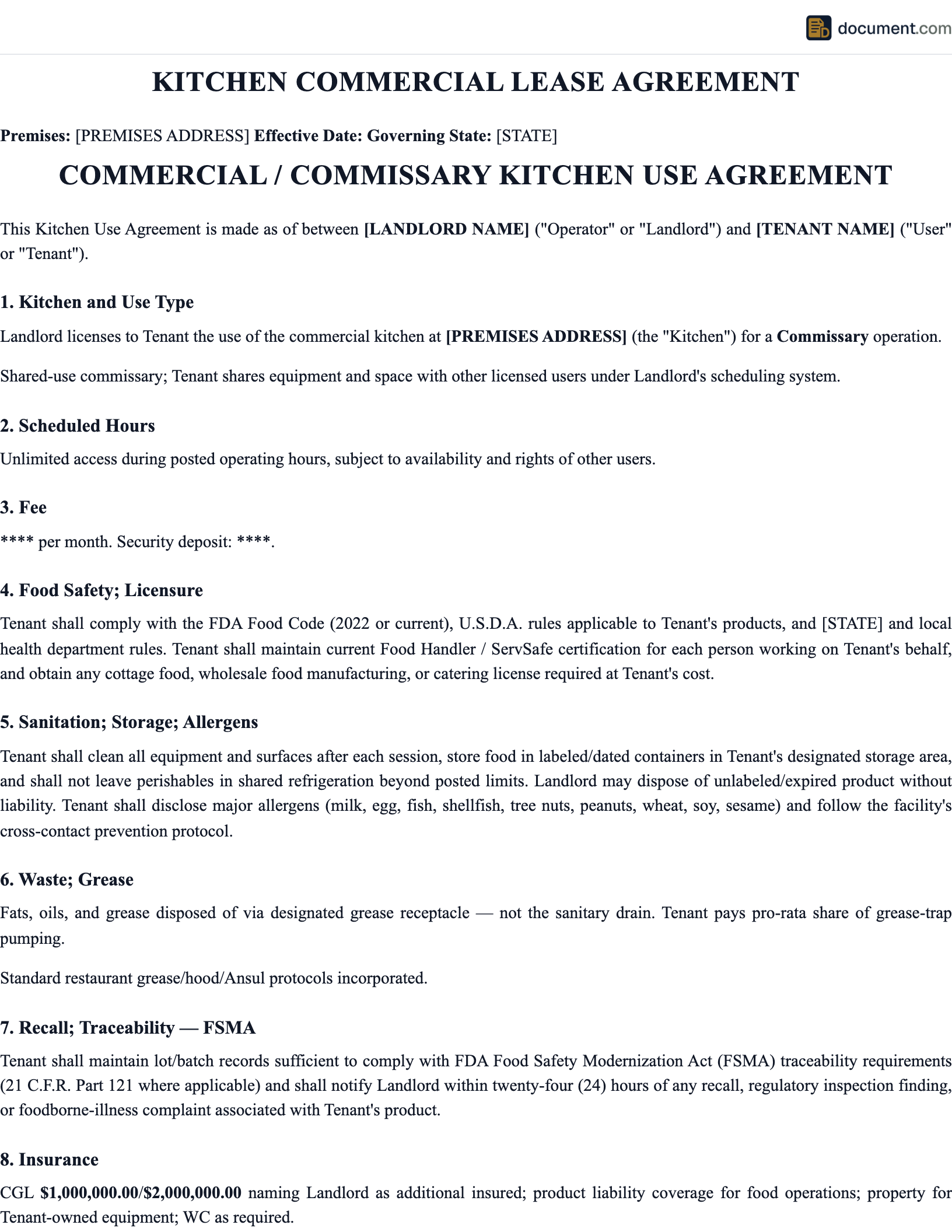
Below is a preview of our West Virginia-specific template. Your customized document will include all fields and provisions required for filing in any West Virginia county.
KITCHEN LEASE AGREEMENT
STATE OF WEST VIRGINIA
Legal Document Template
FACILITY OWNER
Name: [Full Legal Name]
Facility: [Kitchen Name]
Address: [Facility Address]
KITCHEN TENANT
Name: [Full Legal Name / Business]
Business Type: [Restaurant/Catering/Production]
Health Permit #: [Number]
KITCHEN SPECIFICATIONS
Total SF: [Square Feet]
Schedule: [Days/Hours]
Equipment: [See Inventory Addendum]
Storage: [Allocated Space]
FINANCIAL TERMS
Monthly Rent: $[Amount]
Schedule Rate: $[Amount]/hour
Security Deposit: $[Amount]
Equipment Deposit: $[Amount]
West Virginia Kitchen Lease Agreement FAQ
Answers to common questions about filing a kitchen lease agreement in West Virginia, including requirements, fees, and procedures.
Official West Virginia Resources
Use these official state resources to verify requirements, find your local filing office, and access government forms for West Virginia.
Related West Virginia Documents
Depending on your situation, you may need additional documents alongside your West Virginia kitchen lease agreement.
Create your West Virginia Commercial Kitchen Lease Agreement in under 5 minutes.
Answer a few questions and download a West Virginia-compliant document, ready for the state agency.