



Washington Kitchen Lease Agreement Overview
Washington's shared kitchen market is anchored by Seattle and King County, which together represent one of the most active food entrepreneurship ecosystems in the western United States. Seattle's tech sector wealth, outdoor recreation culture, and deep Pacific Northwest food identity create consistent demand for specialty food production, catering, and food truck operations that all rely on licensed kitchen access. The state's dual-authority licensing structure means most retail food producers work with local health jurisdictions (Public Health Seattle-King County for the greater Seattle area, county health departments elsewhere), while manufacturers of packaged goods destined for wholesale are regulated by the Washington State Department of Agriculture (WSDA). Navigating both authorities is a normal part of shared kitchen operations in Washington, particularly for operators whose products cross the retail-wholesale line.
Washington's Business and Occupation tax applies to food production businesses in addition to standard sales tax, creating a heavier administrative burden than most states. Combined local sales tax rates in Seattle regularly exceed 10%, which affects food truck and catering pricing models significantly. No personal income tax reduces individual overhead, but the B&O tax and Seattle's high minimum wage floor need to be built into any shared kitchen business model. For operators producing Pacific Northwest seafood, salmon products, or shellfish, WSDA cold chain compliance adds documentation requirements that should be addressed explicitly in the shared kitchen lease rather than assumed as part of standard facility operations.
$62.50
Filing fee
Required
Notarization
0
Witnesses required
County
Filing office
Washington Requirements
Washington shared kitchen leases need to address local health jurisdiction licensing, WSDA food processor licensing for wholesale products, Seattle's minimum wage implications, and Pacific Northwest seafood handling requirements where applicable.
Washington Dual-Authority Licensing Note
Washington food businesses may need permits from both the local health jurisdiction and WSDA depending on what they produce and where they sell. Retail food production is typically licensed by the local health department, while packaged goods sold wholesale require a WSDA food processor license. If you are a shared kitchen operator in King County, confirm whether your production model requires coordination with both Public Health Seattle-King County and WSDA, since operating under only one authority when both apply can create compliance gaps that surface during inspections.
Document Requirements
- Local Health Jurisdiction License: Confirm the facility holds a current permit from the applicable local health jurisdiction and that your production type is covered, including commissary approval for food truck operations
- Scheduling and Peak Catering Provisions: Define reserved hours and address how conflicts are resolved during the May through October outdoor event and farmers market season when Seattle-area kitchen demand peaks
- Cold Storage and Seafood Handling: Assign specific refrigerator and freezer capacity, set temperature maintenance standards, and include WSDA cold chain documentation requirements for seafood production
- Insurance Requirements: Carry general liability of at least $1 million per occurrence naming the facility as additional insured, plus product liability for packaged goods; some Seattle facilities require $2 million
- Permitted Use and Seafood Restrictions: Confirm the permitted use clause covers your production categories, particularly seafood and shellfish processing that may require designated time blocks and enhanced cleaning protocols
How to File in Washington
Executing a shared kitchen lease in Washington involves confirming local health jurisdiction and WSDA licensing, inspecting the facility, and negotiating terms that reflect Washington's tech-driven catering economy and Pacific Northwest food production environment. Follow these steps.
Verify Local Health and WSDA Licensing
Request a copy of the facility's current health department permit and confirm whether your production model also requires a WSDA food processor license for wholesale distribution. In King County, verify the permit with Public Health Seattle-King County specifically. Confirm commissary approval for food truck operations at the local health jurisdiction level before signing.
Inspect Equipment and Cold Storage Systems
Walk through all equipment you will use, test cold storage temperatures, and confirm the facility has adequate capacity for your production volume. For seafood or shellfish production, verify temperature monitoring documentation systems are in place and that the facility can support WSDA cold chain compliance requirements before your first production run.
Negotiate Scheduling and Permitted Use Terms
Finalize reserved hours and confirm how the facility handles scheduling conflicts during the May through October outdoor event and farmers market season. Review the permitted use clause to confirm it covers your production categories, particularly seafood or specialty fermented products that may require dedicated cleaning protocols or separate time blocks.
Execute the Lease and Obtain Insurance
Sign the agreement and deliver a certificate of insurance naming the facility as additional insured. Register for a Washington state business license and sales tax account through the Department of Revenue, and confirm your B&O tax classification with a Washington tax professional before making any sales.
Complete Health Jurisdiction Compliance and Begin Production
Obtain your individual food establishment permit from the applicable local health jurisdiction and, if required, your WSDA food processor license. Submit commissary documentation for any mobile unit operations, complete your facility orientation, confirm cold storage assignments, and coordinate your first scheduled production run with the facility manager.
Washington Fees & Costs
Washington shared kitchen costs are among the highest in the Pacific Northwest, with Seattle carrying premium rates that reflect the area's high real estate costs and labor overhead. Here is a breakdown of typical costs for kitchen operators in Washington.
| Fee / Cost | Amount |
|---|---|
| Local Health Jurisdiction Permit | $200 - $800 depending on facility type and county jurisdiction |
| Operator Liability Insurance | $500 - $2,500 annually; Seattle facilities often require $2 million coverage |
| Kitchen Rental Rate (Seattle/King County) | $22 - $45 per hour or $600 - $2,000 monthly block |
| Kitchen Rental Rate (Tacoma/Spokane) | $14 - $28 per hour or $350 - $1,100 monthly block |
| Washington Sales Tax on Prepared Food | 6.5% state rate plus local additions; Seattle combined rate reaches 10.25%+ |
| Attorney Review (optional) | $400 - $900 for lease review and licensing guidance |
Sample Washington Kitchen Lease Agreement
Below is a preview of our Washington-specific template. Your customized document will include all fields and provisions required for filing in any Washington county.
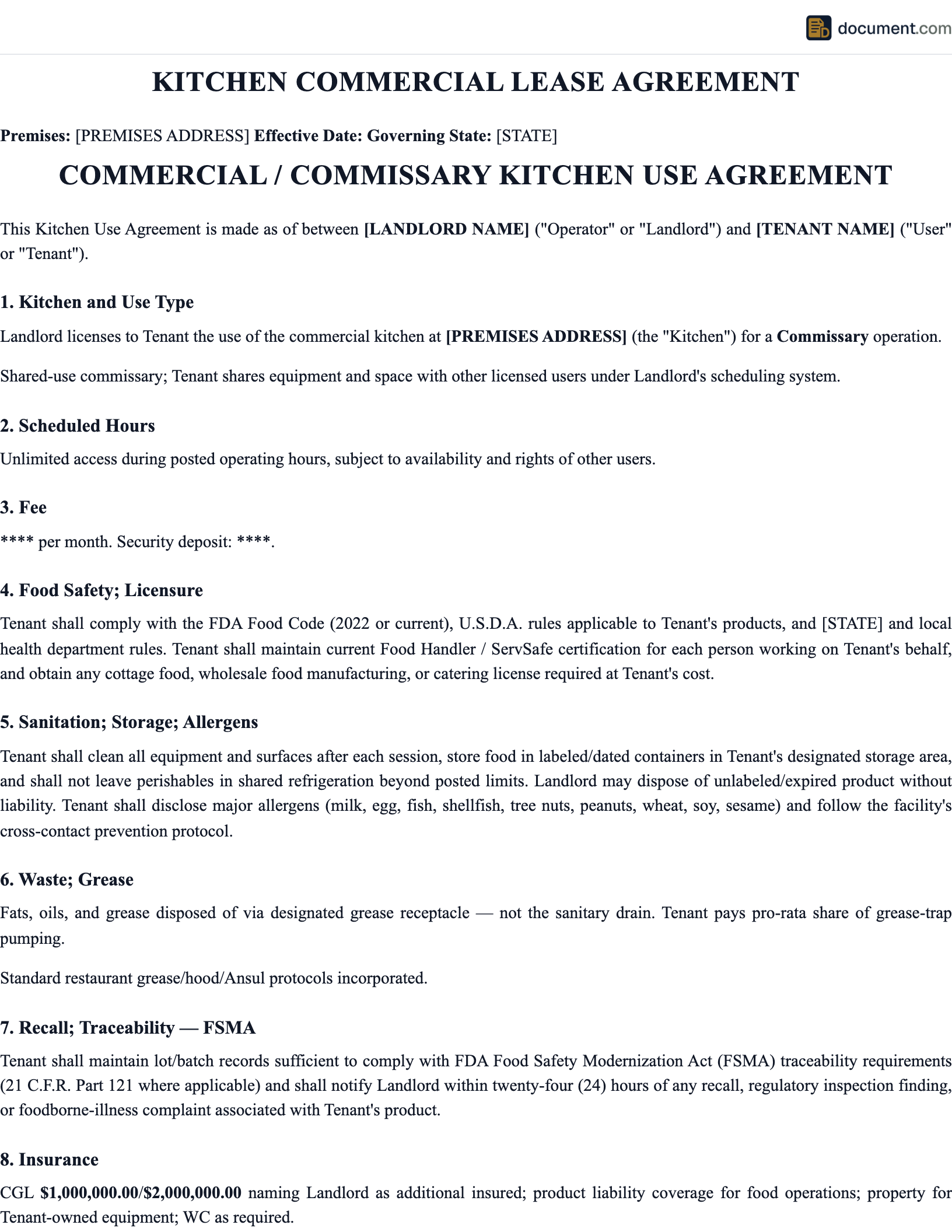
KITCHEN LEASE AGREEMENT
STATE OF WASHINGTON
Legal Document Template
FACILITY OWNER
Name: [Full Legal Name]
Facility: [Kitchen Name]
Address: [Facility Address]
KITCHEN TENANT
Name: [Full Legal Name / Business]
Business Type: [Restaurant/Catering/Production]
Health Permit #: [Number]
KITCHEN SPECIFICATIONS
Total SF: [Square Feet]
Schedule: [Days/Hours]
Equipment: [See Inventory Addendum]
Storage: [Allocated Space]
FINANCIAL TERMS
Monthly Rent: $[Amount]
Schedule Rate: $[Amount]/hour
Security Deposit: $[Amount]
Equipment Deposit: $[Amount]
Washington Kitchen Lease Agreement FAQ
Answers to common questions about filing a kitchen lease agreement in Washington, including requirements, fees, and procedures.
Official Washington Resources
Use these official state resources to verify requirements, find your local filing office, and access government forms for Washington.
Related Washington Documents
Depending on your situation, you may need additional documents alongside your Washington kitchen lease agreement.
Create your Washington Commercial Kitchen Lease Agreement in under 5 minutes.
Answer a few questions and download a Washington-compliant document, ready for the state agency.