



Virginia Kitchen Lease Agreement Overview
The Virginia shared kitchen market is genuinely regional rather than statewide. Northern Virginia runs on the federal government and tech sector catering economy centered in Fairfax County and the Arlington-Alexandria corridor. The demand here is consistent year-round with periodic intensity spikes tied to the federal calendar, and rates reflect that premium. Richmond has built a distinct food entrepreneurship scene around the Scott's Addition food hall and brewery district, Carytown independent retail, and a growing festival and arts catering market that operates on a summer and fall event calendar. Hampton Roads serves military catering, Chesapeake Bay seafood production, and Virginia Beach resort hospitality from May through September with a quieter off-season.
VDH food establishment licensing runs through local health districts, and while state standards are consistent under the Virginia Food Regulations, Northern Virginia and Tidewater districts have historically applied requirements in some areas that exceed the minimum state floor. Mobile food vendors using a Virginia shared kitchen as a commissary need to verify that the facility's VDH permit explicitly covers commissary operations and, for some NoVA and Tidewater municipalities, that local mobile vendor operating permits are also in order. Virginia's reduced 2.5% sales tax on grocery food benefits packaged goods producers selling into retail, but catering and prepared food sales are taxed at the full 4.3% state rate with locality-specific meals taxes on top. The lease should address scheduling provisions reflecting each regional catering calendar, cold storage reliability for humid summers, and cross-contamination liability in shared equipment environments.
$12
Filing fee
Required
Notarization
0
Witnesses required
Circuit
Filing office
Virginia Requirements
A Virginia shared kitchen lease needs to address VDH food establishment licensing with commissary coverage for mobile operators, regional scheduling provisions that reflect each market's catering calendar, cold storage allocation with temperature standards, and cross-contamination liability in shared equipment environments.
NoVA and Tidewater Health District Note
Northern Virginia (Fairfax County, Arlington, Alexandria) and Hampton Roads health districts have historically applied requirements in some areas above the minimum Virginia state standard. If you are leasing shared kitchen time in these jurisdictions, confirm with the local health district whether your specific production category requires additional permits beyond the facility's base VDH license. Commissary approvals for food truck operations in these jurisdictions sometimes require district-level approval in addition to the VDH statewide framework.
Key Lease Provisions
- VDH License and Commissary Coverage: Verify the facility's current VDH food establishment permit explicitly covers commissary operations for mobile food units and your specific production category
- Regional Catering Calendar Scheduling: Define reserved hours, advance notice requirements, and conflict resolution procedures for NoVA's federal event calendar, Richmond's summer and fall festival season, or Virginia Beach resort catering peak season
- Cold Storage Allocation and Temperature Standards: Assign specific capacity, set minimum temperature maintenance thresholds, and include VDH temperature logging documentation requirements for seafood and Chesapeake Bay product operators
- Cross-Contamination Liability: Address allergen cleaning protocols between users, shared equipment sanitation standards, and which party bears liability for cross-contamination events in the shared kitchen environment
- Equipment Maintenance and Failure Response: Assign maintenance responsibilities for shared equipment, specify response time for failures during scheduled production runs, and address compensation or rescheduling rights when failures occur
How to Execute a Virginia Kitchen Lease
Securing a Virginia shared kitchen lease involves confirming VDH and local health district licensing, inspecting the facility, negotiating scheduling terms that reflect your specific regional market, and addressing the practical issues that arise in shared equipment environments. Do the licensing verification before signing, not after.
Verify VDH License Status and Local Health District Coverage
Request the facility's current VDH food establishment permit and confirm it covers commissary operations if you operate a food truck. In Northern Virginia or Hampton Roads, contact the local health district directly to confirm whether your production category requires any concurrent local approval in addition to the VDH state license. Do this before signing, not after you need the commissary designation on your mobile vendor permit.
Inspect Equipment and Cold Storage Capacity
Walk through all equipment you plan to use, test cold storage temperatures, and verify that refrigeration systems can handle Virginia's humid summers without degradation. For seafood or Chesapeake Bay product producers, confirm that temperature monitoring and documentation systems meet VDH's cold chain inspection standards before you commit to a production schedule that depends on them.
Negotiate Regional Scheduling Provisions and Cross-Contamination Terms
Lock in reserved hours, peak demand priority access terms, and cross-contamination liability language at the negotiation stage. NoVA operators should address the federal event calendar in writing. Richmond operators should address summer festival and fall arts season access. Virginia Beach operators should address Memorial Day through Labor Day resort season scheduling priority.
Execute the Lease and Obtain Insurance Coverage
Sign the agreement and deliver a certificate of insurance naming the facility as additional insured. Register for a Virginia sales tax account and, if you sell catering or prepared food, confirm your meals tax registration obligation in the applicable locality before your first sale.
Obtain Individual VDH Permit and Begin Production
Get your individual VDH food establishment permit and submit commissary documentation for any mobile unit. Complete the facility orientation, confirm your cold storage allocations, and establish your regular booking schedule before your first production run rather than trying to sort out access informally during the first busy catering week.
Virginia Kitchen Lease Costs
Virginia shared kitchen rates vary considerably by region, with Northern Virginia's federal government and tech sector demand pushing rates well above what Richmond and Hampton Roads operators pay. Budget for licensing, insurance, and sales tax registration alongside the kitchen rental rate itself.
| Fee / Cost | Typical Range |
|---|---|
| VDH Food Establishment License | $100 - $500 annually depending on facility type, production category, and applicable local health district |
| General Liability and Product Liability Insurance | $450 - $2,500 annually; NoVA facilities with high-value corporate catering may require $2 million coverage minimums |
| Kitchen Rental Rate (Northern Virginia) | $22 - $42 per hour or $600 - $2,000 monthly block; higher rates reflect federal and tech sector catering demand |
| Kitchen Rental Rate (Richmond / Hampton Roads) | $14 - $28 per hour or $350 - $1,100 monthly block |
| Virginia Sales Tax | 2.5% on grocery food; 4.3% state rate plus local meals tax on prepared food and catering sales |
| Attorney Review | $350 - $800 for lease review with VDH commissary coverage verification, scheduling provisions, and cross-contamination liability language |
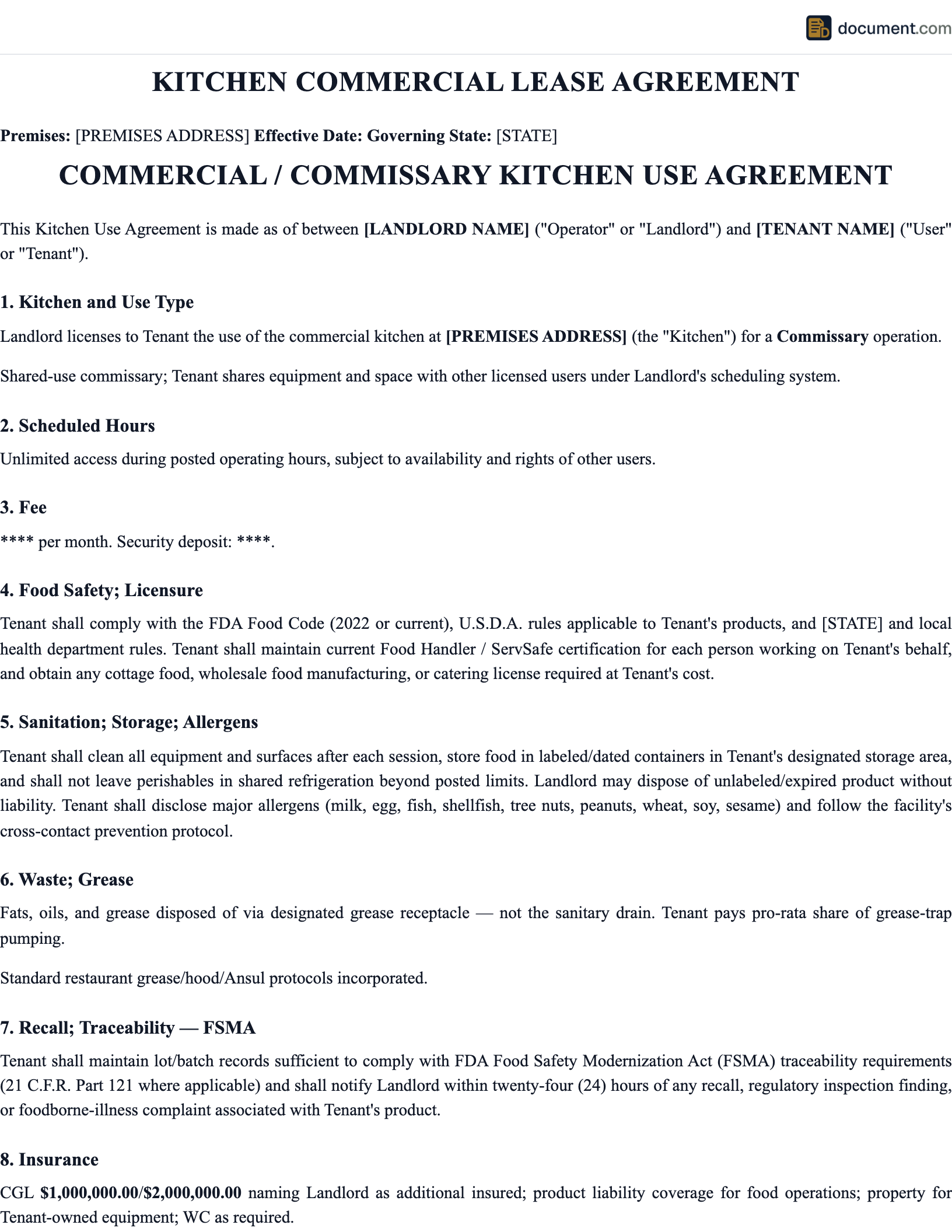
Sample Virginia Kitchen Lease Agreement
Below is a preview of our Virginia-specific template. Your customized document will include all fields and provisions required for filing in any Virginia county.
KITCHEN LEASE AGREEMENT
STATE OF VIRGINIA
Legal Document Template
FACILITY OWNER
Name: [Full Legal Name]
Facility: [Kitchen Name]
Address: [Facility Address]
KITCHEN TENANT
Name: [Full Legal Name / Business]
Business Type: [Restaurant/Catering/Production]
Health Permit #: [Number]
KITCHEN SPECIFICATIONS
Total SF: [Square Feet]
Schedule: [Days/Hours]
Equipment: [See Inventory Addendum]
Storage: [Allocated Space]
FINANCIAL TERMS
Monthly Rent: $[Amount]
Schedule Rate: $[Amount]/hour
Security Deposit: $[Amount]
Equipment Deposit: $[Amount]
Virginia Kitchen Lease Agreement FAQ
Answers to common questions about filing a kitchen lease agreement in Virginia, including requirements, fees, and procedures.
Official Virginia Resources
Use these official state resources to verify requirements, find your local filing office, and access government forms for Virginia.
Related Virginia Documents
Depending on your situation, you may need additional documents alongside your Virginia kitchen lease agreement.
Create your Virginia Commercial Kitchen Lease Agreement in under 5 minutes.
Answer a few questions and download a Virginia-compliant document, ready for the state agency.