



Utah Kitchen Lease Agreement Overview
Utah's shared kitchen market is shaped by two distinct economic forces: a fast-growing Wasatch Front urban corridor centered on Salt Lake City and Provo, and a resort and tourism economy anchored by Park City, the Cottonwood Canyon ski areas, and the Sundance Film Festival. Salt Lake City has developed a vibrant food startup scene over the past decade, with caterers, specialty food producers, and food truck operators competing for licensed kitchen access. Park City and the resort communities generate intense but highly seasonal demand, with winter ski season and January's Sundance festival creating windows when kitchen time is genuinely scarce. The Utah Department of Agriculture and Food (UDAF) licenses food establishments under the Utah Food Safety and Sanitation Act, though Salt Lake County and Utah County add local health department layers that operators on the Wasatch Front need to track.
Utah's tax environment is generally favorable for food businesses. Grocery food is taxed at a reduced 3% state rate rather than the full 6.1%, which helps food producers keep product pricing competitive. Prepared food is taxed at the full rate, so catering and ready-to-eat sales need to account for that in pricing. No personal income tax on wages is assessed beyond the flat state rate, and Utah's business registration process is efficient. For shared kitchen operators, the most important practical considerations are UDAF and local health authority licensing, scheduling provisions that address ski season and Sundance demand spikes, cold storage reliability across Utah's climate extremes, and permitted use definitions that clearly match your actual production categories.
$40
Filing fee
Required
Notarization
0
Witnesses required
County
Filing office
Utah Requirements
Utah shared kitchen leases need to address UDAF licensing, local health department requirements on the Wasatch Front, ski season scheduling provisions, and cold storage reliability across Utah's climate extremes. The following requirements protect both the facility and the tenant.
Utah Wasatch Front Local Health Department Note
Facilities in Salt Lake County and Utah County are subject to local health department oversight in addition to UDAF state licensing. If your shared kitchen is in one of these counties, confirm which authority has primary inspection jurisdiction and whether your individual operator license must come from the county health department rather than UDAF directly. Overlooking local jurisdiction can delay your start date and affect your commissary approval for mobile unit operations.
Document Requirements
- UDAF License Verification: Confirm the facility holds a current UDAF food establishment license and that your production type is covered, including commissary approval for food truck operations
- Ski Season Scheduling Provisions: Define reserved hours and explicitly address how scheduling conflicts are resolved during winter ski season and the Sundance Film Festival in January
- Cold Storage Allocation: Assign specific refrigerator and freezer capacity, establish temperature maintenance standards, and include a credit or compensation protocol for storage failures in either summer heat or mountain winter
- Insurance Requirements: Carry general liability of at least $1 million per occurrence naming the facility as additional insured, plus product liability for packaged goods
- Permitted Use Restrictions: Confirm the permitted use clause covers your specific product categories and review any building noise restrictions that may limit early-morning or late-night production hours in resort communities
How to File in Utah
Executing a shared kitchen lease in Utah involves confirming UDAF and local health licensing, inspecting the facility, and negotiating terms that address Utah's ski season demand patterns and climate challenges. Follow these steps.
Verify UDAF License Status and Local Health Jurisdiction
Request a copy of the facility's current UDAF food establishment license and confirm whether Salt Lake County or Utah County health departments have concurrent jurisdiction. If you operate a food truck, confirm the facility has formal commissary approval and that your specific vehicle can be named in the commissary documentation.
Inspect Equipment and Cold Storage Systems
Walk through all equipment you will use, test cold storage temperatures, and check that the facility's HVAC system handles both summer heat in the Salt Lake Valley and potential loading dock challenges in mountain locations during winter. Document maintenance issues that need to be addressed before your production start date.
Negotiate Ski Season and Scheduling Provisions
Finalize your reserved hours and confirm how the facility handles scheduling conflicts during ski season and Sundance Film Festival in January. If expanded access during these windows is important to your business, specify it in writing rather than assuming seasonal availability will work itself out informally.
Execute the Lease and Obtain Insurance
Sign the agreement and deliver a certificate of insurance naming the facility as additional insured. Register for a Utah sales and use tax account through the Utah State Tax Commission if you will be selling food products, and confirm with a tax professional whether your specific items are taxed at the grocery rate or the full prepared food rate.
Complete UDAF Compliance and Begin Production
Obtain your individual UDAF or local health authority food establishment license, provide commissary documentation for mobile unit operations, and complete your facility orientation. Confirm cold storage assignments and coordinate your first scheduled production run with the facility manager before your lease start date.
Utah Fees & Costs
Utah shared kitchen costs are moderate overall, with Park City resort-area kitchens running higher than Salt Lake Valley rates. Here is a breakdown of typical costs for kitchen operators in Utah.
| Fee / Cost | Amount |
|---|---|
| UDAF Food Establishment License | $150 - $600 depending on facility type and production category |
| Operator Liability Insurance | $450 - $1,800 annually depending on coverage limits and product type |
| Kitchen Rental Rate (Salt Lake City) | $16 - $30 per hour or $400 - $1,200 monthly block |
| Kitchen Rental Rate (Park City area) | $22 - $40 per hour or $600 - $1,600 monthly block in ski season |
| Utah Sales Tax on Prepared Food | 6.1% state rate plus local additions; grocery food taxed at reduced 3% rate |
| Attorney Review (optional) | $300 - $700 for lease review and licensing guidance |
Sample Utah Kitchen Lease Agreement
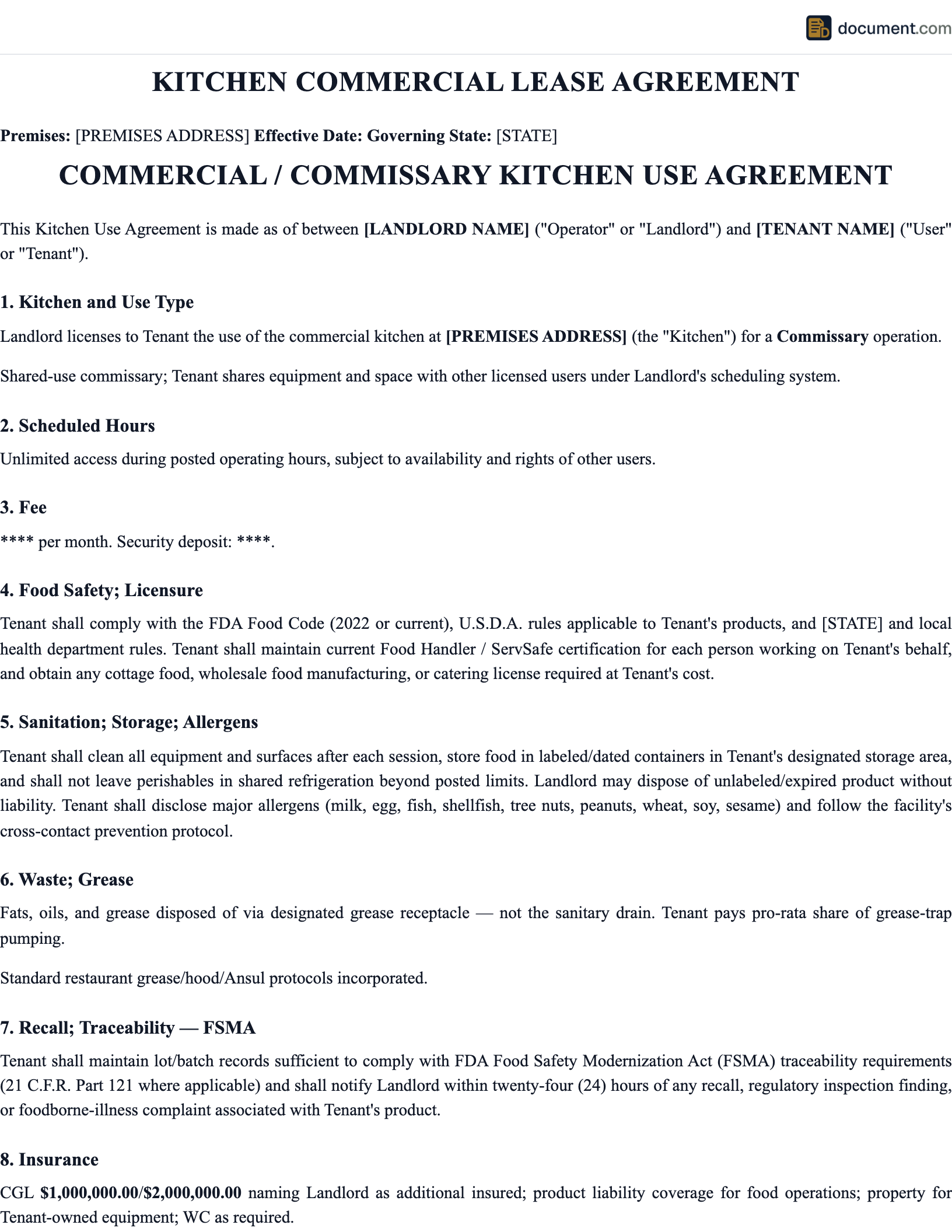
Below is a preview of our Utah-specific template. Your customized document will include all fields and provisions required for filing in any Utah county.
KITCHEN LEASE AGREEMENT
STATE OF UTAH
Legal Document Template
FACILITY OWNER
Name: [Full Legal Name]
Facility: [Kitchen Name]
Address: [Facility Address]
KITCHEN TENANT
Name: [Full Legal Name / Business]
Business Type: [Restaurant/Catering/Production]
Health Permit #: [Number]
KITCHEN SPECIFICATIONS
Total SF: [Square Feet]
Schedule: [Days/Hours]
Equipment: [See Inventory Addendum]
Storage: [Allocated Space]
FINANCIAL TERMS
Monthly Rent: $[Amount]
Schedule Rate: $[Amount]/hour
Security Deposit: $[Amount]
Equipment Deposit: $[Amount]
Utah Kitchen Lease Agreement FAQ
Answers to common questions about filing an kitchen lease agreement in Utah, including requirements, fees, and procedures.
Official Utah Resources
Use these official state resources to verify requirements, find your local filing office, and access government forms for Utah.
Related Utah Documents
Depending on your situation, you may need additional documents alongside your Utah kitchen lease agreement.
Create your Utah Commercial Kitchen Lease Agreement in under 5 minutes.
Answer a few questions and download a Utah-compliant document, ready for the state agency.