



Texas Kitchen Lease Agreement Overview
Texas runs one of the largest shared kitchen markets in the United States, and it does not look the same in every city. Austin's market is shaped by food entrepreneurs scaling out of the cottage food framework, food truck operators who need licensed commissary space, and catering operations serving the city's relentless event calendar. Houston's shared kitchen ecosystem reflects the city's extraordinary cultural diversity — Vietnamese food producers, Latin American caterers, Gulf Coast seafood processors, and West African specialty food makers all compete for production time in a market that is enormous but unevenly distributed across the metro. Dallas tends toward higher-end catering infrastructure serving corporate events and weddings. San Antonio's market is smaller but driven by a strong food heritage culture.
The practical operational challenges in Texas shared kitchens are different from what operators in northern states expect. Texas summer heat pushes refrigeration systems hard. Houston's humidity adds a packaging and storage dimension that does not exist in Austin or Dallas. And Texas barbecue culture creates demand for heavy smoke production that many shared kitchens are simply not equipped to accommodate, regardless of what operators assume. Confirming actual ventilation capacity and permitted use scope before signing is more important here than in most states. The regulatory structure involves DSHS at the state level and independent local health authorities in major cities, each with its own jurisdiction, which affects licensing timelines and commissary documentation requirements for mobile unit operators.
$26
Filing fee
Required
Notarization
0
Witnesses required
County
Filing office
Texas Requirements
Texas shared kitchen lease requirements center on confirming the correct licensing authority for the specific city, establishing documented commissary coverage for mobile unit operators, addressing summer cold storage reliability, and reviewing permitted use terms against your actual production needs including any barbecue or smoke production.
DSHS Versus City Health Authority: Know Which One Has Jurisdiction
In Houston, Dallas, Austin, and San Antonio, the local health authority typically has jurisdiction over food establishment licensing rather than DSHS. This affects which agency you contact for your individual operator license, which inspection schedule the facility is on, and what documentation is required for commissary approval. Confirm which authority issued the facility's license before signing, not after.
Key Requirements for Texas Kitchen Leases
- License Verification with the Correct Authority: Request the facility's current DSHS or city health department license and independently verify it is current before committing to the space
- Commissary Documentation for Mobile Units: The lease must name commissary operations as a permitted use and identify your specific mobile unit; also confirm city-level mobile food vendor permit requirements in your operating area
- Named Cold Storage Allocation with Summer Heat Remedies: Assign specific refrigerator and freezer capacity, set temperature thresholds, and define compensation for failures during Texas summer production runs
- Smoke Production Confirmation in Writing: If barbecue or wood-fire production is part of your business, confirm ventilation capacity and local fire code compliance in the lease before signing, not after
- General Liability and Product Liability Insurance: Minimum $1 million per occurrence at most Texas facilities; product liability must extend to products after they leave the premises
How to File in Texas
Getting into a Texas shared kitchen requires verifying the right licensing authority for your city, not just assuming DSHS handles everything. Work through these steps before committing to any facility.
Identify the Correct Health Authority for Your City and Verify the Facility's License
Determine whether DSHS or the local city health department has jurisdiction. Request the facility's current license from the issuing agency — not just a copy from the facility itself — and confirm it is current. For mobile unit operators, verify commissary approval status at the same time, including whether city-level commissary documentation is also required in your operating area.
Test Cold Storage and Confirm Ventilation Before Signing
Texas summer heat is a serious refrigeration stress factor. Test actual temperatures in refrigerators and freezers before finalizing lease terms. Ask about temperature monitoring protocols, backup cooling plans, and what happens if storage fails mid-production run. If smoke or barbecue production is part of your model, confirm ventilation capacity and local fire code compliance with documentation before signing, not after.
Negotiate Scheduling Around Texas Event Demand Peaks
Houston Livestock Show, Austin October festival season, Dallas NFL weekends — these are periods when kitchen demand exceeds facility capacity at many Texas shared kitchens. Negotiate expanded access provisions for the specific events that matter to your production schedule before signing. Monthly-hour blocks with flexible booking tend to handle seasonal fluctuations better than rigid daily slots for operators whose volume is uneven.
Execute the Lease, Obtain Insurance, and Register for Sales Tax
Sign the agreement and deliver the insurance certificate before your access start date. Register for a Texas sales and use tax permit through the Comptroller before making any sales. Confirm with a Texas tax professional whether your specific products are classified as exempt grocery items or taxable prepared food — the distinction is not always obvious and getting it wrong creates back-tax exposure.
Obtain Your Operator License and Submit Commissary Documentation
Apply for your individual food establishment license through DSHS or the applicable city health authority and submit commissary documentation for any mobile units. Complete the facility orientation and confirm cold storage allocation in writing with the facility manager. Schedule your first production run with sufficient advance notice to meet the lease's scheduling requirements.
Texas Fees & Costs
Texas shared kitchen costs vary substantially by city. Austin rates reflect that city's competitive real estate and high demand from food entrepreneurs. Houston's larger and more geographically spread market offers more price variation. Understanding typical costs before negotiating keeps you from overpaying.
| Fee / Cost | Amount |
|---|---|
| DSHS or City Health Authority Food Establishment License (Operator) | $100 to $700 depending on jurisdiction and license category; confirm with DSHS or the applicable city health department for current fees |
| General Liability and Product Liability Insurance (Annual) | $500 to $2,500 depending on coverage level, product type, and whether catering event coverage is included |
| Kitchen Rental Rate in Austin | Approximately $20 to $40 per hour or $550 to $1,800 for a monthly block; premium facilities with specialized equipment at the higher end |
| Kitchen Rental Rate in Houston and Dallas | Approximately $16 to $32 per hour or $400 to $1,400 for a monthly block; Houston offers more price variation than Austin given the larger market size |
| Texas Sales Tax on Prepared Food and Catering | 6.25% state rate plus local additions; maximum combined rate of 8.25% in Austin, Houston, Dallas, and San Antonio |
Sample Texas Kitchen Lease Agreement
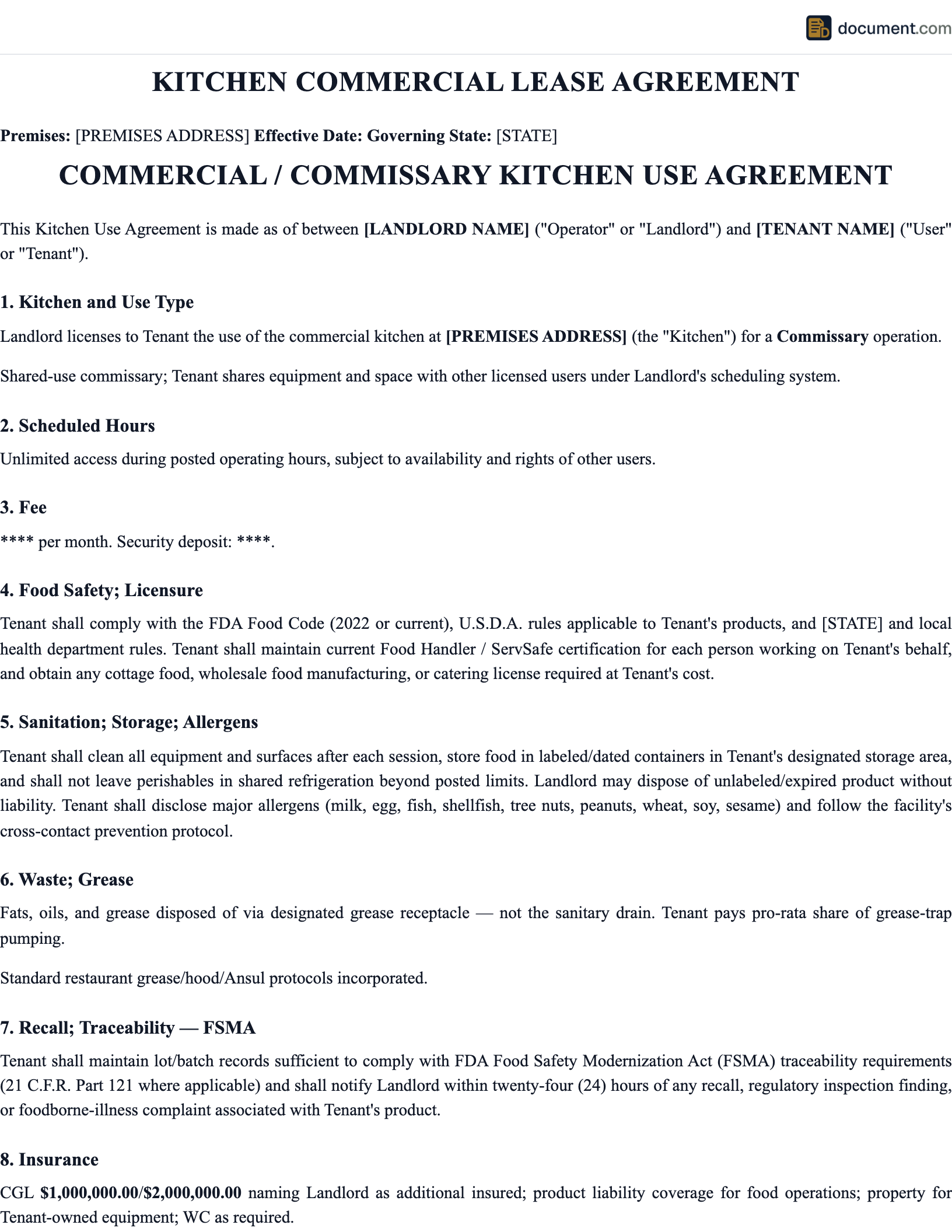
Below is a preview of our Texas-specific template. Your customized document will include all fields and provisions required for filing in any Texas county.
KITCHEN LEASE AGREEMENT
STATE OF TEXAS
Legal Document Template
FACILITY OWNER
Name: [Full Legal Name]
Facility: [Kitchen Name]
Address: [Facility Address]
KITCHEN TENANT
Name: [Full Legal Name / Business]
Business Type: [Restaurant/Catering/Production]
Health Permit #: [Number]
KITCHEN SPECIFICATIONS
Total SF: [Square Feet]
Schedule: [Days/Hours]
Equipment: [See Inventory Addendum]
Storage: [Allocated Space]
FINANCIAL TERMS
Monthly Rent: $[Amount]
Schedule Rate: $[Amount]/hour
Security Deposit: $[Amount]
Equipment Deposit: $[Amount]
Texas Kitchen Lease Agreement FAQ
Answers to common questions about filing a kitchen lease agreement in Texas, including requirements, fees, and procedures.
Official Texas Resources
Use these official state resources to verify requirements, find your local filing office, and access government forms for Texas.
Related Texas Documents
Depending on your situation, you may need additional documents alongside your Texas kitchen lease agreement.
Create your Texas Commercial Kitchen Lease Agreement in under 5 minutes.
Answer a few questions and download a Texas-compliant document, ready for the state agency.