



South Carolina Kitchen Lease Agreement Overview
South Carolina's commercial kitchen leasing market is strongest in Charleston, where the state's nationally recognized culinary scene drives demand from catering companies, artisan food producers, and food truck operators. The South Carolina Department of Health and Environmental Control licenses food establishments statewide, and the state's warm climate and coastal seafood industry create specific cold storage and shellfish handling requirements that affect kitchen lease terms. South Carolina's growing beach resort and destination wedding markets in Myrtle Beach and Hilton Head generate seasonal kitchen demand peaks that operators should account for in scheduling provisions.
South Carolina's coastal identity shapes the commercial kitchen market in ways that affect cold storage availability, permitted use provisions for shellfish handling, and the seasonal rhythms of catering and food production. Kitchen operators in Charleston and Lowcountry markets should confirm that their facility's SCDHEC permit covers seafood-related production if that is part of their business model. The state's 5% sales tax plus applicable local additions creates a modest tax environment for food producers, though operators should confirm their product classification before the first retail sale.
$15
Filing fee
Required
Notarization
2
Witnesses required
Register
Filing office
South Carolina Requirements
A South Carolina commercial kitchen lease must address SCDHEC facility licensing, cold storage provisions for perishable and seafood production, seasonal scheduling for the state's catering and event markets, and shellfish handling compliance if applicable.
South Carolina SCDHEC Shellfish Handling Requirement
SCDHEC has specific requirements for shellfish handling and processing that differ from standard food production licensing. If you plan to process or prepare shrimp, oysters, crab, or other shellfish at a shared kitchen facility, confirm that the facility's SCDHEC permit explicitly covers shellfish operations and that cold storage and water systems meet shellfish-specific standards before signing the lease.
Document Requirements
- SCDHEC Facility Permit: Confirm the facility holds a current SCDHEC food service permit; confirm permit coverage includes your intended production type, especially if shellfish handling is involved
- Cold Storage Reliability: Specify cold storage allocation per operator and assign maintenance responsibility; temperature monitoring provisions are especially important for fresh seafood and high-volume perishable production
- Seasonal Access Provisions: Address peak season scheduling for spring wedding and summer beach resort catering demand; include provisions for scaling production hours up and down with the seasonal pattern
- Insurance Requirements: Specify minimum general liability and product liability coverage with the facility owner named as additional insured; workers' compensation required for employees
- Permitted Use and BBQ Production: Review lease restrictions on smoke production and ventilation-intensive cooking methods; South Carolina's BBQ culture means some facilities have specific provisions for smoked meat operators
How to File in South Carolina
Executing a commercial kitchen lease in South Carolina involves confirming SCDHEC facility licensing, verifying cold storage capacity for your production model, and negotiating seasonal access provisions for peak catering periods.
Confirm SCDHEC Facility Permit and Shellfish Coverage
Before signing, confirm the facility holds a current SCDHEC food service permit. If your production involves shellfish, verify that the permit explicitly covers shellfish handling and that cold storage and water systems meet SCDHEC's shellfish-specific standards.
Inspect Equipment and Cold Storage
Inspect kitchen equipment condition and available cold storage. In South Carolina's warm, humid climate, confirm that refrigeration equipment is properly maintained and that cold storage allocation is sufficient for your production volume, particularly if you are handling fresh seafood or high-volume perishables.
Negotiate Scheduling, Seasonal Access, and Permitted Use
Define shift windows and peak season access provisions for spring wedding and summer beach resort catering. Review permitted use restrictions on shellfish processing and smoke production. Confirm your production type is covered under the facility's SCDHEC permit before signing.
Execute Lease and Obtain Insurance Coverage
Execute the kitchen lease and obtain required general liability and product liability insurance with the facility owner as additional insured. South Carolina requires workers' compensation for employees. Provide the certificate of insurance before your first production day.
Complete SCDHEC Compliance and Begin Production
Confirm food handler certifications are current under SCDHEC requirements. Review the facility's sanitation protocols. Register with the South Carolina Department of Revenue for applicable sales tax obligations if selling food directly to consumers or at retail.
South Carolina Fees & Costs
South Carolina commercial kitchen costs include SCDHEC facility permit fees paid at the facility level, operator insurance requirements, and kitchen rental rates that are generally accessible compared to Northern or West Coast urban markets.
| Fee / Cost | Amount |
|---|---|
| SCDHEC Food Service Permit (Facility Level) | $100 - $600 annually depending on facility class; paid by facility owner |
| Operator Insurance (General and Product Liability) | $500 - $2,200 annually depending on production type, seafood handling, and revenue volume |
| Kitchen Rental Rate (Charleston) | $15 - $30 per hour for hourly access; $400 - $1,500 monthly for dedicated shift agreements |
| Attorney Review | $250 - $600 for kitchen lease review with SCDHEC compliance, shellfish handling, and seasonal access provisions |
Sample South Carolina Kitchen Lease Agreement
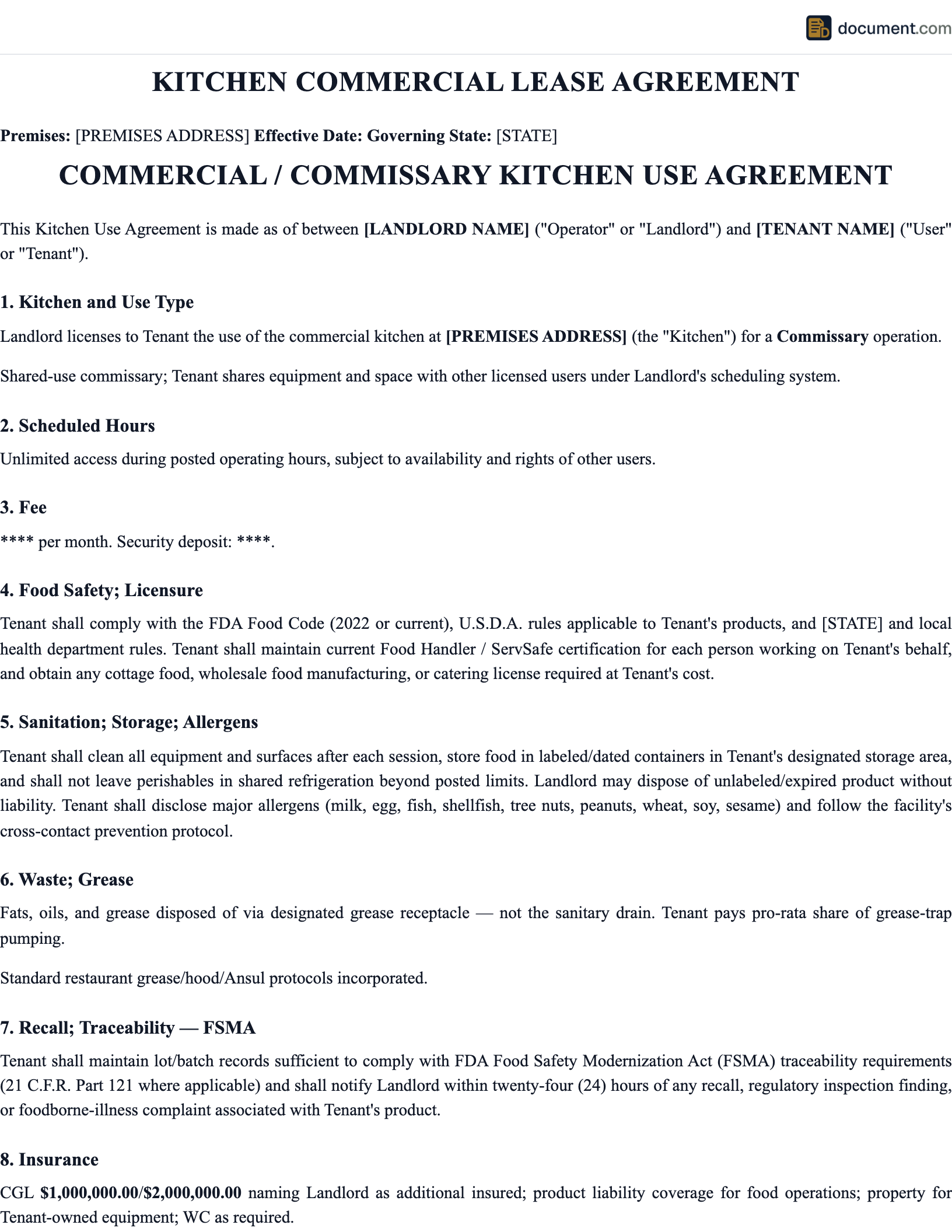
Below is a preview of our South Carolina-specific template. Your customized document will include all fields and provisions required for filing in any South Carolina county.
KITCHEN LEASE AGREEMENT
STATE OF SOUTH CAROLINA
Legal Document Template
FACILITY OWNER
Name: [Full Legal Name]
Facility: [Kitchen Name]
Address: [Facility Address]
KITCHEN TENANT
Name: [Full Legal Name / Business]
Business Type: [Restaurant/Catering/Production]
Health Permit #: [Number]
KITCHEN SPECIFICATIONS
Total SF: [Square Feet]
Schedule: [Days/Hours]
Equipment: [See Inventory Addendum]
Storage: [Allocated Space]
FINANCIAL TERMS
Monthly Rent: $[Amount]
Schedule Rate: $[Amount]/hour
Security Deposit: $[Amount]
Equipment Deposit: $[Amount]
South Carolina Kitchen Lease Agreement FAQ
Answers to common questions about filing a kitchen lease agreement in South Carolina, including requirements, fees, and procedures.
Official South Carolina Resources
Use these official state resources to verify requirements, find your local filing office, and access government forms for South Carolina.
Related South Carolina Documents
Depending on your situation, you may need additional documents alongside your South Carolina kitchen lease agreement.
Create your South Carolina Commercial Kitchen Lease Agreement in under 5 minutes.
Answer a few questions and download a South Carolina-compliant document, ready for the state agency.