
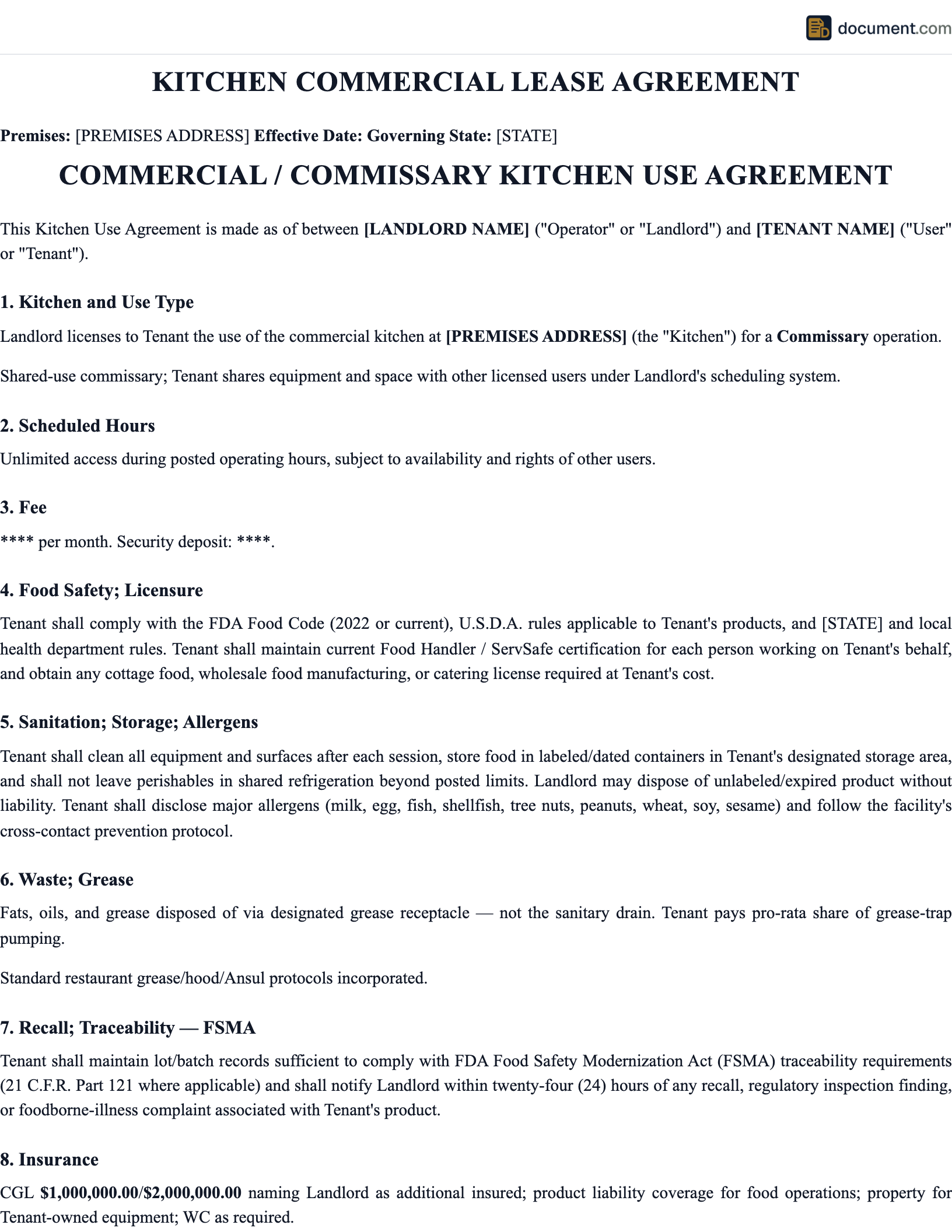



Oregon Kitchen Lease Agreement Overview
Oregon's commercial kitchen leasing market is among the most active on the West Coast, driven largely by Portland's nationally recognized food cart culture and a strong independent food producer community across the Willamette Valley. The Oregon Health Authority licenses food establishments statewide, and local health departments in Multnomah, Washington, and Lane counties conduct most of the day-to-day inspections that affect shared kitchen facilities. Food cart operators who need OHA-compliant commissaries represent a substantial segment of kitchen lease demand in Portland, creating a distinct submarket with specific lease terms around equipment storage, prep access, and permit documentation.
Oregon has no statewide sales tax on food sold for home consumption, which affects the regulatory classification of food produced in commercial kitchens depending on whether it is sold wholesale, retail, or through food service channels. The Oregon Corporate Activity Tax (CAT) applies to high-revenue operators, though most early-stage kitchen tenants fall below the threshold. Portland's competitive market for shared kitchen space means scheduling, storage allocation, and exclusive equipment access provisions in the lease deserve careful attention before signing.
$15
Filing fee
Required
Notarization
0
Witnesses required
County
Filing office
Oregon Requirements
An Oregon commercial kitchen lease must address OHA facility licensing, operator-level compliance obligations, storage allocation, scheduling, and the specific needs of food cart commissary operators who represent a significant share of Portland's kitchen lease market.
Oregon OHA Food Cart Commissary Requirement
Oregon food cart operators are required by the Oregon Health Authority to operate from a licensed commissary. If a commercial kitchen serves as a commissary for food cart clients, the lease must confirm that the facility's OHA commissary license covers each cart operator, specify the physical address documentation OHA requires for the cart permit, and address equipment storage access outside scheduled prep hours.
Document Requirements
- OHA Facility License: Confirm the kitchen facility holds a current Oregon Health Authority food establishment license and identify who is responsible for maintaining facility-level compliance throughout the lease term
- Scheduling and Storage Allocation: Define reserved shift windows or scheduling procedures, cold storage allocation per operator, and dry storage assignments to prevent disputes in multi-operator facilities
- Insurance Requirements: Specify minimum general liability and product liability coverage, require additional insured status for the facility owner, and address liability allocation for food safety incidents involving multiple operators
- Permitted Use Restrictions: Review any restrictions on allergen-intensive production, high-smoke cooking methods, or product categories requiring separate OHA licensing before signing
- Cold Storage Failure Protocol: Include provisions for temperature monitoring, failure notification, and liability allocation if refrigeration equipment failure results in product loss
How to File in Oregon
Executing a commercial kitchen lease in Oregon requires verifying OHA facility licensing, confirming operator-level compliance obligations, and negotiating scheduling, storage, and insurance provisions that work for your specific production model.
Verify OHA Facility License and Commissary Status
Confirm the kitchen facility holds a current Oregon Health Authority food establishment license. If you are a food cart operator, confirm the facility's commissary license covers your cart and provides the physical address documentation OHA requires for your cart permit.
Inspect Equipment and Cold Storage
Before signing, inspect the equipment condition, cold storage capacity, and temperature monitoring systems. Confirm that the available cold storage allocation is adequate for your production volume and that refrigeration maintenance responsibility is clearly assigned in the lease.
Negotiate Scheduling, Storage, and Permitted Use Provisions
Define your shift schedule, reserved equipment access, storage allocation, and permitted production types before signing. Review any restrictions on allergen-intensive production or high-smoke cooking methods to confirm your operations are covered. Address holiday production access provisions if your business has seasonal demand spikes.
Execute Lease and Obtain Insurance Coverage
Execute the lease and obtain the required general liability and product liability insurance with the facility owner named as an additional insured. Provide the certificate of insurance before taking occupancy. Oregon workers' compensation coverage is required for any employees from the first day of operation.
Onboard with OHA and Begin Production
Complete any OHA operator registration or food handler certification requirements before your first production day. Confirm the facility's OHA license is current, review cleaning and sanitation protocols with the facility operator, and begin production within your scheduled hours.
Oregon Fees & Costs
Oregon commercial kitchen costs include OHA facility permit fees paid at the facility level, operator-level insurance requirements, and the hourly or monthly rent charged by the kitchen facility. Oregon has no statewide sales tax, which simplifies the tax structure for food production operators.
| Fee / Cost | Amount |
|---|---|
| OHA Food Establishment License (Facility Level) | $200 - $700+ annually depending on establishment class; paid by facility owner |
| Operator Insurance (General and Product Liability) | $500 - $2,500 annually depending on production type and revenue level |
| Kitchen Rental Rate (Portland Metro) | $20 - $40 per hour for hourly use; $500 - $1,800 monthly for dedicated shift agreements |
| Attorney Review | $300 - $700 for kitchen lease review with OHA compliance, scheduling, and liability provisions |
Sample Oregon Kitchen Lease Agreement
Below is a preview of our Oregon-specific template. Your customized document will include all fields and provisions required for filing in any Oregon county.
KITCHEN LEASE AGREEMENT
STATE OF OREGON
Legal Document Template
FACILITY OWNER
Name: [Full Legal Name]
Facility: [Kitchen Name]
Address: [Facility Address]
KITCHEN TENANT
Name: [Full Legal Name / Business]
Business Type: [Restaurant/Catering/Production]
Health Permit #: [Number]
KITCHEN SPECIFICATIONS
Total SF: [Square Feet]
Schedule: [Days/Hours]
Equipment: [See Inventory Addendum]
Storage: [Allocated Space]
FINANCIAL TERMS
Monthly Rent: $[Amount]
Schedule Rate: $[Amount]/hour
Security Deposit: $[Amount]
Equipment Deposit: $[Amount]
Oregon Kitchen Lease Agreement FAQ
Answers to common questions about filing an kitchen lease agreement in Oregon, including requirements, fees, and procedures.
Official Oregon Resources
Use these official state resources to verify requirements, find your local filing office, and access government forms for Oregon.
Related Oregon Documents
Depending on your situation, you may need additional documents alongside your Oregon kitchen lease agreement.
Create your Oregon Commercial Kitchen Lease Agreement in under 5 minutes.
Answer a few questions and download a Oregon-compliant document, ready for the state agency.