
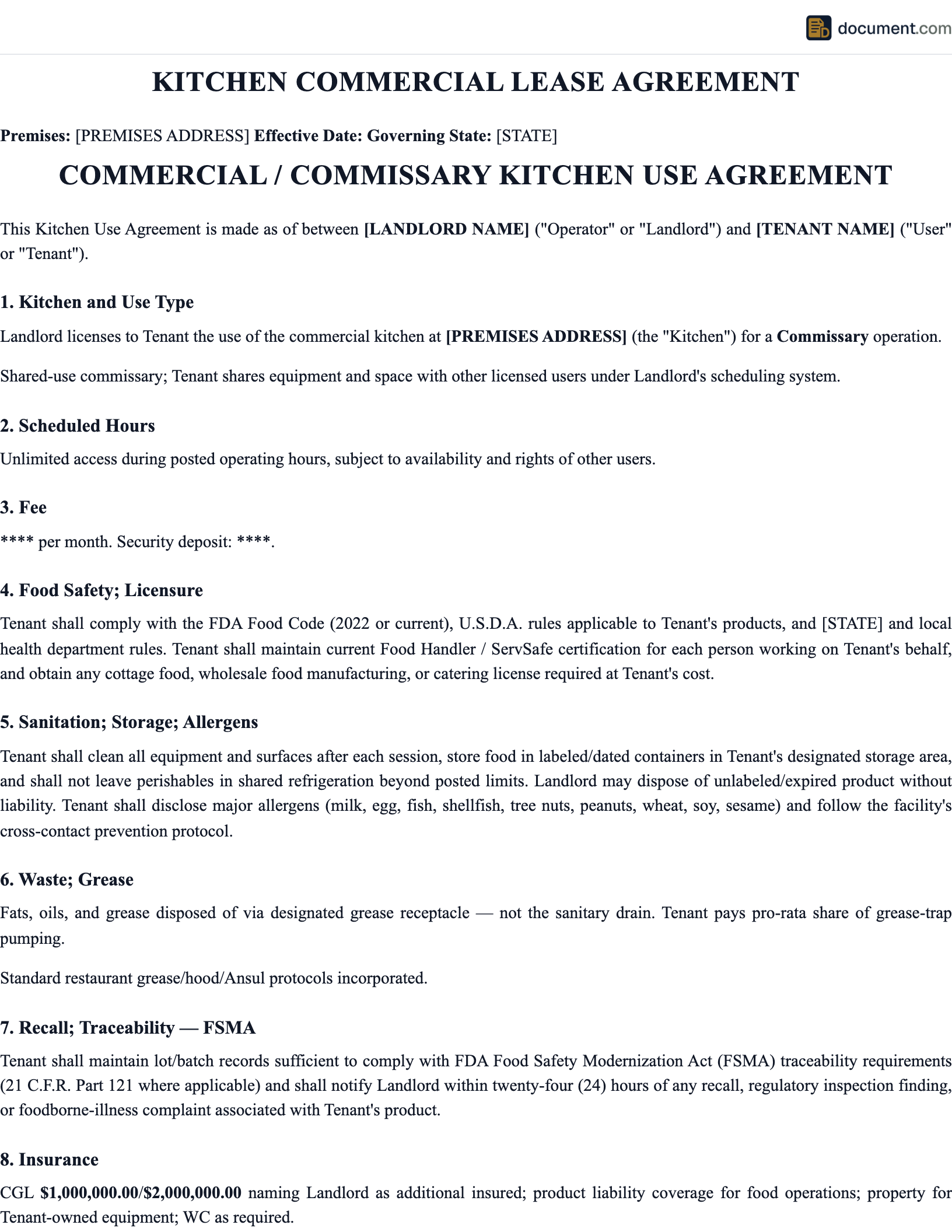



Ohio Kitchen Lease Agreement Overview
Ohio's shared kitchen market is centered in Columbus, which has the most developed ecosystem of commissary and incubator kitchen facilities in the state. Cleveland and Cincinnati each support smaller but active markets, serving food truck operators, caterers, meal prep businesses, cottage food producers, and restaurant incubators. A kitchen lease in Ohio is the formal agreement between a shared kitchen facility and a tenant who rents time, prep space, and equipment access rather than a dedicated standalone commercial kitchen.
Ohio Department of Health (ODH) oversight is the central regulatory consideration for shared kitchen arrangements in Ohio. The facility owner must hold an ODH Food Service Operation license. Each tenant must also independently obtain their own ODH license, which is issued to the individual operator rather than the facility. In Columbus, Cincinnati, and Cleveland, the relevant local health authority handles licensing under ODH delegation. Verifying the facility's current license status and confirming it covers your intended food production category is a required step before signing any Ohio shared kitchen lease.
ODH
Licensing authority
Individual
License per tenant
3 markets
Columbus, Cleveland, Cincinnati
Written
Lease strongly advised
Ohio Requirements
Ohio shared kitchen tenants face a layered set of requirements that combine ODH licensing obligations, lease terms, and local health authority procedures. Getting these right before you sign protects your business from disruption.
Facility License Suspension Risk
If an Ohio shared kitchen facility loses its ODH license due to an inspection failure or regulatory order, all tenants lose their ability to operate, regardless of their own individual license status. Your lease should include explicit provisions granting rent abatement and termination rights if the facility is closed due to a license issue that you did not cause. Do not assume these protections exist by default.
Ohio Shared Kitchen Lease Requirements
- Verify Facility ODH License: Confirm the facility holds a current ODH Food Service Operation license that covers your intended food production category before signing
- Tenant ODH License: Each tenant must obtain their own ODH food service license, issued to the individual operator and tied to the specific facility address
- Commissary Authorization: If you operate a food truck or cottage food business and need commissary certification, confirm the facility will provide written commissary authorization
- Cold Storage Allocation: Specify your designated refrigerator and freezer space by compartment or assigned area, including any shared-use arrangements and conflict resolution procedures
- Schedule and Equipment Rights: Define your scheduled access hours, which equipment you may use, and whether other tenants may use your equipment during your scheduled time
- License Suspension Remedy: Include a rent suspension and early termination right tied to facility closure or license suspension for reasons outside your control
How to Execute an Ohio Shared Kitchen Lease
Executing an Ohio shared kitchen lease involves verifying the facility's regulatory standing, negotiating key operational terms, and coordinating your ODH license application. Follow these steps to protect your business.
Verify the Facility's ODH License
Request a copy of the facility's current ODH Food Service Operation license. Confirm it is active, that it covers your food production category, and that the facility is not operating under a variance or corrective action plan. In Columbus, Cleveland, and Cincinnati, confirm with the local health authority.
Tour and Document the Space
Walk through the kitchen with the facility owner. Photograph the equipment you will use, your assigned storage areas, and any shared-use equipment. Identify any items that are out of service or restricted to certain users. This documentation helps resolve disputes later if terms are contested.
Negotiate Key Lease Provisions
Negotiate your access schedule, cold storage allocation, commissary authorization rights, maintenance responsibilities, and remedies for facility closure or license suspension. If you operate a food truck, confirm the facility will provide written commissary documentation to ODH. Get all verbal commitments reduced to written lease terms.
Execute the Written Lease Agreement
Both parties should sign the written lease before you begin using the facility. Ohio law does not require notarization of a kitchen lease for it to be enforceable, but having both signatures witnessed provides additional protection. Retain a fully executed copy for your records.
Apply for Your ODH License
Submit your Ohio Food Service Operation license application to ODH or the appropriate local health authority. Your application must reference the facility address where you will operate. Coordinate with the facility owner to ensure ODH can inspect your assigned area. Do not begin production until your individual license is in hand.
Ohio Tax Implications for Shared Kitchen Tenants
Ohio shared kitchen tenants face a combination of state sales tax obligations, business deduction opportunities, and local tax considerations that differ depending on how your kitchen agreement is structured.
| Tax Item | Ohio Treatment |
|---|---|
| Ohio Sales Tax on Prepared Food | 5.75% state rate plus local rates (up to 8% in Cuyahoga and Franklin Counties) on taxable prepared food sold to end customers |
| Kitchen Rent Deductibility | Monthly kitchen access fees and hourly use charges are generally deductible as ordinary business expenses under federal and Ohio tax law |
| Security Deposit Treatment | Security deposits held by the landlord are not income to the landlord or deductible by the tenant until applied; consult a tax professional for timing rules |
| Ohio Commercial Activity Tax (CAT) | Ohio CAT applies to gross receipts above the annual threshold; food producers using shared kitchens should track all revenue carefully to determine CAT filing obligations |
Sample Ohio Kitchen Lease Agreement
Below is a preview of our Ohio-specific template. Your customized document will include all fields and provisions required for filing in any Ohio county.
KITCHEN LEASE AGREEMENT
STATE OF OHIO
Legal Document Template
FACILITY OWNER
Name: [Full Legal Name]
Facility: [Kitchen Name]
Address: [Facility Address]
KITCHEN TENANT
Name: [Full Legal Name / Business]
Business Type: [Restaurant/Catering/Production]
Health Permit #: [Number]
KITCHEN SPECIFICATIONS
Total SF: [Square Feet]
Schedule: [Days/Hours]
Equipment: [See Inventory Addendum]
Storage: [Allocated Space]
FINANCIAL TERMS
Monthly Rent: $[Amount]
Schedule Rate: $[Amount]/hour
Security Deposit: $[Amount]
Equipment Deposit: $[Amount]
Ohio Kitchen Lease Agreement FAQ
Answers to common questions about filing an kitchen lease agreement in Ohio, including requirements, fees, and procedures.
Important Considerations for Ohio Shared Kitchen Tenants
Ohio's three main shared kitchen markets serve different operator types, and understanding the dynamics of each helps you choose the right facility and negotiate appropriate terms.
Columbus: Largest Market with the Most Options
Columbus has the most developed shared kitchen ecosystem in Ohio, with multiple dedicated commissary facilities, incubator kitchens, and time-share operations serving food truck operators, caterers, ghost kitchen brands, and cottage food producers. The competitive market means you have options, but also means that popular facilities book quickly. Lock in your preferred time slots early and confirm that your schedule is protected in writing against other tenants or operator changes.
Cleveland: Older Facilities and Infrastructure Considerations
Cleveland's shared kitchen market serves a growing food manufacturing, catering, and cottage food sector. Many facilities are housed in older industrial or commercial buildings, and HVAC, plumbing, and electrical infrastructure may vary in quality. Before signing, confirm that the facility has adequate ventilation for your production methods, that refrigeration is reliable and temperature-monitored, and that any shared equipment is serviced regularly. Ask about the facility's inspection history with Cuyahoga County Board of Health.
Cincinnati: Growing Market with Local Health Department Oversight
Cincinnati's shared kitchen market is smaller but growing, supported by a strong local food culture and increasing demand from cottage food producers and catering businesses serving the Over-the-Rhine and surrounding neighborhoods. Cincinnati Public Health administers food service licensing under ODH delegation, and their inspection standards and timelines can differ from other parts of Ohio. Verify current processing times for new license applications before you commit to a lease start date.
Shared kitchen leases in Ohio are not standardized, and the protections available to tenants vary significantly from facility to facility. Before signing, have a commercial attorney review the lease for license contingency language, facility closure remedies, and any exclusivity or competition restrictions that could limit your business growth. The cost of a review is minor relative to the disruption of losing kitchen access mid-season.
Official Ohio Resources
Use these official state and county resources to verify food service licensing requirements and understand your tax obligations as an Ohio shared kitchen tenant.
Ohio Department of Health - Food Safety
ODH Food Service Operation licensing program and requirements
Cuyahoga County Board of Health - Food Safety
Food service licensing and inspection for Cleveland-area facilities
Ohio Department of Taxation - CAT
Commercial Activity Tax filing requirements for Ohio food businesses
Ohio Attorney General - Business Resources
Ohio commercial lease rights and business regulatory guidance
Related Ohio Documents
Depending on your situation, you may need additional documents alongside your Ohio kitchen lease agreement.
Create your Ohio Commercial Kitchen Lease Agreement in under 5 minutes.
Answer a few questions and download a Ohio-compliant document, ready for the state agency.