



North Carolina Kitchen Lease Agreement Overview
North Carolina's shared kitchen and ghost kitchen market is concentrated in Charlotte, Raleigh, and Asheville, three cities with distinct food cultures and different tenant profiles. Charlotte's dense urban neighborhoods generate consistent delivery demand, making dedicated ghost kitchen infrastructure a viable business model for operators leasing space in South End and NoDa. Raleigh's Research Triangle population skews toward delivery-friendly consumers who support a robust ghost kitchen market, particularly around the universities and tech corridors. Asheville stands apart with a deep artisan food production tradition, where shared kitchen tenants are as likely to be craft bakeries, specialty condiment producers, or small-batch prepared food operations as they are delivery-only restaurant concepts.
Unlike states that operate food safety programs at the state level, North Carolina delegates food service permitting to county environmental health departments operating under NCDHHS Division of Public Health standards. That means a shared kitchen operator in Mecklenburg County deals with the Mecklenburg County Health Department, while a Buncombe County kitchen reports to Buncombe County Environmental Health. Each county conducts its own inspections and issues its own permits, which matters significantly for kitchen tenants who plan to use the facility as their permitted base of operations. A kitchen lease in North Carolina must identify the correct permitting authority and address what happens to tenant operations if the facility's permit is suspended, revoked, or subjected to a correction order that limits capacity.
County
Health permitting
NCDHHS
Standards body
3+
Major markets
Written
Lease required
North Carolina Requirements
A North Carolina kitchen lease involves layers of regulatory compliance that go well beyond standard commercial lease requirements. The facility itself must hold a valid county health department permit, and tenants who plan to operate independently need their own permits tied to the facility. Before signing, tenants should verify the facility's current permit status and confirm the county environmental health department has approved the facility for the type of production the tenant intends to conduct.
County Health Permit Risk
North Carolina food service permits are issued at the county level, meaning a citation or permit suspension at the facility level can immediately halt operations for every tenant using that kitchen as their permitted base. Include lease provisions specifying what remedies you have if the facility's permit is restricted or revoked, including rent abatement or early termination rights.
Key Lease Requirements
- County Health Permit Verification: Confirm the facility holds a valid county health department Food Service Establishment Permit and that the permit covers the tenant's intended production type
- Commissary Authorization: Caterers who will use the kitchen as their commissary should confirm the lease explicitly authorizes this use and that the landlord will cooperate with county health inspections related to the caterer's permit
- Prep Schedule and Time Blocks: The lease should define each tenant's assigned time blocks in writing, including advance scheduling procedures and what happens when a tenant needs additional time
- Cold and Dry Storage Allocation: Specify each tenant's refrigeration, freezer, and dry storage allocation by labeled zone or cubic footage, not just "shared access"
- Equipment Rights and Cleaning: Define which equipment the tenant may use, cleaning responsibilities between sessions, and liability for equipment damage during a tenant's session
- Permit Suspension Remedies: Include specific tenant remedies if the facility's county health permit is suspended, revoked, or subject to a correction order that limits tenant operations
How to Execute a North Carolina Kitchen Lease
Executing a North Carolina kitchen lease successfully requires addressing health permitting, operational logistics, and lease terms in the right sequence. Operators who skip the regulatory verification steps before signing often face costly surprises after they have committed.
Verify the Facility's County Health Permit Status
Contact the county environmental health department in the county where the kitchen is located. Confirm the facility's Food Service Establishment Permit is current and valid for the type of production you intend to conduct. Ask about any outstanding correction orders or recent inspection history. In Charlotte, contact Mecklenburg County Public Health; in Raleigh, Wake County Environmental Services; in Asheville, Buncombe County Health and Human Services.
Tour the Facility and Document Equipment Condition
Walk through the kitchen during an active operating period if possible. Verify that the equipment listed in the lease matches what is actually present and in working condition. Document cold storage temperatures, hood functionality, and the current state of all shared equipment. Photograph any existing damage before signing. This documentation protects you from being held responsible for pre-existing issues when you vacate.
Negotiate Operational and Regulatory Provisions
Push for specific language addressing your assigned prep schedule and time blocks, cold and dry storage allocation by labeled zone, commissary authorization if you are a caterer, and tenant remedies if the facility's health permit is suspended or revoked. Ghost kitchen operators should also negotiate terms addressing delivery platform pickup logistics and whether the landlord will restrict competing concepts from operating out of the same facility.
Execute the Lease
North Carolina law requires leases exceeding three years to be in writing to be enforceable. Even for shorter terms, both parties should sign a comprehensive written agreement. Both parties should retain fully executed original copies. Artisan food producers in Asheville or caterers who need scheduling flexibility should ensure those provisions are in the signed agreement before accepting keys or beginning operations.
Apply for Your Individual Health Permit and Maintain Records
After executing the lease, apply for your individual Food Service Establishment Permit through the applicable county health department. Bring your signed lease as proof of your right to operate at the facility. Maintain records of your scheduled prep sessions, cleaning logs, and any equipment issues you report to the landlord throughout the lease term. Good documentation protects you in the event of a county inspection or a dispute with the facility operator.
Tax Implications for North Carolina Kitchen Tenants
North Carolina kitchen tenants face several tax considerations that differ depending on their business type and how they use the kitchen space.
| Tax Issue | North Carolina Treatment |
|---|---|
| NC Sales Tax on Food Sales | North Carolina imposes a 2% state sales tax on qualifying food items sold at retail; prepared food sold for immediate consumption is taxed at the full 4.75% state rate plus applicable county tax. Ghost kitchen operators selling through delivery platforms must understand how their sales are classified. |
| Lease Rent Deductibility | Kitchen rent paid by a business is deductible as an ordinary business expense for both federal and NC state income tax purposes, provided the space is used exclusively and regularly for business production. |
| Security Deposit Tax Treatment | Security deposits held by the landlord are not income until applied to rent or damages. Tenants should confirm the lease is clear about whether deposits earn interest and the conditions under which they can be retained. |
| Equipment Depreciation | Equipment installed by the tenant in a shared kitchen may qualify for Section 179 expensing or bonus depreciation, depending on whether it qualifies as personal property or is treated as a leasehold improvement. Consult a tax advisor about how removable kitchen equipment is classified in your specific lease arrangement. |
Sample North Carolina Kitchen Lease Agreement
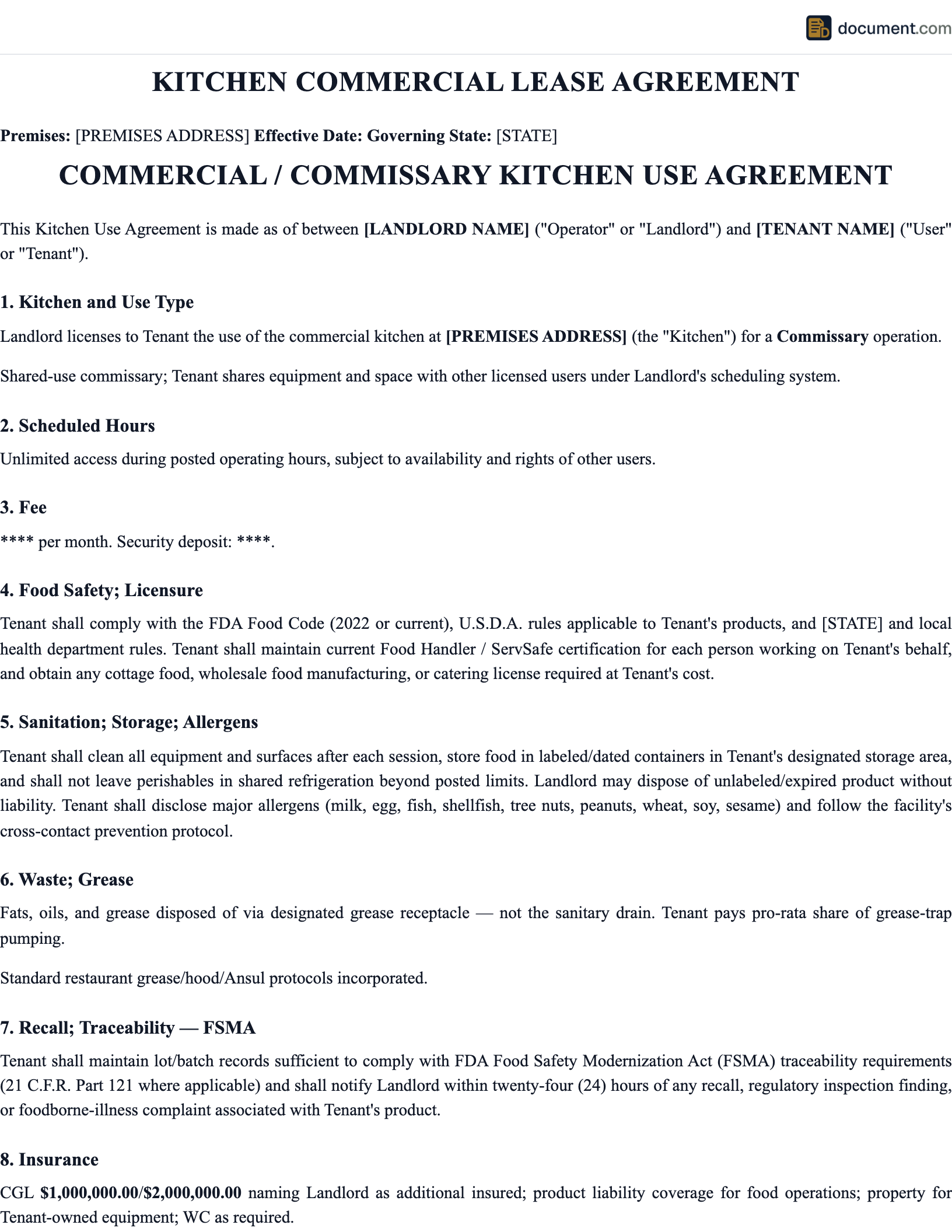
Below is a preview of our North Carolina-specific template. Your customized document will include all fields and provisions required for filing in any North Carolina county.
KITCHEN LEASE AGREEMENT
STATE OF NORTH CAROLINA
Legal Document Template
FACILITY OWNER
Name: [Full Legal Name]
Facility: [Kitchen Name]
Address: [Facility Address]
KITCHEN TENANT
Name: [Full Legal Name / Business]
Business Type: [Restaurant/Catering/Production]
Health Permit #: [Number]
KITCHEN SPECIFICATIONS
Total SF: [Square Feet]
Schedule: [Days/Hours]
Equipment: [See Inventory Addendum]
Storage: [Allocated Space]
FINANCIAL TERMS
Monthly Rent: $[Amount]
Schedule Rate: $[Amount]/hour
Security Deposit: $[Amount]
Equipment Deposit: $[Amount]
North Carolina Kitchen Lease Agreement FAQ
Answers to common questions about filing a kitchen lease agreement in North Carolina, including requirements, fees, and procedures.
Important Considerations for NC Kitchen Tenants
North Carolina's three major food markets present different risk profiles for kitchen tenants. Charlotte is a high-demand market where ghost kitchen operators compete for schedule time at established facilities, and securing favorable time blocks in a new lease often requires negotiating carefully before other tenants take priority slots. Raleigh's market is growing fast enough that new shared kitchen facilities are opening regularly, giving tenants more options than they had five years ago, but that same growth means the regulatory environment is getting more scrutiny from county health authorities who are seeing more operators in the market.
Asheville's artisan food production community has different needs than delivery-oriented ghost kitchen operators. Producers making specialty condiments, baked goods, or small-batch prepared foods often need longer uninterrupted prep sessions, more cold storage for finished goods awaiting delivery to retail accounts, and a reliable prep schedule that does not change week to week. If a facility primarily serves caterers and rotating ghost kitchen operators, the scheduling model may not work for a production-oriented tenant who needs consistency.
Get a Lease Review Before You Sign
North Carolina commercial kitchen leases involve county health permitting complexity that most standard commercial lease attorneys do not encounter regularly. An attorney with food business or commercial real estate experience can identify gaps in the operational provisions, confirm the permit suspension language actually protects you, and advise on whether the insurance requirements are appropriate for your production type. The cost of a lease review is small relative to what you could lose if a facility permit suspension shuts down your operations mid-season.
Official North Carolina Resources
Use these official state and county resources to verify health permit requirements and access regulatory guidance for North Carolina kitchen tenants.
NCDHHS Food and Lodging Section
State food service standards and county health contacts
Mecklenburg County Public Health
Charlotte area food service permits and inspections
Wake County Environmental Services
Raleigh area food service permitting
NC Department of Revenue
NC sales tax rates on food sales and prepared food
Related North Carolina Documents
Depending on your situation, you may need additional documents alongside your North Carolina kitchen lease agreement.
Create your North Carolina Commercial Kitchen Lease Agreement in under 5 minutes.
Answer a few questions and download a North Carolina-compliant document, ready for the state agency.