



New York Kitchen Lease Agreement Overview
New York has one of the most developed commercial kitchen and ghost kitchen markets in the country, concentrated heavily in New York City. The city's enormous food delivery economy, driven by platforms serving millions of customers across the five boroughs, has created substantial demand for dedicated ghost kitchen facilities in areas including Long Island City, the South Bronx, and parts of Brooklyn. NYC DOHMH permitting applies to all commercial food production facilities in the city, and the inspection process for new kitchen establishments is thorough and must be completed before any commercial food production begins.
Upstate New York also has an active shared kitchen market, with facilities serving caterers, artisan food producers, and small-batch manufacturers in markets like Albany, Buffalo, and the Hudson Valley. Upstate kitchen operators work with county health departments rather than DOHMH, and the inspection and permitting process is generally more straightforward. A kitchen lease in New York must reflect which regulatory authority has jurisdiction, because the specific permit language, cooperation requirements, and operational standards differ significantly between New York City and the rest of the state.
$55
Filing fee
Required
Notarization
0
Witnesses required
County
Filing office
New York Requirements
New York kitchen leases must address the specific health department authority with jurisdiction over the facility and clearly define the responsibilities of the facility operator and each individual tenant with respect to permitting and inspections.
New York Specific Note
In New York City, the DOHMH inspects shared kitchen facilities on an unannounced basis. A closure order from DOHMH can immediately eliminate every tenant's ability to legally operate from that location. The kitchen lease should include specific provisions addressing what happens if the facility receives a closure order, including tenant remedies and any rent abatement or termination rights. Upstate facilities work with county health departments whose inspection processes are more predictable but still require advance planning.
Key Provisions for New York Kitchen Leases
- Regulatory Authority: Identify whether the facility falls under NYC DOHMH jurisdiction or a county health department, and specify permit cooperation obligations accordingly
- DOHMH Permit Status: Confirm that the facility holds a current Food Service Establishment Permit and include a covenant requiring the landlord to maintain it throughout the lease term
- Ventilation and DOB Permits: For NYC locations, assign responsibility for any DOB permit filings required for ventilation modifications, and specify who bears the cost of those permits
- Delivery Logistics: For ghost kitchen operations in NYC, address pickup area access, driver staging, and any building restrictions on delivery vehicle frequency that could affect operations
- Permit Suspension Remedies: Include specific tenant remedies if the facility's health permit is suspended, including a right to terminate and receive prepaid rent refunds
- Cold Storage Allocation: Specify refrigeration and freezer space by labeled zone, confirm access hours, and assign liability for temperature control failures and resulting product spoilage
How to Execute a New York Kitchen Lease
Executing a commercial kitchen lease in New York requires verifying the facility's regulatory status with the applicable health authority before committing to a lease term, and ensuring all operational requirements are documented in writing.
Verify the Facility's Health Permit Status
For NYC locations, confirm that the facility holds a current DOHMH Food Service Establishment Permit and has no outstanding violations or pending closure orders. For upstate locations, verify the facility's county health department permit status. Ask to see the most recent inspection report and any violation correction notices.
Tour the Facility and Document Conditions
Walk through the entire kitchen and photograph all equipment you will use. Note any items that are broken, improperly cleaned, or in need of repair. For NYC ghost kitchen facilities, assess the delivery pickup area and building access for drivers. Document your findings as a lease exhibit to prevent future disputes about pre-existing conditions.
Negotiate and Document All Operational Terms
Agree on your prep schedule, cold storage allocation, equipment access, restricted activities, and cleaning responsibilities before signing. For NYC ghost kitchen arrangements, address platform delivery staging, secure storage, and any building access restrictions that could affect your delivery operations. Get every material operational term in the written lease.
Execute the Lease
Both parties sign the written lease agreement. Notarization is not required for enforceability between the parties under New York law, though it is required if the lease will be recorded. For month-to-month or short-term kitchen access arrangements, a signed written agreement is binding without recording. Keep fully executed originals for both parties.
Obtain Your Individual Permits and Begin Operations
Apply for any individual food business permits required for your operation at this location. In NYC, this may require a separate DOHMH permit identifying the shared kitchen as your production address. In upstate New York, contact your county health department to understand what documentation is needed to authorize production at the shared facility.
New York Fees & Costs
Below is a breakdown of the typical costs associated with filing this document in New York. Actual fees may vary by county.
| Fee / Cost | Amount |
|---|---|
| Filing Fee | $55 first page |
| Notarization | $5 - $25 per signature |
| Certified Copy | $1 - $10 per page |
| Attorney Review (optional) | $150 - $500 |
Sample New York Kitchen Lease Agreement
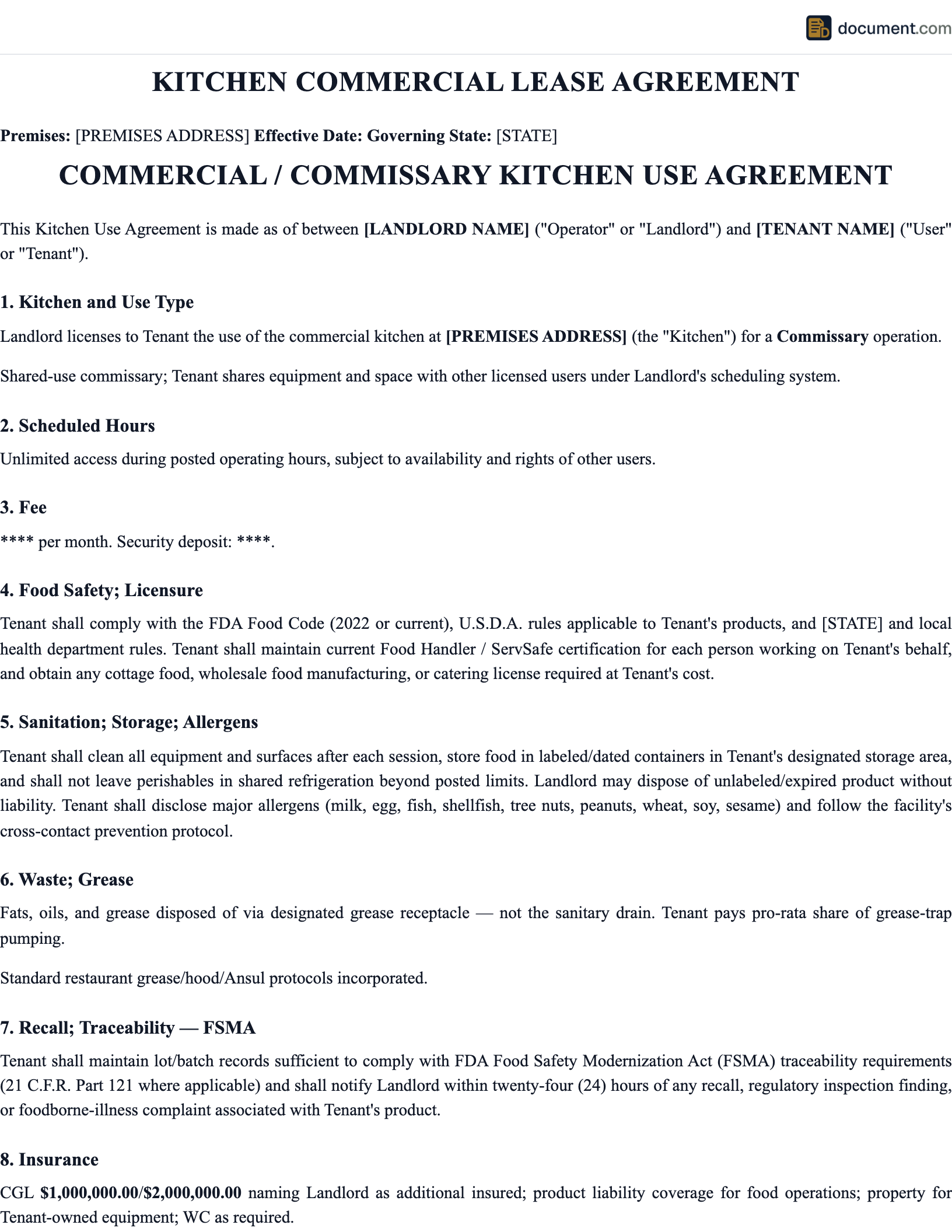
Below is a preview of our New York-specific template. Your customized document will include all fields and provisions required for filing in any New York county.
KITCHEN LEASE AGREEMENT
STATE OF NEW YORK
Legal Document Template
FACILITY OWNER
Name: [Full Legal Name]
Facility: [Kitchen Name]
Address: [Facility Address]
KITCHEN TENANT
Name: [Full Legal Name / Business]
Business Type: [Restaurant/Catering/Production]
Health Permit #: [Number]
KITCHEN SPECIFICATIONS
Total SF: [Square Feet]
Schedule: [Days/Hours]
Equipment: [See Inventory Addendum]
Storage: [Allocated Space]
FINANCIAL TERMS
Monthly Rent: $[Amount]
Schedule Rate: $[Amount]/hour
Security Deposit: $[Amount]
Equipment Deposit: $[Amount]
New York Kitchen Lease Agreement FAQ
Answers to common questions about filing a kitchen lease agreement in New York, including requirements, fees, and procedures.
Tax Implications for New York Kitchen Leases
New York State sales tax applies to most food products sold by commercial kitchen tenants, with the specific treatment depending on whether the product is prepared food, a grocery item, or an ingredient. Ghost kitchen operators selling prepared meals pay New York sales tax at the combined state and local rate. NYC operators pay the city's additional local rate on top of the state rate, for a total of 8.875% in most categories.
Kitchen lease payments are deductible business expenses. Equipment deposits and security deposits are not income to the landlord unless they are retained. For kitchen tenants who install their own equipment in a shared facility, the depreciation treatment depends on whether the equipment is truly personal property of the tenant or has become a fixture. This distinction matters for both income tax purposes and for what the tenant can remove at lease termination.
NYC ghost kitchen operators who receive income through third-party delivery platforms should understand that the platform may report gross transaction amounts to tax authorities, potentially creating a mismatch with income reported on the business's own returns. Working with an accountant familiar with NYC food business tax issues from the outset avoids reconciliation problems later.
Important Considerations for New York Kitchen Tenants
The NYC ghost kitchen market is competitive, and the best facilities book up quickly. Operators who find a facility with strong DOHMH inspection history, good cold storage, and efficient delivery pickup logistics should understand that they are competing with other operators for those time blocks. A longer-term lease commitment, even at a slightly higher rate, often provides more operational stability than rolling month-to-month in a facility that may lose space to better-funded operators.
Upstate New York has an emerging artisan food production community that uses shared kitchen facilities differently than NYC ghost kitchen operators. In the Hudson Valley and Finger Lakes regions, shared kitchens serve jam producers, specialty bakers, small-batch condiment makers, and farm-to-table food businesses that sell at farmers markets and regional retailers. These tenants need different lease provisions than ghost kitchen operators, including provisions for batch labeling, product storage, and compliance with New York State Department of Agriculture and Markets requirements for licensed food products.
DOHMH Inspection Risk
New York City DOHMH inspections are unannounced and can result in immediate closure for critical violations. A shared kitchen closure not only affects the facility operator but immediately shuts down every tenant's production. Before signing, ask the facility operator for their inspection history and any prior closure orders. A facility with a pattern of critical violations is a significant business risk for every tenant operating within it.
Official New York Resources
These official agencies handle food service permits and business tax registration for New York kitchen operators.
NYC DOHMH Food Operators
Food service permits and inspection requirements for NYC kitchens
NY Department of Taxation and Finance
Sales tax registration and food business tax requirements
NY Dept of Agriculture and Markets
Food processing licenses for artisan food producers
NYC Department of Buildings
Building permits for kitchen ventilation and equipment installation
Related New York Documents
Depending on your situation, you may need additional documents alongside your New York kitchen lease agreement.
Create your New York Commercial Kitchen Lease Agreement in under 5 minutes.
Answer a few questions and download a New York-compliant document, ready for the state agency.