
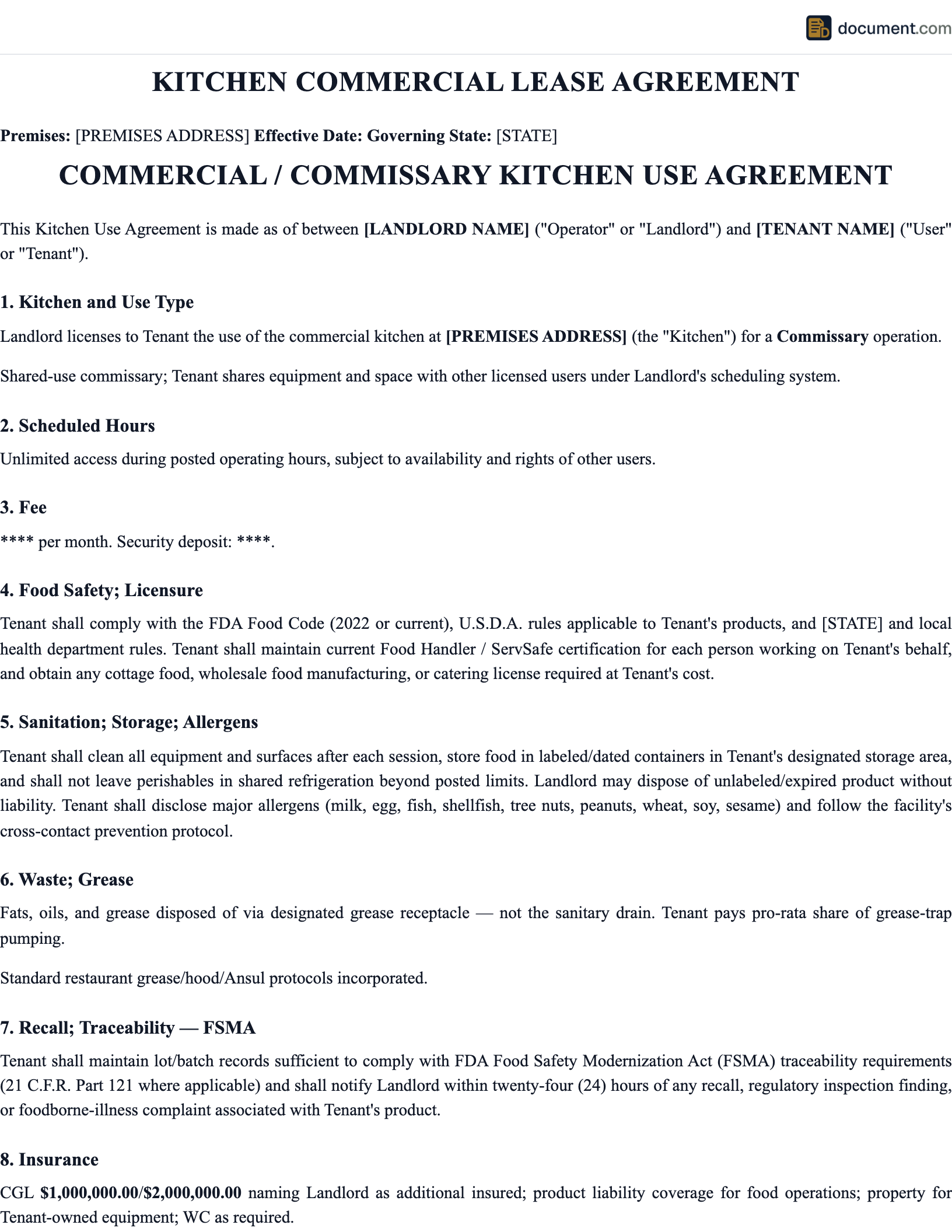



New Jersey Kitchen Lease Agreement Overview
New Jersey's shared kitchen market is concentrated in northern New Jersey's urban corridor, where the proximity to New York City drives strong demand from catering businesses, food truck operators, ghost kitchens, and specialty food producers who need licensed commissary access. The regulatory framework for food service licensing in New Jersey is highly decentralized: each of the state's 566 municipalities administers its own health inspection program under the authority of the NJ Department of Health, which means a shared kitchen's licensing is issued by the local health department in that specific town, and each tenant business must obtain its own separate retail food establishment license from the same local authority.
New Jersey's catering hall culture, particularly in Essex, Bergen, Passaic, and Hudson counties, generates substantial demand for commissary kitchen access from catering businesses supporting weddings, corporate events, and private parties. A well-drafted shared kitchen lease in New Jersey must address the multi-layered municipal health licensing structure, commissary agreement obligations for food truck and mobile vendor tenants, prep schedule allocation in a dense urban market, and what protections tenants have if the facility's own municipal license is jeopardized.
$15
Filing fee
Required
Notarization
0
Witnesses required
County
Filing office
New Jersey Requirements
New Jersey has specific requirements for this type of legal document. Meeting these requirements ensures your document is accepted by the county clerk and is legally enforceable.
New Jersey Municipal Health Licensing Note
Each food business operating from a New Jersey shared kitchen must obtain its own retail food establishment license from the local municipal health department where the kitchen is located. The facility's license does not cover tenants. New Jersey's 566 municipalities each administer their own inspection programs, meaning pre-opening inspection timelines and specific requirements vary by location. Tenants should begin the licensing process as soon as a lease is signed.
Key Lease Requirements
- Municipal health permit verification: Confirm the facility holds a valid local health department food service license covering commissary use, and that the municipality will issue tenant licenses from this location
- Commissary agreement obligation: Require the facility operator to execute NJ Department of Health commissary agreements for tenants who need them for food truck or mobile vendor licensing
- Prep schedule addendum: Define assigned days and hours, advance booking procedures, conflict resolution, and seasonal peak access rules
- Cold storage allocation: Specify refrigerator and freezer space assignments, temperature monitoring responsibilities, and equipment failure remedies for high-volume catering tenants
- Facility license suspension clause: Grant tenants the right to terminate without penalty if the facility's municipal health license is suspended, with required notice and relocation timeline from the operator
How to Execute a New Jersey Kitchen Lease
Executing a shared kitchen lease in New Jersey requires verifying the facility's municipal health permit, confirming the local health department will issue tenant licenses from the location, and starting the tenant's own licensing process immediately after signing.
Verify the facility's municipal health permit and commissary status
Request a copy of the facility's current retail food establishment license issued by the local health department. Confirm that the facility is permitted to operate as a commissary and that the local health department will accept individual tenant applications from businesses operating at this address.
Negotiate the prep schedule, cold storage, and commissary agreement terms
In northern New Jersey's dense urban market, prep time windows are competitive, particularly for weekend-heavy catering businesses. Define assigned days and hours in a schedule addendum, allocated cold storage space, and the operator's obligation to execute commissary agreements for food truck or mobile vendor tenants who need them.
Execute the lease with a licensing contingency
Both parties sign the lease, but rent commencement should be contingent on the tenant receiving a retail food establishment license from the local health department. New Jersey's municipal inspection timelines vary significantly by town, and a contingency protects the tenant from paying rent during delays outside their control.
Apply to the local health department immediately
Submit the retail food establishment application to the municipal health department as soon as the lease is signed. Schedule the pre-operating inspection early. If the business is a food truck or mobile vendor, submit the commissary agreement from the facility at the same time.
Retain all originals and confirm insurance coverage
Both parties retain original signed copies of the lease, prep schedule addendum, commissary agreement, and equipment inventory. Provide the facility operator with a certificate of commercial general liability insurance naming the operator as additional insured before first kitchen access.
New Jersey Fees & Costs
Below is a breakdown of the typical costs associated with filing this document in New Jersey. Actual fees may vary by county.
| Fee / Cost | Amount |
|---|---|
| Filing Fee | $15 per page |
| Notarization | $5 - $25 per signature |
| Certified Copy | $1 - $10 per page |
| Attorney Review (optional) | $150 - $500 |
Tax Implications of a New Jersey Kitchen Lease
New Jersey imposes a 6.625% sales tax on prepared food sold to consumers. Shared kitchen tenants who sell wholesale to retailers, restaurants, or distributors using a New Jersey resale certificate can generally purchase ingredients and supplies tax-free. Caterers who sell prepared meals at events must collect and remit sales tax in most circumstances. Tenants should confirm their specific sales tax obligations with a NJ CPA based on how and where they sell their products.
Lease payments for a shared kitchen are deductible as ordinary and necessary business expenses under federal tax rules. Equipment purchased for kitchen use may qualify for Section 179 expensing or bonus depreciation in the year of acquisition. Shared kitchen operators who charge tenants hourly or per-session rates report that income as business revenue and may deduct facility operating costs including rent, utilities, insurance, and equipment maintenance.
New Jersey businesses with nexus in the state are subject to the Corporation Business Tax if operating as a corporation, or the Business Alternative Income Tax (BAIT) for pass-through entities that elect it. Food producers who operate across state lines should be aware of potential multistate income allocation issues, particularly those whose commissary is in New Jersey but who sell primarily in New York or Pennsylvania.
Important Considerations for New Jersey Kitchen Tenants
Professional Recommendation
New Jersey shared kitchen leases benefit from legal review, particularly around the municipal health permit licensing structure, commissary agreement obligations, and facility license suspension clauses. Because NJ food licensing runs through individual municipalities rather than a state agency, the specific requirements and timelines can vary meaningfully between towns, and an attorney familiar with NJ food business law can help structure the lease to protect the tenant from licensing delays and facility compliance failures.
Northern NJ's catering and food production market
New Jersey's strong catering hall culture in Essex, Bergen, Passaic, and Hudson counties creates sustained demand for shared kitchen access from caterers who need licensed commissary facilities to operate. Caterers serving weekend weddings and corporate events have specific access needs concentrated on Friday through Sunday, and shared kitchen leases in this market should accommodate those patterns with guaranteed weekend access windows and advance booking procedures that give catering businesses the schedule certainty they need.
Food truck and mobile vendor commissary requirements
New Jersey food truck operators are required to maintain a commissary agreement with a licensed fixed food service establishment. The shared kitchen lease should specifically address the facility's obligation to execute these commissary agreements and maintain the facility license conditions that support them. In northern New Jersey, food truck markets near New York City generate significant demand for commissary access, and the competition for facilities that actively support food truck operators can be significant in some municipalities.
Municipal licensing variation across 566 towns
New Jersey's highly decentralized food inspection structure means that the licensing experience at a shared kitchen in Newark differs from one in Hoboken, Montclair, or Cherry Hill. Pre-operating inspection wait times, application fees, and specific health department requirements all vary by municipality. Prospective tenants should contact the local health department before signing any lease to understand the specific licensing timeline and requirements for that particular town.
Sample New Jersey Kitchen Lease Agreement
Below is a preview of our New Jersey-specific template. Your customized document will include all fields and provisions required for filing in any New Jersey county.
KITCHEN LEASE AGREEMENT
STATE OF NEW JERSEY
Legal Document Template
FACILITY OWNER
Name: [Full Legal Name]
Facility: [Kitchen Name]
Address: [Facility Address]
KITCHEN TENANT
Name: [Full Legal Name / Business]
Business Type: [Restaurant/Catering/Production]
Health Permit #: [Number]
KITCHEN SPECIFICATIONS
Total SF: [Square Feet]
Schedule: [Days/Hours]
Equipment: [See Inventory Addendum]
Storage: [Allocated Space]
FINANCIAL TERMS
Monthly Rent: $[Amount]
Schedule Rate: $[Amount]/hour
Security Deposit: $[Amount]
Equipment Deposit: $[Amount]
New Jersey Kitchen Lease Agreement FAQ
Answers to common questions about filing a kitchen lease agreement in New Jersey, including requirements, fees, and procedures.
Official New Jersey Resources
Use these official state resources to verify requirements, find your local filing office, and access government forms for New Jersey.
Related New Jersey Documents
Depending on your situation, you may need additional documents alongside your New Jersey kitchen lease agreement.
Create your New Jersey Commercial Kitchen Lease Agreement in under 5 minutes.
Answer a few questions and download a New Jersey-compliant document, ready for the state agency.