



New Hampshire Kitchen Lease Agreement Overview
New Hampshire's shared kitchen market primarily serves food entrepreneurs in Manchester, Nashua, Concord, and the Seacoast region, with Portsmouth generating strong demand from caterers and specialty food producers tied to the restaurant and event industry there. The regulatory framework is built around the New Hampshire Department of Health and Human Services Division of Public Health Services, which licenses individual food businesses under RSA 143-A rather than certifying kitchen facilities as collective operators. Each tenant running a catering business, food truck, or commercial food production operation from a shared kitchen must hold their own DHHS food service establishment license, and the facility itself must hold a valid food service establishment permit covering its use as a commissary.
New Hampshire has no general sales tax, which benefits food producers selling wholesale or at retail, though the 8.5% Meals and Rooms Tax applies to prepared food sold to consumers. Unlike states with municipal health departments, NH food licensing runs through a single state agency, which simplifies the licensing path but also means DHHS is the sole authority that can suspend or revoke both the facility permit and tenant commissary arrangements. A shared kitchen lease in New Hampshire should carefully address DHHS licensing contingencies, prep schedule allocation, cold storage responsibilities, and what happens to tenant access if the facility's own licensing status changes.
$26
Filing fee
Required
Notarization
0
Witnesses required
Register
Filing office
New Hampshire Requirements
New Hampshire has specific requirements for this type of legal document. Meeting these requirements ensures your document is accepted by the register of deeds and is legally enforceable.
New Hampshire DHHS Licensing Note
Each food business operating out of a New Hampshire shared kitchen must hold its own DHHS food service establishment license under RSA 143-A. The facility's permit does not automatically cover tenants. New tenants should begin the DHHS licensing process as soon as a lease is signed, as pre-opening inspections can take several weeks to schedule through the Division of Public Health Services.
Key Lease Requirements
- DHHS commissary verification: Confirm the facility holds a valid food service establishment permit and will execute DHHS commissary agreements for tenants who need one for their own licensing
- Tenant license obligations: Require each tenant to obtain and maintain their own DHHS food service license before beginning operations, with the lease contingent on license issuance
- Prep schedule addendum: Specify assigned days and hours, booking procedures for additional time, and conflict resolution between tenants
- Cold storage allocation: Define refrigerator and freezer space assignments, temperature monitoring responsibilities, and equipment failure remedies
- Facility license suspension clause: Include tenant rights to terminate without penalty if the facility's DHHS permit is suspended or revoked, with notice and relocation timeline obligations on the operator
How to Execute a New Hampshire Kitchen Lease
Executing a shared kitchen lease in New Hampshire requires confirming facility licensing, aligning the lease with DHHS commissary requirements, and launching the tenant's own licensing process immediately after signing.
Verify the facility's DHHS licensing status
Before signing, confirm the facility holds a current DHHS food service establishment license and that it covers commissary use. Request a copy of the facility's license and any recent inspection reports from the Division of Public Health Services.
Negotiate the prep schedule and cold storage addendum
Work out assigned prep days and hours, advance booking procedures, and allocated refrigerator and freezer space before executing the lease. In busy NH markets like Portsmouth and Manchester, peak prep windows fill quickly and schedule terms are harder to renegotiate after signing.
Execute the lease with contingency on DHHS license issuance
Both parties sign the lease, but the tenant's obligation to begin paying rent should be contingent on DHHS issuing the tenant's own food service license. This protects tenants from paying rent during a licensing delay caused by inspection scheduling backlogs at the Division of Public Health Services.
Apply for DHHS food service license immediately
Submit the food service establishment license application to DHHS along with any required commissary agreement from the facility. Pre-opening inspections can take 4 to 8 weeks to schedule. If a cottage food exemption applies, confirm its scope covers your products before relying on it instead of a full license.
Retain all originals and confirm insurance coverage
Each party should retain an original signed lease, the prep schedule addendum, the equipment inventory, and the commissary agreement. Verify your commercial general liability insurance certificate names the facility operator as an additional insured before first kitchen access.
New Hampshire Fees & Costs
Below is a breakdown of the typical costs associated with filing this document in New Hampshire. Actual fees may vary by county.
| Fee / Cost | Amount |
|---|---|
| Filing Fee | $26 per page |
| Notarization | $5 - $25 per signature |
| Certified Copy | $1 - $10 per page |
| Attorney Review (optional) | $150 - $500 |
Tax Implications of a New Hampshire Kitchen Lease
New Hampshire has no general sales tax, which benefits food producers selling wholesale to restaurants, retailers, or other food businesses, since those transactions are not subject to state sales tax. However, the 8.5% Meals and Rooms Tax applies to prepared food sold directly to consumers, so caterers serving end customers must collect and remit this tax regardless of where they prepare the food.
Lease payments for a shared kitchen are generally deductible as an ordinary and necessary business expense under federal tax rules. Equipment purchased or leased for use in the kitchen may be eligible for Section 179 expensing or bonus depreciation in the year of acquisition. Shared kitchen operators who charge tenants a usage fee or hourly rate report that income as business revenue and can deduct facility operating costs including rent, utilities, and insurance.
New Hampshire businesses with gross receipts above $92,000 may be subject to the Business Enterprise Tax, and those with net income face the Business Profits Tax, currently at 7.5%. Food entrepreneurs growing a product line through a shared kitchen should track all lease payments, equipment costs, and supply expenses carefully to support accurate BPT filings. A New Hampshire CPA familiar with the food and beverage sector is the best resource for structuring deductions correctly.
Important Considerations for New Hampshire Kitchen Tenants
Professional Recommendation
Shared kitchen operators and food entrepreneurs in New Hampshire benefit from legal review of the lease before signing, particularly around DHHS commissary obligations, facility license suspension clauses, and prep schedule rights. An attorney familiar with New Hampshire food business law can catch terms that expose tenants to significant financial risk if the facility's licensing situation changes.
Portsmouth and Seacoast market dynamics
Portsmouth's restaurant and event industry creates strong demand for catering and specialty food production, but the city's compact size means relatively few shared kitchen facilities serve a concentrated population of food entrepreneurs. Caterers servicing Portsmouth's wedding and corporate event market often compete for the same Saturday and Sunday morning prep windows. Tenants in Seacoast kitchens should negotiate specific schedule protections in the lease and confirm how the operator handles conflicts during the summer high season.
Cottage food law scope and growth planning
New Hampshire's cottage food law allows producers of certain low-risk foods to operate without a licensed kitchen when selling at farmers markets and farm stands, but the exemption does not cover all products or all sales channels. Food entrepreneurs who scale beyond farmers markets or add products outside the exemption categories need a DHHS-licensed commissary quickly. A shared kitchen lease should be structured to accommodate this transition rather than requiring a full lease renegotiation as the business grows.
Fall foliage and seasonal demand concentration
New Hampshire's fall foliage season drives significant event and catering volume across the state, particularly in the Lakes Region, White Mountains, and Monadnock Region. Caterers and food producers who rely on shared kitchens during this peak period should negotiate guaranteed schedule access in the lease for September through November rather than operating on a first-come, first-served booking basis that favors established tenants.
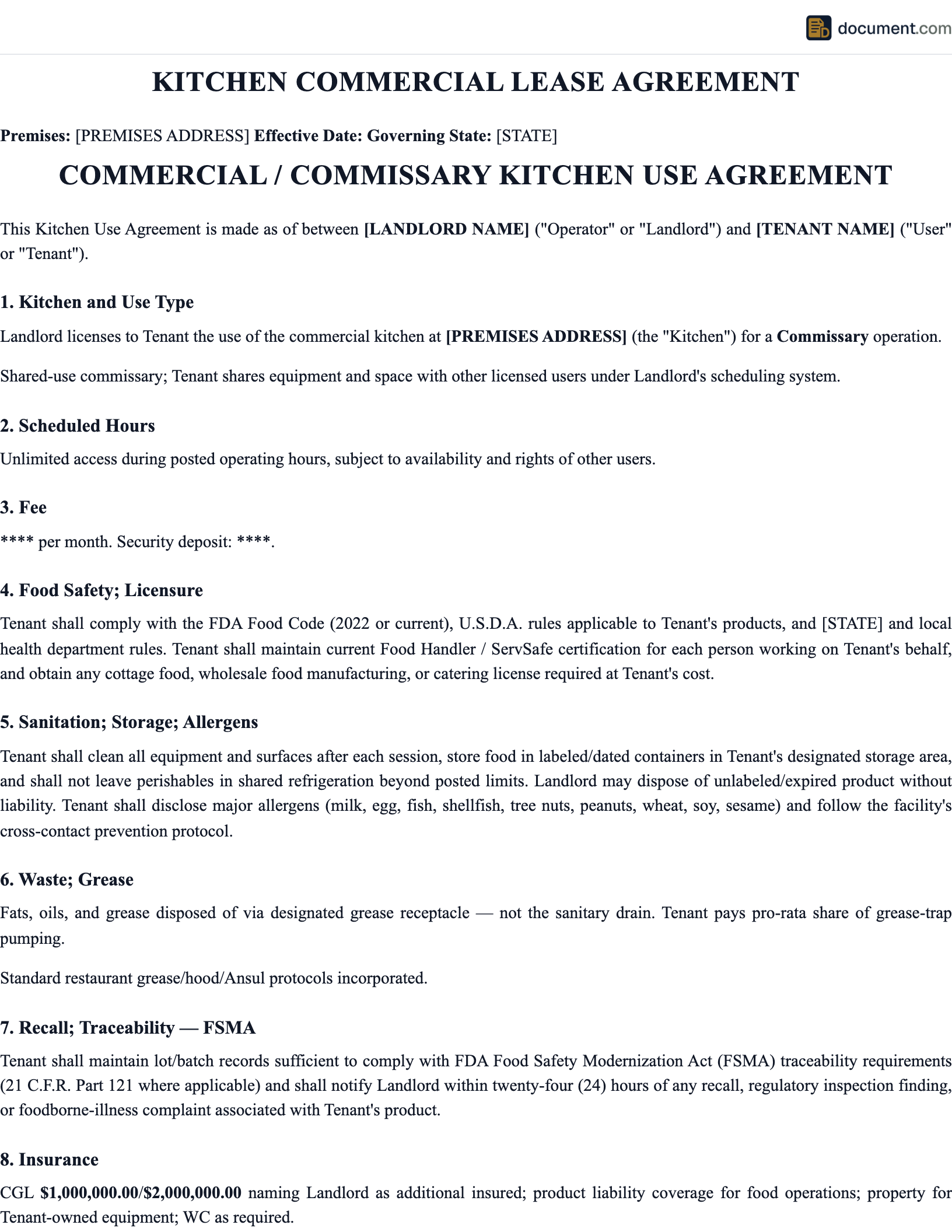
Sample New Hampshire Kitchen Lease Agreement
Below is a preview of our New Hampshire-specific template. Your customized document will include all fields and provisions required for filing in any New Hampshire county.
KITCHEN LEASE AGREEMENT
STATE OF NEW HAMPSHIRE
Legal Document Template
FACILITY OWNER
Name: [Full Legal Name]
Facility: [Kitchen Name]
Address: [Facility Address]
KITCHEN TENANT
Name: [Full Legal Name / Business]
Business Type: [Restaurant/Catering/Production]
Health Permit #: [Number]
KITCHEN SPECIFICATIONS
Total SF: [Square Feet]
Schedule: [Days/Hours]
Equipment: [See Inventory Addendum]
Storage: [Allocated Space]
FINANCIAL TERMS
Monthly Rent: $[Amount]
Schedule Rate: $[Amount]/hour
Security Deposit: $[Amount]
Equipment Deposit: $[Amount]
New Hampshire Kitchen Lease Agreement FAQ
Answers to common questions about filing a kitchen lease agreement in New Hampshire, including requirements, fees, and procedures.
Official New Hampshire Resources
Use these official state resources to verify requirements, find your local filing office, and access government forms for New Hampshire.
Related New Hampshire Documents
Depending on your situation, you may need additional documents alongside your New Hampshire kitchen lease agreement.
Create your New Hampshire Commercial Kitchen Lease Agreement in under 5 minutes.
Answer a few questions and download a New Hampshire-compliant document, ready for the state agency.