
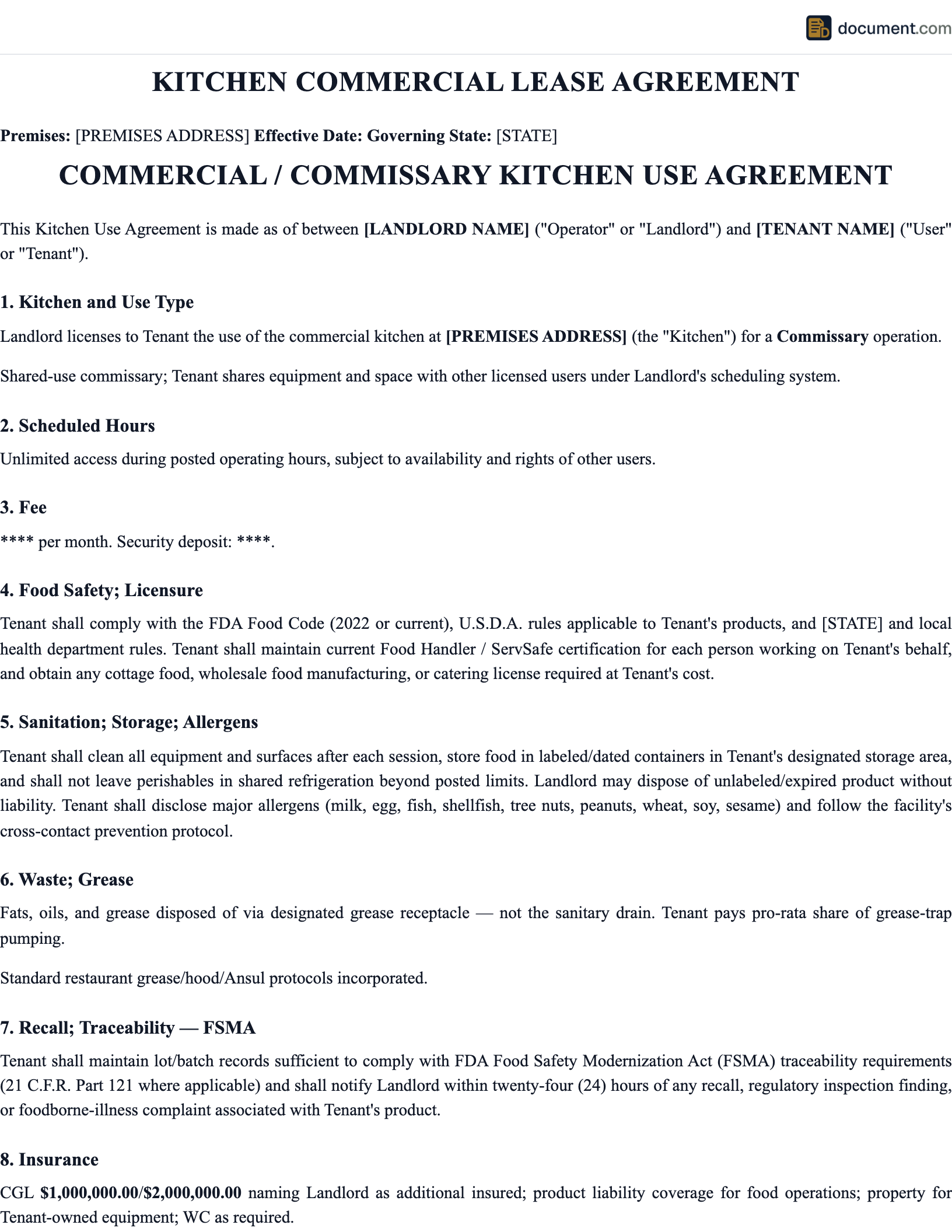



Nevada Kitchen Lease Agreement Overview
Nevada's shared commercial kitchen market is most active in Clark County, where Las Vegas's 24-hour food culture, massive catering industry, and delivery-focused ghost kitchen market have created consistent demand for licensed commissary space. Ghost kitchen operators serving late-night delivery demand, catering businesses serving casino events, and food entrepreneurs scaling up from home production all compete for shared kitchen access in the Las Vegas metro. Reno has a smaller but growing shared kitchen market driven by the Tahoe region's event catering needs and Reno's expanding food scene.
Nevada kitchen leases operate in a county health district framework rather than a statewide licensing structure. In Clark County, the Southern Nevada Health District licenses the commissary facility and issues individual permits to each food business using the kitchen. SNHD is among the more active health districts in the western US, with regular inspections and strict temperature and sanitation standards. The extreme Las Vegas heat makes cold chain compliance a practical concern that goes beyond paper compliance. A Nevada kitchen lease that does not address cold storage, temperature monitoring, and equipment maintenance creates real health code exposure for both the facility operator and kitchen tenants.
$25
Filing fee
Required
Notarization
0
Witnesses required
County
Filing office
Nevada Requirements
A Nevada kitchen lease must address the county health district licensing framework, cold storage requirements given the desert climate, prep schedule access, equipment ownership, and insurance obligations. The SNHD framework in Clark County is more demanding than what kitchen tenants encounter in most other western states.
Nevada Specific Note
SNHD in Clark County issues food establishment permits to each business operating from a shared kitchen, not just to the facility. Each ghost kitchen or catering tenant must hold its own SNHD permit at the commissary address. SNHD pre-opening inspections are required for new permit applicants, and scheduling delays are common. Factor SNHD permit timing into your kitchen lease start date and include a permit contingency clause.
Document Requirements
- SNHD/County Health Permit Verification: Confirm the facility holds a current county health district food establishment permit and attach the permit number and expiration date to the lease
- Individual Tenant Permit Obligation: Specify that kitchen tenants must obtain their own county health district food establishment permits and that the operator will provide commissary authorization documentation for the application
- Cold Storage and Temperature Monitoring: Allocate specific refrigerated and frozen storage space per tenant with documented temperature log requirements and equipment maintenance responsibilities
- 24-Hour Access Provisions: Specify whether the facility operates 24 hours and how overnight and weekend prep access is allocated and priced among tenants
- Insurance Requirements: Require each tenant to maintain general liability and product liability insurance naming the facility operator as additional insured, with minimum limits appropriate for the tenant's operation scale
How to Execute a Nevada Kitchen Lease
Executing a Nevada kitchen lease requires both legal and health district regulatory steps. In Clark County, allow for SNHD scheduling timelines when planning your production start date.
Verify the Facility Permit and Inspection History
Confirm the kitchen holds a current, active SNHD or county health district food establishment permit. Request the most recent inspection report. Any Class A or B violations are material to the lease negotiation since outstanding violations can slow your own permit application.
Inspect Cold Storage and Equipment
Tour the facility with attention to refrigeration capacity, freezer space, temperature logging systems, and sanitation stations. Nevada's heat makes refrigeration reliability critical. Document all equipment and create a signed inventory addendum.
Execute the Lease with Permit Contingency
Sign the lease with a clear permit contingency that delays your obligation to pay rent until your county health district food establishment permit is issued. Execute the main lease, prep schedule addendum, and equipment inventory at the same time.
Apply for Your SNHD or County Health Permit
Submit your food establishment permit application to SNHD (Clark County) or the applicable county health district. The facility operator should provide a commissary authorization letter. Schedule the pre-opening inspection promptly; SNHD inspection slots book out and delays are common during busy periods.
Secure Insurance and Begin Production
Obtain general liability and product liability insurance naming the facility operator as additional insured. Deliver the certificate before your first prep session. Display your health permit as required and keep all documentation accessible in the kitchen during your scheduled use.
Nevada Tax Implications for Kitchen Leases
Nevada has no state income tax, which is a significant advantage for kitchen tenants running food production businesses. Business profits from food production operations in Nevada are not subject to state income tax. Larger operations with Nevada gross revenue above $4 million may be subject to the Nevada Commerce Tax, but most shared kitchen food entrepreneurs operate well below that threshold.
Nevada imposes sales tax on prepared food and most food sold to end consumers. Food products sold to restaurants or retailers at wholesale may qualify for a resale exemption. Kitchen tenants should confirm with the Nevada Department of Taxation how their specific product sales are classified and maintain proper exemption certificates for all wholesale transactions.
Kitchen lease payments are deductible as ordinary business expenses. Equipment purchased by tenants and used in the kitchen may qualify for Section 179 expensing or federal bonus depreciation. Since Nevada has no income tax, the federal treatment is the primary tax impact for most kitchen tenants operating as sole proprietors or pass-through entities.
Important Considerations for Nevada Kitchen Tenants
The Las Vegas shared kitchen market has unique dynamics that result from the city's 24-hour culture and massive hospitality industry. Ghost kitchen operators serving app-based delivery platforms compete for overnight and early morning prep slots. Event catering businesses serving casino banquet facilities need large-capacity production windows that standard shared kitchen schedules may not accommodate. If your production model has specific timing requirements, confirm that the kitchen's schedule can actually support your business before signing a lease.
Nevada's extreme summer heat creates refrigeration risk that most shared kitchen leases do not address adequately. Walk-in cooler failures in summer can result in rapid product losses exceeding the value of a month's rent. The lease should specify the minimum acceptable refrigeration equipment performance standards, the landlord's repair response timeline, and how product loss from equipment failure is handled when the failure is the landlord's responsibility.
Reno's shared kitchen market is simpler and less competitive. Washoe County District Health has a less complex permitting process than SNHD, and the Reno food entrepreneur community is tight-knit. Kitchen operators in Reno often have more scheduling flexibility and simpler lease terms than those in the Las Vegas market.
SNHD Consultation Recommended for Clark County
Before signing a Clark County kitchen lease, contact SNHD directly to confirm the facility's permit status and understand the specific permit requirements for your food production category. SNHD staff are generally helpful in pre-application conversations and can save significant time by clarifying requirements before you commit to a facility and begin the formal permit process.
Nevada Fees & Costs
Below is a breakdown of the typical costs associated with filing this document in Nevada. Actual fees may vary by county.
| Fee / Cost | Amount |
|---|---|
| Filing Fee | $25 first page |
| Notarization | $5 - $25 per signature |
| Certified Copy | $1 - $10 per page |
| Attorney Review (optional) | $150 - $500 |
Sample Nevada Kitchen Lease Agreement
Below is a preview of our Nevada-specific template. Your customized document will include all fields and provisions required for filing in any Nevada county.
KITCHEN LEASE AGREEMENT
STATE OF NEVADA
Legal Document Template
FACILITY OWNER
Name: [Full Legal Name]
Facility: [Kitchen Name]
Address: [Facility Address]
KITCHEN TENANT
Name: [Full Legal Name / Business]
Business Type: [Restaurant/Catering/Production]
Health Permit #: [Number]
KITCHEN SPECIFICATIONS
Total SF: [Square Feet]
Schedule: [Days/Hours]
Equipment: [See Inventory Addendum]
Storage: [Allocated Space]
FINANCIAL TERMS
Monthly Rent: $[Amount]
Schedule Rate: $[Amount]/hour
Security Deposit: $[Amount]
Equipment Deposit: $[Amount]
Nevada Kitchen Lease Agreement FAQ
Answers to common questions about filing a kitchen lease agreement in Nevada, including requirements, fees, and procedures.
Official Nevada Resources
Use these official state resources to verify requirements, find your local filing office, and access government forms for Nevada.
Related Nevada Documents
Depending on your situation, you may need additional documents alongside your Nevada kitchen lease agreement.
Create your Nevada Commercial Kitchen Lease Agreement in under 5 minutes.
Answer a few questions and download a Nevada-compliant document, ready for the state agency.