
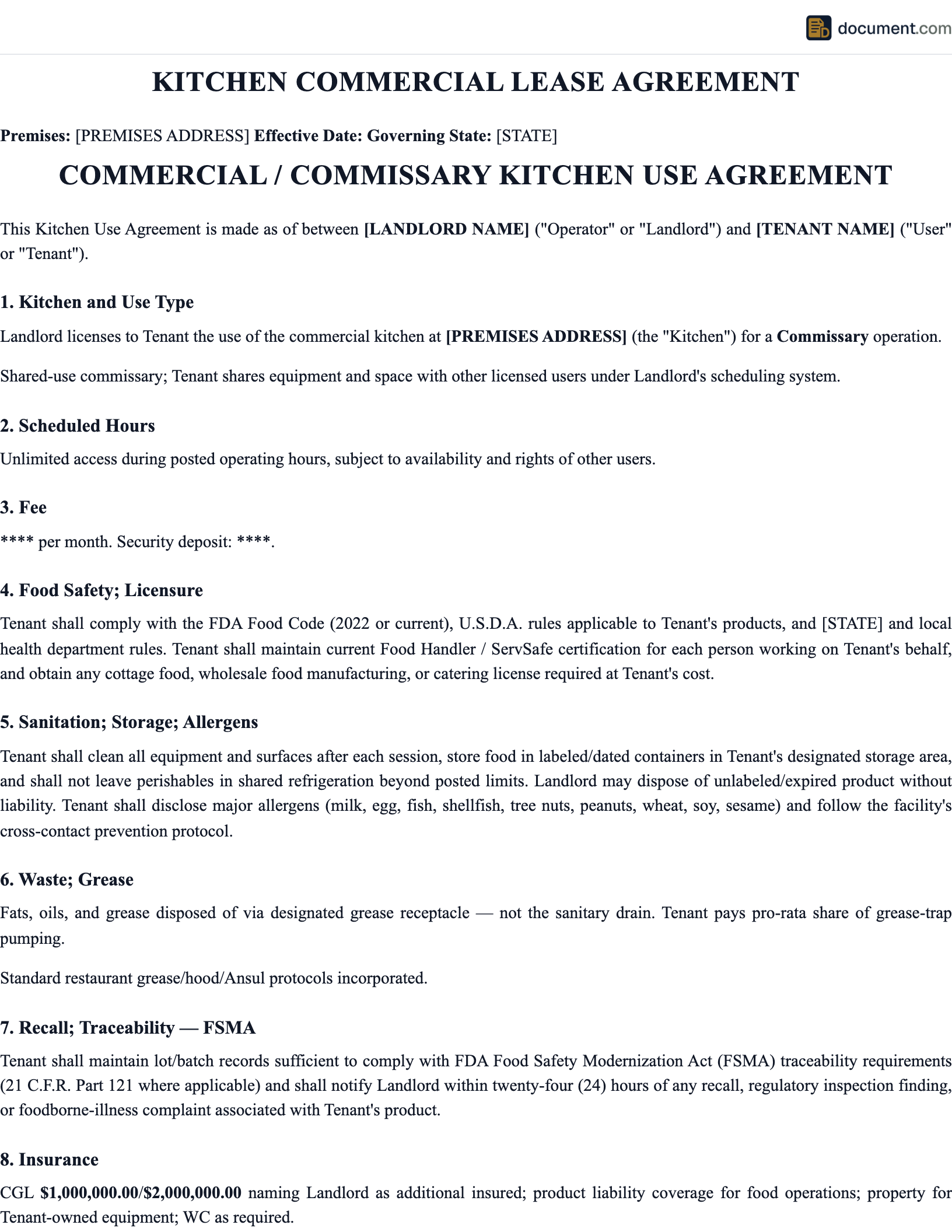



Nebraska Kitchen Lease Agreement Overview
Nebraska's shared commercial kitchen market has expanded alongside the growth of food entrepreneurship in Omaha and Lincoln. Ghost kitchens, catering operations, food truck commissaries, and cottage food businesses scaling up have all contributed to demand for licensed shared kitchen space. A Nebraska kitchen lease is a distinct agreement from a standard commercial lease, built around NDHHS food service licensing, prep schedule access, cold storage, and equipment maintenance obligations that are specific to food production environments.
The Nebraska Department of Health and Human Services licenses shared kitchens as retail food establishments under the Nebraska Pure Food Act. The facility operator holds the primary license; individual kitchen tenants typically need their own NDHHS food establishment licenses tied to the facility address as a commissary. Nebraska does not have a cottage food exemption that broadly covers commercial shared kitchen use, so understanding the licensing requirement for each type of food business before signing a kitchen lease is important. A lease that does not address the NDHHS licensing framework creates confusion about who is responsible for what when inspectors arrive.
$10
Filing fee
Required
Notarization
0
Witnesses required
Register
Filing office
Nebraska Requirements
A Nebraska kitchen lease must clearly address the NDHHS licensing framework, prep schedule access, cold storage allocation, equipment ownership, and insurance requirements. A generic commercial lease is not adequate for a food production environment where regulatory compliance is ongoing and facility-level licensing affects every tenant.
Nebraska Specific Note
Nebraska NDHHS expects individual kitchen tenants operating from a commissary to hold their own food establishment licenses. The facility operator's license does not automatically cover each tenant's production activities. Confirm the licensing structure with your local NDHHS district office before commencing operations, as inspectors will ask each tenant for their own license documentation.
Document Requirements
- NDHHS Commissary License Status: Confirm the facility holds a current NDHHS retail food establishment license and attach a copy as a lease exhibit
- Tenant License Requirements: Specify that kitchen tenants must obtain their own NDHHS food establishment licenses and that the facility operator will provide necessary documentation for the application
- Cold Storage Allocation: Define each tenant's allocated refrigerator and freezer space by cubic feet or labeled shelf area with temperature compliance responsibilities
- Prep Schedule Addendum: Attach a signed schedule specifying guaranteed weekly access hours and the process for requesting additional time
- Equipment Inventory: Document all facility-owned equipment available for tenant use, maintenance responsibilities, and tenant's rights to install and remove their own equipment
How to Execute a Nebraska Kitchen Lease
Executing a Nebraska kitchen lease requires both legal and regulatory steps. Complete these in sequence to avoid gaps in licensing or access rights.
Verify the Facility's NDHHS License
Confirm the kitchen holds an active NDHHS retail food establishment license in good standing. Request the most recent inspection report and confirm there are no outstanding corrective action orders. This is a non-negotiable starting point before committing to the lease.
Inspect Equipment and Storage
Tour the facility and document available equipment, refrigeration, storage space, and sanitation stations. Take photographs and create an inventory that becomes the equipment addendum to the lease.
Execute the Lease with Addenda
Sign the main lease agreement along with the prep schedule addendum and equipment inventory at the same time. Keep signed originals of all documents together as a single package.
Apply for Your NDHHS License
Submit your NDHHS retail food establishment license application using the commissary address. The facility operator should provide a commissary authorization letter for your application. Nebraska NDHHS processes applications through district offices; the Lincoln and Omaha districts handle the majority of urban applications.
Secure Insurance and Begin Prep
Obtain general liability and product liability insurance naming the facility operator as additional insured. Provide a certificate of insurance before your first scheduled prep session. Keep all documents accessible in the kitchen during your scheduled use periods.
Nebraska Tax Implications for Kitchen Leases
Nebraska imposes a 5.5% state sales tax on prepared food sold to consumers, but products sold at wholesale to restaurants or retailers may qualify for resale exemptions. Kitchen tenants producing packaged goods for wholesale distribution should confirm with the Nebraska Department of Revenue whether their specific product sales qualify for the resale exemption and document all exempt transactions properly.
Kitchen lease payments are deductible as ordinary business expenses for tenant operators. Equipment that tenants purchase and use in the kitchen may be eligible for Section 179 expensing or bonus depreciation at the federal level. Nebraska conforms to federal income tax treatment for most business expenses, so the Nebraska income tax impact generally mirrors the federal treatment.
Facility operators who receive rental income from kitchen tenants report that income as ordinary business income on their Nebraska returns. If the shared kitchen is part of a larger commercial building with pass-through property tax provisions, confirm whether kitchen tenant lease rates include a property tax component and document that clearly in the lease agreement.
Important Considerations for Nebraska Kitchen Tenants
Omaha and Lincoln have active food entrepreneurship communities, and shared kitchen demand in both cities has grown. The most common friction points in Nebraska kitchen leases involve prep schedule conflicts between multiple tenants, unclear cold storage boundaries, and disputes over who is responsible for equipment that breaks during a tenant's scheduled session. A well-drafted lease addresses all three of these before they become problems.
Agricultural and artisan food producers from rural Nebraska increasingly use Omaha and Lincoln shared kitchens to scale production for regional retail accounts. These producers may have intermittent rather than weekly prep needs. If your usage pattern is seasonal or project-based, negotiate a flexible scheduling arrangement rather than a fixed monthly prep block that you may not fully use.
Nebraska's farmers market and food festival scene creates significant demand for commissary-based production. Confirm with your local NDHHS district office that commissary-based production qualifies for all the sales channels you intend to use, including temporary food service events where some counties issue separate temporary permits distinct from the commissary license.
NDHHS Consultation Recommended
Before signing a Nebraska kitchen lease, a direct conversation with your local NDHHS district food safety office clarifies exactly what license your operation needs and whether the facility qualifies as your commissary. This is free, takes under an hour, and prevents the cost of a delayed or denied license application.
Nebraska Fees & Costs
Below is a breakdown of the typical costs associated with filing this document in Nebraska. Actual fees may vary by county.
| Fee / Cost | Amount |
|---|---|
| Filing Fee | $10 first page + $6/additional |
| Notarization | $5 - $25 per signature |
| Certified Copy | $1 - $10 per page |
| Attorney Review (optional) | $150 - $500 |
Sample Nebraska Kitchen Lease Agreement
Below is a preview of our Nebraska-specific template. Your customized document will include all fields and provisions required for filing in any Nebraska county.
KITCHEN LEASE AGREEMENT
STATE OF NEBRASKA
Legal Document Template
FACILITY OWNER
Name: [Full Legal Name]
Facility: [Kitchen Name]
Address: [Facility Address]
KITCHEN TENANT
Name: [Full Legal Name / Business]
Business Type: [Restaurant/Catering/Production]
Health Permit #: [Number]
KITCHEN SPECIFICATIONS
Total SF: [Square Feet]
Schedule: [Days/Hours]
Equipment: [See Inventory Addendum]
Storage: [Allocated Space]
FINANCIAL TERMS
Monthly Rent: $[Amount]
Schedule Rate: $[Amount]/hour
Security Deposit: $[Amount]
Equipment Deposit: $[Amount]
Nebraska Kitchen Lease Agreement FAQ
Answers to common questions about filing a kitchen lease agreement in Nebraska, including requirements, fees, and procedures.
Official Nebraska Resources
Use these official state resources to verify requirements, find your local filing office, and access government forms for Nebraska.
Related Nebraska Documents
Depending on your situation, you may need additional documents alongside your Nebraska kitchen lease agreement.
Create your Nebraska Commercial Kitchen Lease Agreement in under 5 minutes.
Answer a few questions and download a Nebraska-compliant document, ready for the state agency.