



Montana Kitchen Lease Agreement Overview
Montana has seen real growth in shared commercial kitchens and ghost kitchen concepts over the past several years, particularly in Bozeman and Missoula where food entrepreneurship has accelerated alongside population growth. A kitchen lease in Montana is a specialized commercial agreement that goes well beyond a standard office or retail lease. It must address Montana DPHHS licensing structure, equipment ownership, prep schedules, cold storage allocation, and liability between the facility operator and each kitchen tenant.
Montana's Department of Public Health and Human Services licenses shared commercial kitchens under ARM Title 37. The facility license covers the physical kitchen, but each individual food business operating from that kitchen typically needs its own food establishment license tied to the address. This layered licensing structure creates specific obligations that should be addressed explicitly in every Montana kitchen lease. A kitchen lease that ignores the DPHHS framework creates compliance risk for both the facility operator and the individual kitchen tenants.
$12
Filing fee
Required
Notarization
0
Witnesses required
County
Filing office
Montana Requirements
A Montana kitchen lease must account for the state's food service licensing framework, equipment standards, and the practical realities of operating in a multi-user food production environment. Unlike a standard commercial lease, the regulatory layer here is significant and facility-specific.
Montana Specific Note
Montana DPHHS requires the commissary facility to maintain its own retail food establishment license. Individual kitchen tenants in most cases need separate DPHHS licenses tied to the facility address. Confirm the licensing structure with your local DPHHS district office before executing the lease, as requirements can vary by county health district.
Document Requirements
- DPHHS Commissary Certification: The lease should identify which party holds the facility's DPHHS retail food establishment license and confirm the facility is currently in good standing
- Tenant License Obligations: Specify whether kitchen tenants must obtain their own separate DPHHS food establishment licenses and who assists with the application address documentation
- Cold Storage Allocation: Document each tenant's dedicated refrigerated and frozen storage space by cubic feet or labeled shelf area with temperature monitoring obligations
- Prep Schedule and Access Hours: Attach a schedule addendum specifying each tenant's guaranteed weekly access hours and the procedure for requesting additional time
- Equipment Inventory and Responsibility: Attach a signed equipment inventory identifying which items are landlord-owned versus tenant-owned, with assigned maintenance responsibilities for each
How to Execute a Montana Kitchen Lease
Setting up a kitchen lease in Montana requires coordinating the legal agreement with the regulatory licensing process. These steps should happen largely in parallel to avoid delays.
Verify the Facility License Status
Confirm that the kitchen facility holds a current, active DPHHS retail food establishment license. Request a copy of the most recent inspection report. Any outstanding violations or corrective action orders are material to the lease negotiation.
Document Equipment and Cold Storage
Walk the facility with the operator and document all available equipment, refrigeration, and storage space. Photograph and inventory what is included in your lease. This becomes the binding equipment addendum to the lease.
Execute the Lease with All Addenda
Sign the main lease agreement along with the prep schedule addendum and equipment inventory addendum at the same time. All documents should be dated consistently and initialed by both parties.
Apply for Your DPHHS Food Establishment License
Submit your Montana DPHHS retail food establishment license application using the commissary address. The facility operator should provide a letter confirming your authorized use of the kitchen. Processing times vary by district; Gallatin County has seen longer timelines with population growth.
Obtain Insurance and Begin Operations
Secure a general liability and product liability policy naming the facility operator as additional insured. Provide a certificate of insurance before your first scheduled prep session. Keep the license, lease, and insurance documents accessible at the facility.
Montana Tax Implications for Kitchen Leases
Montana has no general sales tax, which benefits food producers selling products at retail. Revenue from food products made in a shared kitchen and sold to grocery retailers, restaurants, or at farmers markets is not subject to a Montana state sales tax, unlike neighboring states that apply sales tax to food sales. This simplifies pricing and recordkeeping for Montana-based food entrepreneurs.
Kitchen lease payments are generally deductible as ordinary business expenses for tenant operators. Equipment purchased by the tenant and installed in a leased kitchen may be eligible for Section 179 expensing or bonus depreciation under federal rules. Montana conforms to federal income tax treatment for most business expenses, so Montana income tax treatment follows federal in most cases.
Facility operators who receive lease income from kitchen tenants report that income as ordinary business income. If the kitchen facility is part of a larger commercial property with triple-net provisions, understand what property tax portion passes through to kitchen tenants versus what the facility operator absorbs.
Important Considerations for Montana Kitchen Tenants
Shared kitchen operators in Montana serve a wide range of users: caterers, food truck operators, meal prep delivery businesses, cottage food producers scaling up, and ghost kitchen delivery concepts. Each use type has different prep schedule needs, storage requirements, and licensing exposure. A kitchen lease should be specific enough to accommodate your actual operations rather than using generic shared-use language.
Montana's cottage food law (MCA 50-50-116) allows certain home-based food production without a commercial kitchen license, but the exemption is limited by product type and annual revenue. Food businesses that have grown beyond the cottage food exemption and are transitioning to a licensed commercial kitchen should confirm with DPHHS which products require the licensed kitchen and structure lease hours accordingly.
Cold-climate storage outside the kitchen presents a separate concern in Montana. Some rural kitchen facilities use outdoor or unheated storage structures that can create food safety compliance issues during winter months. Confirm that all cold chain requirements are met year-round before signing a long-term kitchen lease.
DPHHS Consultation Recommended
Before signing a Montana kitchen lease, a brief consultation with your local DPHHS district food safety officer can clarify exactly what license your operation needs and whether the facility qualifies as your commissary. This conversation costs nothing and can prevent a delayed or denied license application.
Montana Fees & Costs
Below is a breakdown of the typical costs associated with filing this document in Montana. Actual fees may vary by county.
| Fee / Cost | Amount |
|---|---|
| Filing Fee | $12 per page |
| Notarization | $5 - $25 per signature |
| Certified Copy | $1 - $10 per page |
| Attorney Review (optional) | $150 - $500 |
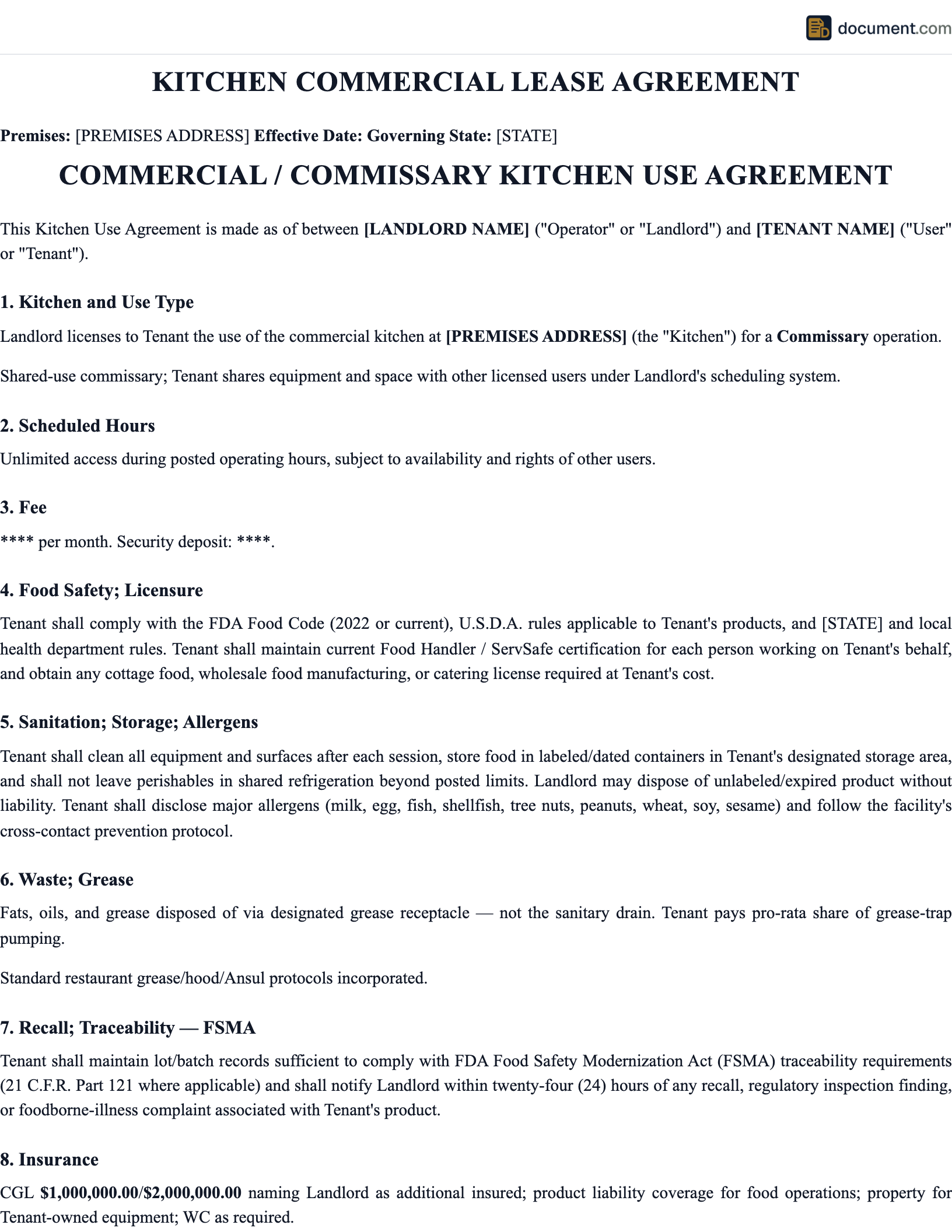
Sample Montana Kitchen Lease Agreement
Below is a preview of our Montana-specific template. Your customized document will include all fields and provisions required for filing in any Montana county.
KITCHEN LEASE AGREEMENT
STATE OF MONTANA
Legal Document Template
FACILITY OWNER
Name: [Full Legal Name]
Facility: [Kitchen Name]
Address: [Facility Address]
KITCHEN TENANT
Name: [Full Legal Name / Business]
Business Type: [Restaurant/Catering/Production]
Health Permit #: [Number]
KITCHEN SPECIFICATIONS
Total SF: [Square Feet]
Schedule: [Days/Hours]
Equipment: [See Inventory Addendum]
Storage: [Allocated Space]
FINANCIAL TERMS
Monthly Rent: $[Amount]
Schedule Rate: $[Amount]/hour
Security Deposit: $[Amount]
Equipment Deposit: $[Amount]
Montana Kitchen Lease Agreement FAQ
Answers to common questions about filing a kitchen lease agreement in Montana, including requirements, fees, and procedures.
Official Montana Resources
Use these official state resources to verify requirements, find your local filing office, and access government forms for Montana.
Related Montana Documents
Depending on your situation, you may need additional documents alongside your Montana kitchen lease agreement.
Create your Montana Commercial Kitchen Lease Agreement in under 5 minutes.
Answer a few questions and download a Montana-compliant document, ready for the state agency.