
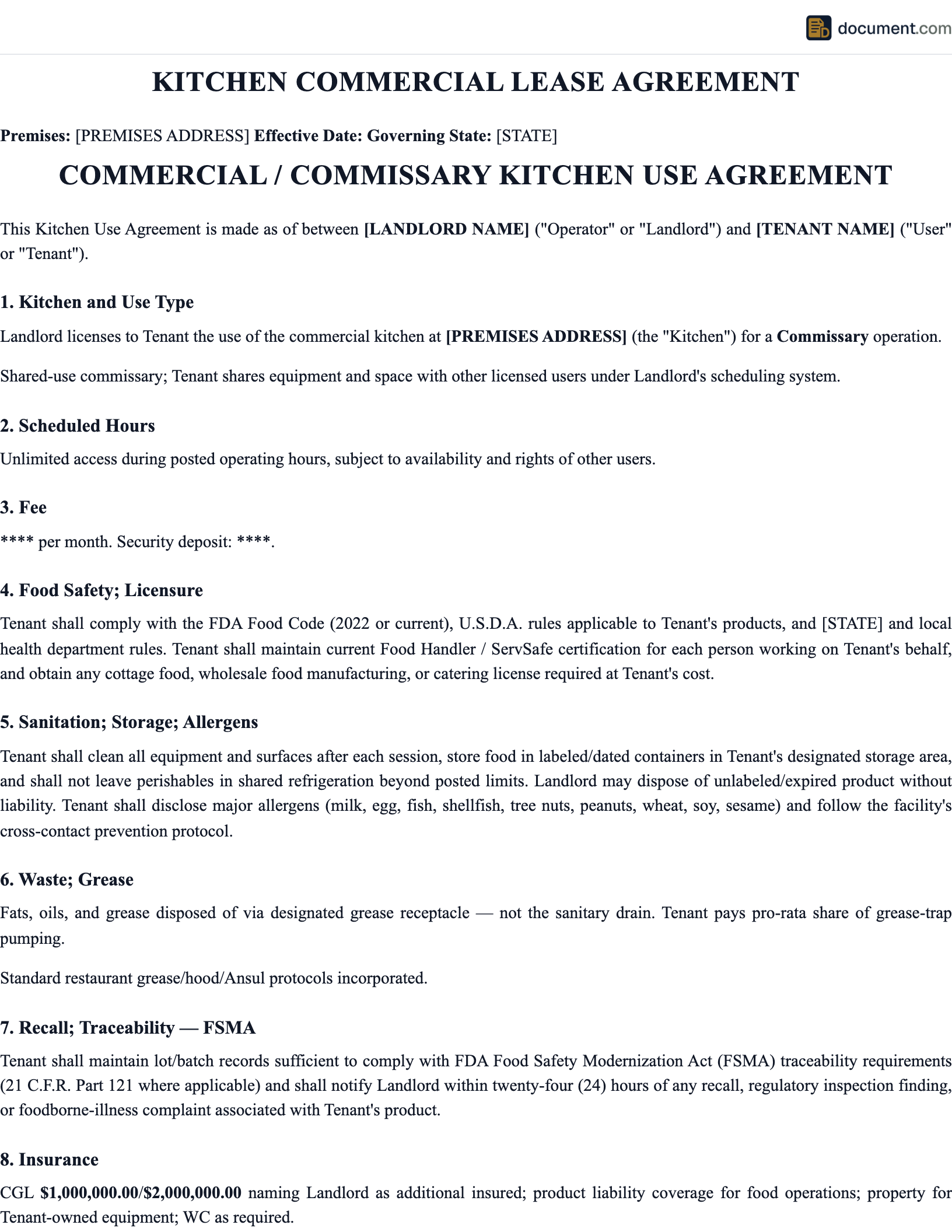



Missouri Kitchen Lease Agreement Overview
Missouri's shared kitchen and ghost kitchen market is concentrated in Kansas City and St. Louis, where the growth of food delivery platforms, an active food truck culture, and demand from barbecue caterers and specialty food producers has created steady demand for licensed commissary and shared production space. Kansas City's food scene, with its nationally recognized barbecue tradition and growing craft food sector, generates catering production demand that often requires more commissary capacity than a single restaurant kitchen can provide. St. Louis's diverse culinary scene supports ghost kitchen growth in midtown and South City, where food delivery demand is strong and restaurant real estate costs create an incentive for delivery-focused operators to use shared kitchen space instead of full buildout.
Missouri shared kitchen leases must navigate food establishment licensing through either the Missouri Department of Health and Senior Services or a local health department, depending on the kitchen's location. Kansas City and St. Louis City have their own health departments that handle food establishment licensing directly. In other Missouri jurisdictions, DHSS handles licensing. Kitchens that serve as commissaries for food trucks must execute written commissary agreements with truck operators, and those agreements become part of the food truck's licensing documentation. A well-drafted Missouri kitchen lease should address DHSS or local health department compliance responsibilities, commissary status documentation, cold storage maintenance, fire suppression compliance, and access scheduling in enough detail to protect both parties if a regulatory issue or equipment failure arises.
$24
Filing fee
Required
Notarization
0
Witnesses required
Recorder
Filing office
Missouri Requirements
Missouri shared kitchen leases must account for food establishment licensing by DHSS or the local health department, commissary agreement requirements for food truck tenants, NFPA 96 fire suppression compliance, cold storage maintenance obligations, and access scheduling provisions. These operational details determine whether the lease actually supports the tenant's business.
Missouri DHSS and Commissary Licensing Notice
In Missouri, food establishment licensing for shared kitchens is handled by the Missouri Department of Health and Senior Services in areas without a local health department, and by the Kansas City or St. Louis City health departments in those jurisdictions. If you plan to use a shared kitchen as a commissary for a food truck or mobile food unit, the commissary agreement must be executed in writing and submitted to the relevant health department as part of the food truck licensing process. Confirm the kitchen holds a current food establishment license and whether its designation covers commissary use before executing any lease.
Document Requirements
- Food Establishment License Verification: Confirm the kitchen holds a current Missouri food establishment license from either DHSS or the applicable local health department before signing; the lease should address what happens if the license lapses or is suspended during your tenancy
- Commissary Agreement for Food Trucks: If the kitchen will serve as your food truck commissary, negotiate the commissary agreement concurrently with the lease; the lease should specify who maintains the commissary documentation DHSS or the local health department requires and how the tenant is protected if the commissary designation is revoked
- Fire Suppression and Hood Inspection: Request documentation of the most recent NFPA 96-compliant hood suppression inspection; confirm who pays for ongoing cleaning and inspection costs during the lease term, particularly for shared equipment
- Cold Storage Maintenance: The lease should specify landlord responsibility for cold storage equipment maintenance, temperature monitoring protocols, emergency response procedures for equipment failures, and whether the landlord or tenant bears liability for product loss due to refrigeration failure
- Access Schedule: Define minimum guaranteed access hours per week or month, priority booking rights for peak production periods, conflict resolution procedures, and whether unused scheduled time is forfeited or can be rolled over
How to File in Missouri
Executing a Missouri shared kitchen lease requires verifying the facility's food establishment license status, negotiating commissary agreement terms if you operate a food truck, establishing a clear access schedule, and documenting the arrangement thoroughly enough to protect your business if the kitchen's permit status or equipment conditions change.
Verify Food Establishment License and Commissary Status
Before negotiating lease terms, confirm that the kitchen holds a current food establishment license. In Kansas City, contact the Kansas City Health Department. In St. Louis City, contact the St. Louis City Health Division. In other Missouri jurisdictions, confirm license status with the Missouri Department of Health and Senior Services. If you plan to use the kitchen as a commissary for a food truck, verify that the kitchen's license and operational setup support commissary designation and that the kitchen operator is willing to execute the written commissary agreement required for your food truck license.
Negotiate Equipment Access and Cold Storage Provisions
Identify which equipment is included in your rental access and negotiate maintenance responsibilities explicitly. For Kansas City barbecue catering operations that need high-output smoking or cooking capacity, confirm the kitchen's hood suppression system is rated for your cooking equipment and that the landlord approves any equipment you intend to bring into the space. Negotiate cold storage maintenance provisions, temperature monitoring protocols, and remedies for product loss from refrigeration failure. Confirm the NFPA 96 hood inspection is current and agree on who pays for ongoing inspections and duct cleaning during the term.
Establish Your Access Schedule
Define your scheduled access hours with specificity. For Missouri catering operations, peak demand often runs Wednesday through Saturday, with pre-event preparation windows that may start as early as midnight on weekend event days. The lease should guarantee minimum access hours per week, specify priority booking rights for peak production windows, define the conflict resolution process when multiple tenants compete for the same time slots, and address whether unused scheduled time is forfeited or can be credited toward future use.
Execute the Lease and Commissary Agreement
Missouri commercial kitchen leases do not require notarization for enforceability between the parties, though notarization is required to record the lease at the Recorder of Deeds for constructive notice. Execute the lease and, if applicable, the commissary agreement simultaneously. The commissary agreement should be in final form before signing the lease, since it will be submitted to the health department as part of your food truck licensing documentation. Confirm the commissary agreement meets the current requirements of the applicable health department before submission.
Maintain Regulatory and Operational Records
Keep copies of the kitchen's food establishment license, your commissary agreement, hood inspection and fire suppression service records, cold storage temperature logs, your scheduled access records, and all lease documents throughout the term. Missouri health departments may request commissary documentation during food truck renewal inspections, and maintaining a complete records file ensures you can respond quickly. If a dispute arises with the kitchen operator over access, equipment failures, or health department compliance, a thorough contemporaneous record is your primary protection.
Missouri Fees & Costs
Below is a breakdown of the typical costs associated with filing this document in Missouri. Actual fees may vary by county.
| Fee / Cost | Amount |
|---|---|
| Filing Fee | $24 first page |
| Notarization | $5 - $25 per signature |
| Certified Copy | $1 - $10 per page |
| Attorney Review (optional) | $150 - $500 |
Sample Missouri Kitchen Lease Agreement
Below is a preview of our Missouri-specific template. Your customized document will include all fields and provisions required for filing in any Missouri county.
KITCHEN LEASE AGREEMENT
STATE OF MISSOURI
Legal Document Template
FACILITY OWNER
Name: [Full Legal Name]
Facility: [Kitchen Name]
Address: [Facility Address]
KITCHEN TENANT
Name: [Full Legal Name / Business]
Business Type: [Restaurant/Catering/Production]
Health Permit #: [Number]
KITCHEN SPECIFICATIONS
Total SF: [Square Feet]
Schedule: [Days/Hours]
Equipment: [See Inventory Addendum]
Storage: [Allocated Space]
FINANCIAL TERMS
Monthly Rent: $[Amount]
Schedule Rate: $[Amount]/hour
Security Deposit: $[Amount]
Equipment Deposit: $[Amount]
Missouri Kitchen Lease Agreement FAQ
Answers to common questions about filing a kitchen lease agreement in Missouri, including requirements, fees, and procedures.
Official Missouri Resources
Use these official state resources to verify requirements, find your local filing office, and access government forms for Missouri.
Related Missouri Documents
Depending on your situation, you may need additional documents alongside your Missouri kitchen lease agreement.
Create your Missouri Commercial Kitchen Lease Agreement in under 5 minutes.
Answer a few questions and download a Missouri-compliant document, ready for the state agency.