
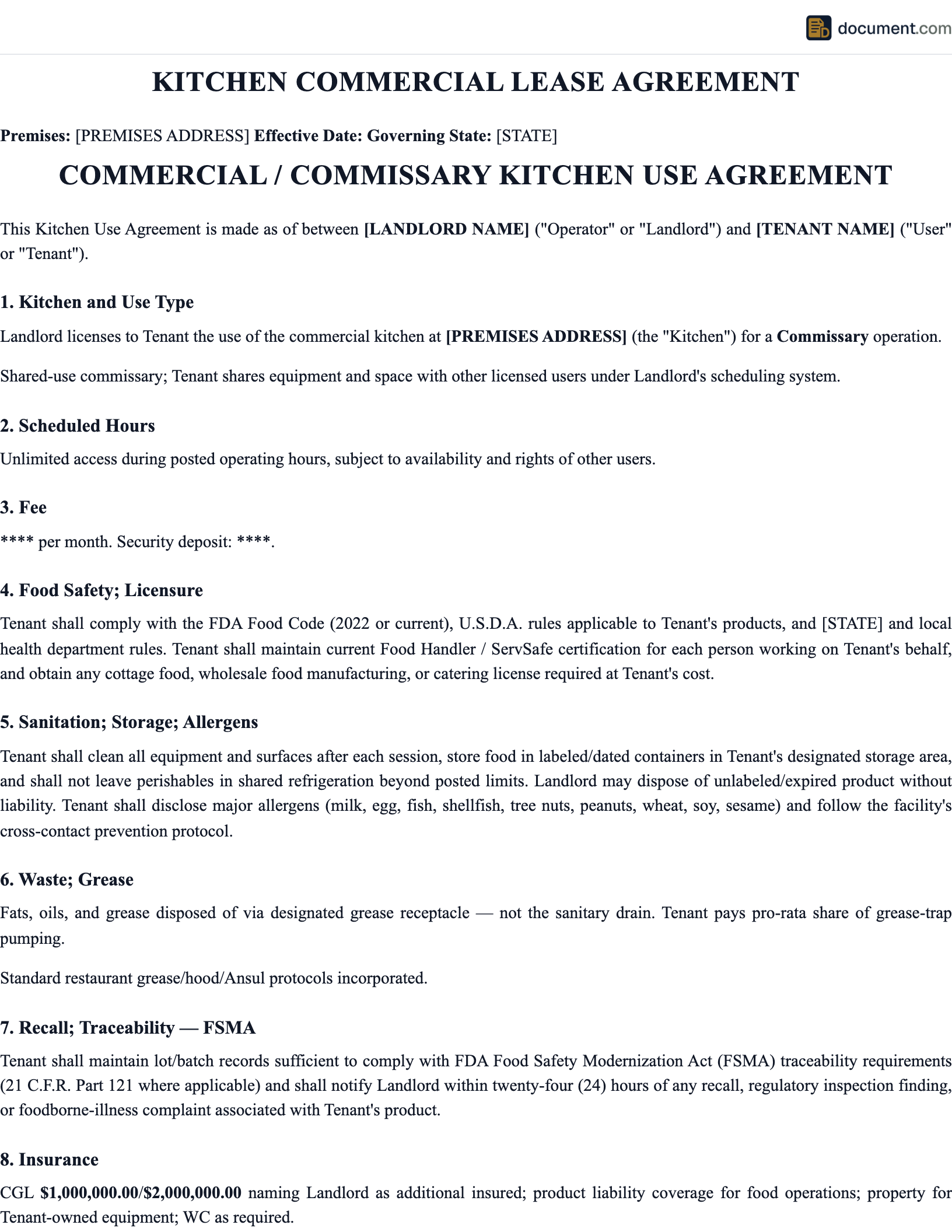



Minnesota Kitchen Lease Agreement Overview
Minnesota's commercial kitchen market is driven by a diverse food production sector, a substantial catering industry serving both corporate and event markets, and the unique seasonal demand spike created by the Minnesota State Fair. The Minnesota Department of Agriculture licenses commercial kitchen facilities statewide, while Minneapolis and St. Paul city health departments handle permitting within their jurisdictions. Food truck operators throughout the Twin Cities metro must use licensed commissary kitchens, which creates consistent demand for well-run shared kitchen facilities with flexible access structures.
A Minnesota kitchen lease should address MDA or city health permit obligations, commissary status for food truck operator tenants, cold storage allocation with attention to Minnesota's cold climate equipment considerations, fire suppression compliance under Minnesota State Fire Code and NFPA 96, and the scheduling structure for multi-tenant access. Minnesota's Statute of Frauds requires written leases for terms over one year, making a thorough written agreement essential for any ongoing commercial kitchen arrangement.
$46
Filing fee
Required
Notarization
0
Witnesses required
County
Filing office
Minnesota Requirements
Minnesota kitchen leases must address MDA or city health permit obligations, commissary status for food truck and mobile vendor tenants, cold storage reliability given Minnesota's climate, fire suppression compliance, and the access scheduling structure. Getting these provisions right protects both the facility operator and the tenants who depend on the kitchen's license status to operate legally.
Minnesota MDA Licensing and Commissary Notice
Minnesota commercial kitchen facilities must be licensed by the Minnesota Department of Agriculture (or city health departments in Minneapolis and St. Paul). Food truck operators who use the kitchen as a commissary must have a written commissary agreement with the licensed facility. A lapse in the kitchen's MDA license directly affects every food truck tenant's ability to operate under their mobile food unit license.
Key Lease Provisions
- MDA or City Health License: Confirm the facility holds a current food establishment license and specify the landlord's obligation to maintain it throughout the lease term
- Commissary Status: Confirm whether the kitchen is registered as an approved commissary and address the landlord's obligation to maintain that status for food truck tenants
- Cold Storage Reliability: Specify minimum temperature requirements for refrigeration and freezer units, who repairs failed equipment, and how product loss is handled if cold storage fails during a tenant's shift
- Fire Suppression: Allocate responsibility for semi-annual hood suppression inspections and cleaning under Minnesota State Fire Code and NFPA 96
- Access Scheduling: Define the shift structure, notice requirements for schedule changes, conflict resolution process, and fee structure for overtime or peak-season access
How to Execute a Minnesota Kitchen Lease
Executing a Minnesota commercial kitchen lease starts with verifying the facility's MDA or city health license status and commissary eligibility, then building the operational provisions that govern day-to-day multi-tenant use.
Verify MDA or City Health License and Commissary Status
Confirm the facility holds a current food establishment license from MDA or the applicable city health department. If the kitchen will serve food truck operators, verify it is registered as an approved commissary on MDA's or the city's approved list.
Negotiate Equipment and Cold Storage Terms
Identify which equipment the landlord provides and which the tenant brings. For cold storage, specify minimum temperature obligations, who maintains and repairs each unit, and how product loss due to equipment failure is handled. Consider Minnesota winter conditions when addressing outdoor loading and storage areas.
Set Up the Access Schedule
Establish the shift or block booking system, notice requirements for changes, conflict resolution process, and overtime booking rates. For kitchens near the State Fairgrounds, consider how the late-August fair season affects access demand and pricing.
Execute the Lease
Both parties sign the Minnesota kitchen lease. Under Minnesota's Statute of Frauds, leases exceeding one year must be in writing to be enforceable. Notarization is not required for the lease to be enforceable between the parties, but is needed if a memorandum of lease will be recorded at the County Recorder.
Maintain All License and Inspection Records
Keep the executed lease, MDA or city health department license and renewal records, inspection reports, commissary agreements with food truck tenants, and fire suppression service records throughout the lease term. These are essential for license renewals and any regulatory review of the facility.
Minnesota Fees & Costs
Below is a breakdown of the typical costs associated with filing this document in Minnesota. Actual fees may vary by county.
| Fee / Cost | Amount |
|---|---|
| Filing Fee | $46 per document |
| Notarization | $5 - $25 per signature |
| Certified Copy | $1 - $10 per page |
| Attorney Review (optional) | $150 - $500 |
Sample Minnesota Kitchen Lease Agreement
Below is a preview of our Minnesota-specific template. Your customized document will include all fields and provisions required for filing in any Minnesota county.
KITCHEN LEASE AGREEMENT
STATE OF MINNESOTA
Legal Document Template
FACILITY OWNER
Name: [Full Legal Name]
Facility: [Kitchen Name]
Address: [Facility Address]
KITCHEN TENANT
Name: [Full Legal Name / Business]
Business Type: [Restaurant/Catering/Production]
Health Permit #: [Number]
KITCHEN SPECIFICATIONS
Total SF: [Square Feet]
Schedule: [Days/Hours]
Equipment: [See Inventory Addendum]
Storage: [Allocated Space]
FINANCIAL TERMS
Monthly Rent: $[Amount]
Schedule Rate: $[Amount]/hour
Security Deposit: $[Amount]
Equipment Deposit: $[Amount]
Minnesota Kitchen Lease Agreement FAQ
Answers to common questions about filing a kitchen lease agreement in Minnesota, including requirements, fees, and procedures.
Official Minnesota Resources
Use these official state resources to verify requirements, find your local filing office, and access government forms for Minnesota.
Related Minnesota Documents
Depending on your situation, you may need additional documents alongside your Minnesota kitchen lease agreement.
Create your Minnesota Commercial Kitchen Lease Agreement in under 5 minutes.
Answer a few questions and download a Minnesota-compliant document, ready for the state agency.