



Massachusetts Kitchen Lease Agreement Overview
Massachusetts has one of the more active ghost kitchen and shared commercial kitchen markets in the Northeast, driven by Boston's dense delivery market and the large student and young professional population in the metro area. The state's food establishment permitting system runs through local boards of health rather than a central state agency, which means licensing requirements for shared kitchen facilities vary depending on whether you are in Boston, Cambridge, Somerville, or a smaller city.
A Massachusetts kitchen lease needs to address commissary certification status, cold storage allocation among multiple users, fire suppression inspection obligations under 527 CMR, and the mechanism for scheduling access across multiple tenants. Chapter 93A of the Massachusetts General Laws gives commercial kitchen tenants meaningful recourse against landlords who misrepresent the space's regulatory status or equipment condition. Documenting the kitchen's permit history and equipment condition before signing protects both parties.
$75
Filing fee
Required
Notarization
0
Witnesses required
Registry
Filing office
Massachusetts Requirements
Massachusetts kitchen leases must address permitting, scheduling, equipment ownership, and fire code compliance. Getting these provisions right from the beginning avoids disputes when a tenant's health permit depends on the kitchen's commissary status.
Massachusetts Commissary and Board of Health Notice
Massachusetts food establishment permits are issued by local boards of health, not a central state agency. If the kitchen is used as an approved commissary by food truck operators or caterers, the lease must confirm its licensed commissary status and the landlord's obligation to maintain that status throughout the lease term. Losing commissary certification mid-lease can put multiple sub-tenants out of compliance.
Key Lease Provisions
- Commissary Status: Confirm whether the kitchen is a licensed commissary with the local board of health and specify the landlord's obligation to maintain that approval
- Access Schedule: Define the shift structure, booking mechanism, conflict resolution process, and what notice a tenant must give to modify a scheduled block
- Cold Storage Allocation: Specify which refrigeration and freezer units each tenant uses, who maintains them, and what happens if a unit fails during a tenant's shift
- Fire Suppression: Under 527 CMR, hood suppression systems require semi-annual inspections. The lease must allocate who schedules and pays for these inspections
- Health Permit Cooperation: Require the landlord to cooperate with board of health inspections and maintain building systems in the condition required to pass those inspections
How to Execute a Massachusetts Kitchen Lease
Executing a Massachusetts kitchen lease involves confirming the space's regulatory status, negotiating operational provisions, and setting up the access structure before tenants begin using the kitchen.
Verify the Kitchen's Permit and Commissary Status
Confirm with the local board of health that the space holds a valid food establishment permit and, if needed, that it is registered as an approved commissary. Request copies of recent inspection reports before signing.
Negotiate Equipment and Storage Terms
Identify which equipment the landlord provides, which the tenant provides, and who handles repair and replacement. For cold storage specifically, define minimum temperature obligations and who bears the cost if a unit fails during the tenant's scheduled shift.
Set Up the Access Schedule
Establish the shift or block booking system, the process for requesting additional time, and how conflicts between tenants are resolved. Include an overtime or flex booking rate if you expect demand to exceed the base schedule regularly.
Execute the Lease
Both parties sign the lease. Massachusetts commercial kitchen leases do not require notarization to be enforceable, but if you plan to record a memorandum of lease at the Registry of Deeds to protect the tenant's interest, notarization is required for recording.
Maintain Permit and Inspection Records
Keep copies of the executed lease, the kitchen's food establishment permit, board of health inspection reports, and fire suppression service records. Chapter 93A claims may arise later in the tenancy, and a paper trail of the kitchen's condition and permit status at signing is valuable protection.
Massachusetts Fees & Costs
Below is a breakdown of the typical costs associated with filing this document in Massachusetts. Actual fees may vary by county.
| Fee / Cost | Amount |
|---|---|
| Filing Fee | $75 first page |
| Notarization | $5 - $25 per signature |
| Certified Copy | $1 - $10 per page |
| Attorney Review (optional) | $150 - $500 |
Sample Massachusetts Kitchen Lease Agreement
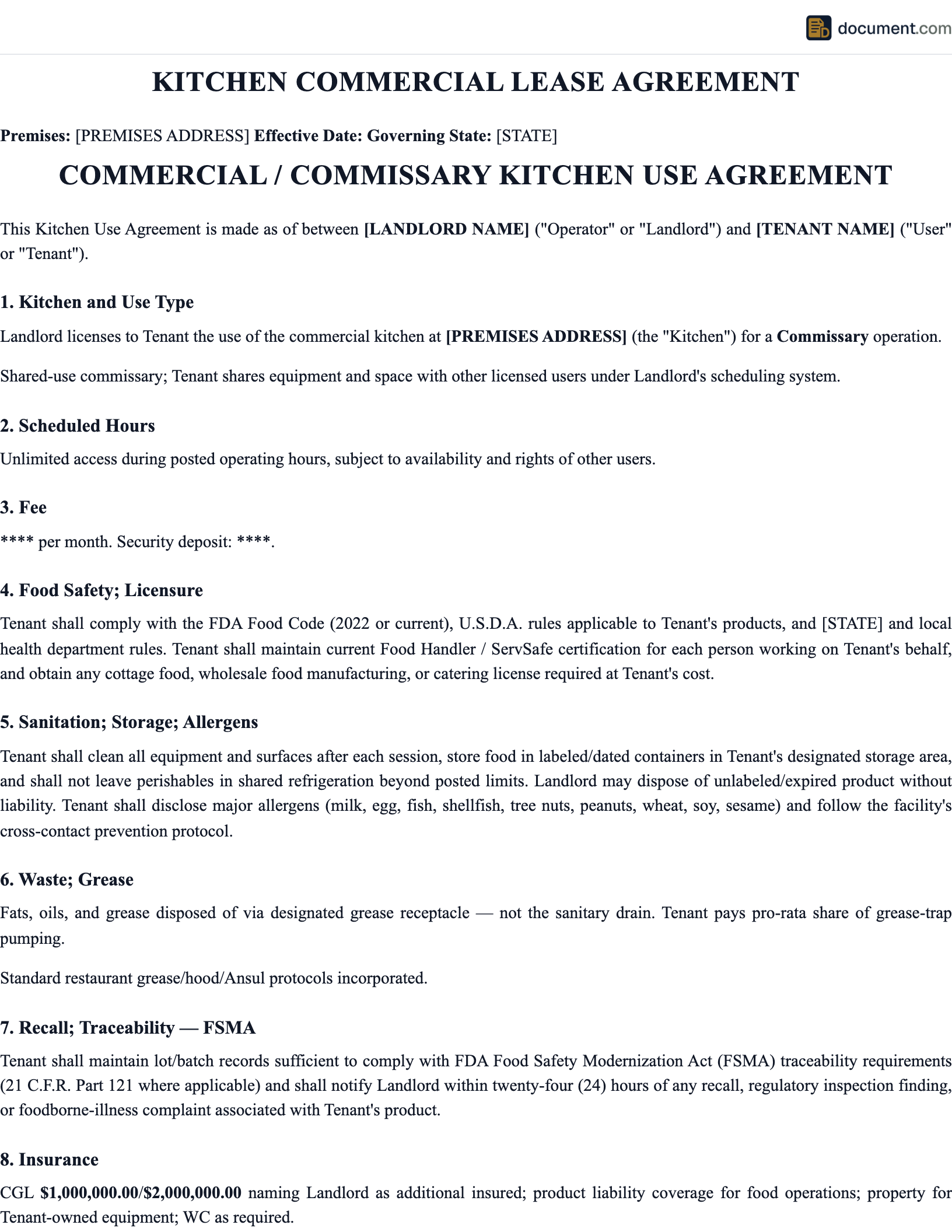
Below is a preview of our Massachusetts-specific template. Your customized document will include all fields and provisions required for filing in any Massachusetts county.
KITCHEN LEASE AGREEMENT
STATE OF MASSACHUSETTS
Legal Document Template
FACILITY OWNER
Name: [Full Legal Name]
Facility: [Kitchen Name]
Address: [Facility Address]
KITCHEN TENANT
Name: [Full Legal Name / Business]
Business Type: [Restaurant/Catering/Production]
Health Permit #: [Number]
KITCHEN SPECIFICATIONS
Total SF: [Square Feet]
Schedule: [Days/Hours]
Equipment: [See Inventory Addendum]
Storage: [Allocated Space]
FINANCIAL TERMS
Monthly Rent: $[Amount]
Schedule Rate: $[Amount]/hour
Security Deposit: $[Amount]
Equipment Deposit: $[Amount]
Massachusetts Kitchen Lease Agreement FAQ
Answers to common questions about filing a kitchen lease agreement in Massachusetts, including requirements, fees, and procedures.
Official Massachusetts Resources
Use these official state resources to verify requirements, find your local filing office, and access government forms for Massachusetts.
Related Massachusetts Documents
Depending on your situation, you may need additional documents alongside your Massachusetts kitchen lease agreement.
Create your Massachusetts Commercial Kitchen Lease Agreement in under 5 minutes.
Answer a few questions and download a Massachusetts-compliant document, ready for the state agency.