



Maine Kitchen Lease Agreement Overview
Maine's shared and ghost kitchen market has grown steadily alongside the state's food truck scene, its expanding catering industry, and the pop-up food brands that emerge each summer to serve coastal tourist traffic. Portland anchors the year-round market, with a concentration of commissary kitchens that serve caterers, meal-kit producers, and mobile food operators working the city and the surrounding Cumberland County area. Seasonal markets in York County, along the Midcoast, and in Downeast Maine see sharp demand spikes from May through October, when food businesses rush to secure licensed prep space ahead of tourist season.
The regulatory framework for shared kitchens in Maine runs through the Department of Agriculture, Conservation and Forestry (DACF), Division of Quality Assurance and Regulations. The facility itself must hold a DACF food establishment license covering the space and equipment, and each individual tenant must obtain their own separate DACF license naming the commissary address. If you operate a mobile food unit, the lease must authorize commissary use so your truck can be licensed from that address. Maine does not impose a statewide sales tax on commercial lease payments, which simplifies cost calculations compared to states that tax rent. Any tenant operating in Maine must also register with the Maine Revenue Services for sales tax collection on food sold at retail.
$13
Filing fee
Required
Notarization
0
Witnesses required
Registry
Filing office
Maine Requirements
Maine has specific requirements for this type of legal document. Meeting these requirements ensures your document is accepted by the registry of deeds and is legally enforceable.
DACF Facility License Must Stay Current
Your ability to operate legally depends on the kitchen facility's DACF food establishment license remaining in good standing. If the owner allows the facility license to lapse, your individual tenant license loses its legal foundation and DACF can require you to stop food production until the facility license is reinstated. Before signing, review the facility's current license status through the DACF licensing portal and include a lease provision requiring the owner to maintain the facility license throughout the lease term.
Document Requirements
- DACF Facility License: Verify the kitchen holds a current DACF food establishment license and include a lease provision requiring the owner to maintain it throughout the term
- Individual Tenant License: Each tenant must obtain a separate DACF food establishment license naming the commissary address before beginning food production
- Commissary Authorization: If you operate a mobile food unit, the lease must explicitly authorize commissary use so your truck can list the address on its DACF license application
- Scheduling Addendum: Attach a written scheduling addendum that specifies your guaranteed prep windows, particularly peak summer slots that fill quickly in coastal Maine markets
- Cold and Dry Storage: Document your allocated refrigerator, freezer, and dry storage space in writing, especially if your business handles seafood, dairy, or other perishables requiring precise temperature control
- Equipment Inventory: Require an equipment condition addendum at lease commencement so both parties have a documented baseline for damage and repair disputes
- Off-Season Operations: Confirm the facility's year-round operating plans and include provisions addressing winter maintenance, minimum heat levels, and what happens if the owner suspends operations during slow months
- Insurance Requirements: Obtain commercial general liability coverage at the levels specified in the lease, with the facility owner named as an additional insured, before your first prep session
How to Execute a Maine Shared Kitchen Lease
Executing a shared kitchen lease in Maine is less about government filings and more about regulatory coordination between you, the facility owner, and DACF. These steps walk through the process from initial due diligence to opening day.
Verify the Facility's DACF License and Inspection History
Before you negotiate, confirm the kitchen's current DACF food establishment license is active and review any recent inspection reports. A facility with recurring compliance violations is a risk. Contact the DACF Division of Quality Assurance and Regulations in Augusta to request the facility's inspection record if the owner does not provide it voluntarily.
Negotiate the Lease With Maine-Specific Addenda
Work out the scheduling addendum, storage allocation, equipment inventory, commissary authorization (if applicable), and off-season operational terms before the lease is drafted. Summer peak-season scheduling rights, winter facility maintenance obligations, and BABLO licensing provisions for alcohol if relevant to your operation should all be in writing before you sign.
Execute the Lease and Obtain Insurance
Both parties sign the lease agreement. Purchase your commercial general liability policy and any required catering or product liability endorsements, naming the facility owner as an additional insured. Maine does not require lease notarization or recording for shared kitchen arrangements, so execution is straightforward once the document is signed.
Apply for Your Individual DACF Food Establishment License
Submit your food establishment license application to DACF naming the commissary kitchen as your licensed address. DACF may conduct a facility inspection before issuing your license, and during tourist season inspection schedules back up, so apply early. If you operate a mobile food unit, submit your mobile unit license application at the same time listing the commissary address.
Register With Maine Revenue Services and Begin Operations
Register your business with Maine Revenue Services for sales tax collection on retail food sales if applicable. Obtain any required city or town business licenses for your municipality. Once your DACF license is issued and your insurance is in place, you are cleared to begin prep sessions per the schedule in your lease addendum.
Maine Fees & Costs
Below is a breakdown of the typical costs associated with filing this document in Maine. Actual fees may vary by county.
| Fee / Cost | Amount |
|---|---|
| Filing Fee | $13 first page |
| Notarization | $5 - $25 per signature |
| Certified Copy | $1 - $10 per page |
| Attorney Review (optional) | $150 - $500 |
Sample Maine Kitchen Lease Agreement
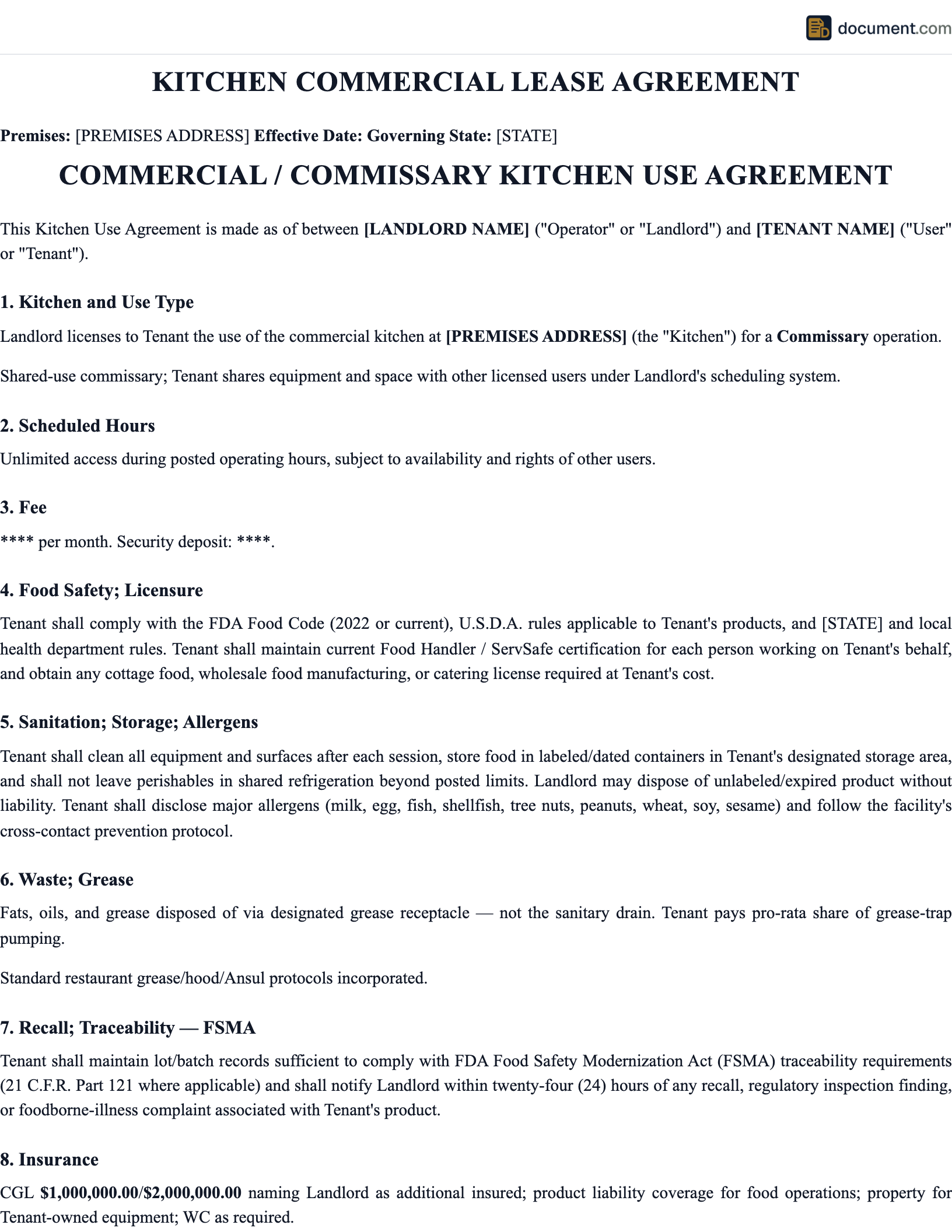
Below is a preview of our Maine-specific template. Your customized document will include all fields and provisions required for filing in any Maine county.
KITCHEN LEASE AGREEMENT
STATE OF MAINE
Legal Document Template
FACILITY OWNER
Name: [Full Legal Name]
Facility: [Kitchen Name]
Address: [Facility Address]
KITCHEN TENANT
Name: [Full Legal Name / Business]
Business Type: [Restaurant/Catering/Production]
Health Permit #: [Number]
KITCHEN SPECIFICATIONS
Total SF: [Square Feet]
Schedule: [Days/Hours]
Equipment: [See Inventory Addendum]
Storage: [Allocated Space]
FINANCIAL TERMS
Monthly Rent: $[Amount]
Schedule Rate: $[Amount]/hour
Security Deposit: $[Amount]
Equipment Deposit: $[Amount]
Maine Kitchen Lease Agreement FAQ
Answers to common questions about filing a kitchen lease agreement in Maine, including requirements, fees, and procedures.
Official Maine Resources
Use these official state resources to verify requirements, find your local filing office, and access government forms for Maine.
Related Maine Documents
Depending on your situation, you may need additional documents alongside your Maine kitchen lease agreement.
Create your Maine Commercial Kitchen Lease Agreement in under 5 minutes.
Answer a few questions and download a Maine-compliant document, ready for the state agency.