
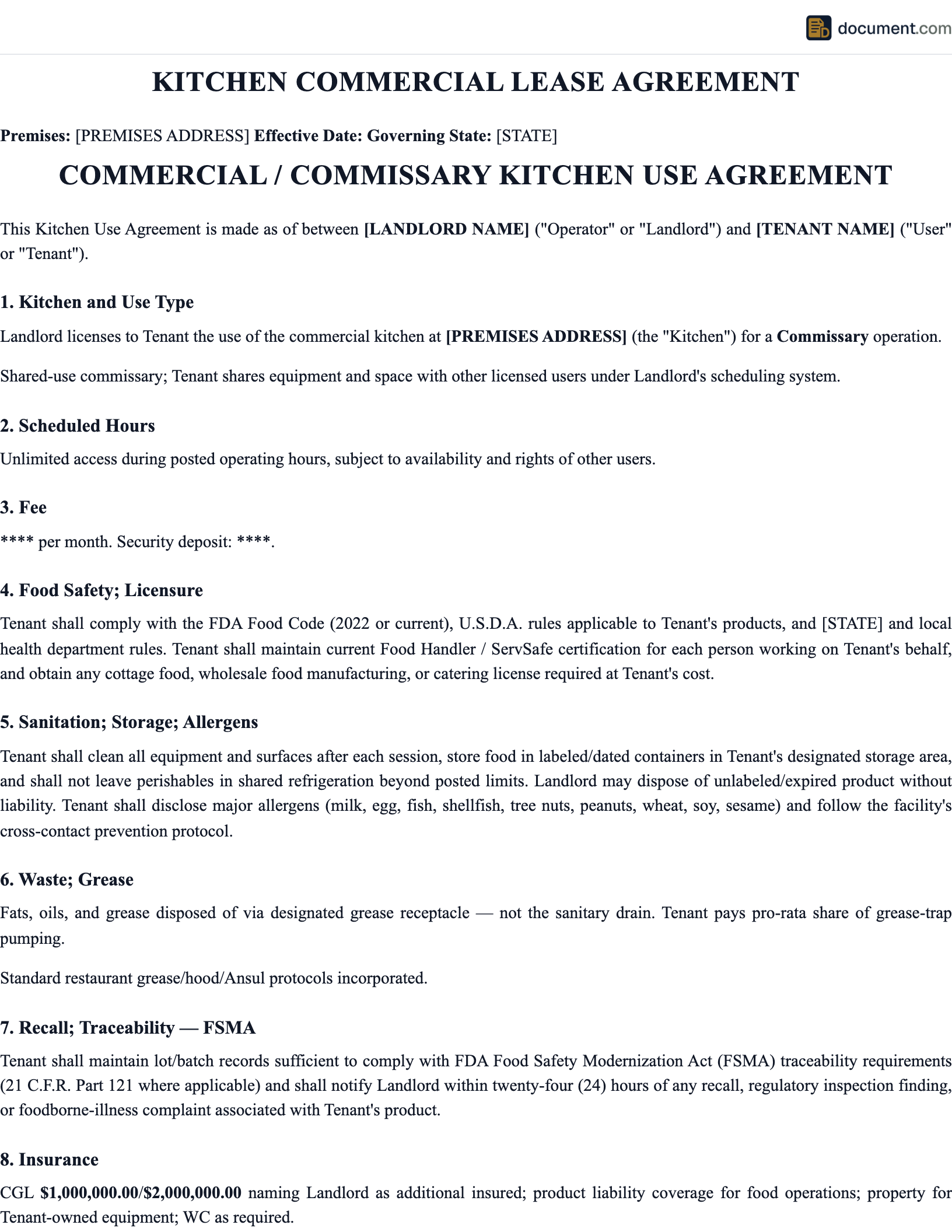



Louisiana Kitchen Lease Agreement Overview
Louisiana's shared kitchen market is driven by one of the most vibrant food cultures in the world. New Orleans in particular has a dense concentration of caterers, pop-up restaurants, specialty food producers, and food truck operators who rely on licensed commercial kitchen space as their operational base. The Louisiana Sanitary Code requires the LDH to license shared kitchen facilities as food service establishments, and every operator using the space needs their own individual permit. The civil law tradition that governs Louisiana commercial leases adds a layer of legal complexity that does not exist anywhere else in the country.
A Louisiana kitchen lease must address LDH facility licensing, individual tenant permit requirements, scheduling and cold storage for the high-volume and diverse tenant mix common in Louisiana shared kitchens, equipment liability, commissary designation for food truck and mobile food operators, and the civil code execution formalities of two witnesses and notarization. In New Orleans, the seasonal demand spikes around Mardi Gras and Jazz Fest create particular challenges for scheduling addenda and require explicit provisions about how peak-season conflicts between tenants are resolved.
$55
Filing fee
Required
Notarization
2
Witnesses required
Clerk
Filing office
Louisiana Shared Kitchen Lease Requirements
Louisiana shared kitchen leases face requirements that exist nowhere else in the country. The civil code execution formalities, LDH facility licensing obligations, and the diversity of the Louisiana food production tenant base all create a need for lease provisions that are more detailed than those used in common law states.
Two Witnesses Required for Valid Execution in Louisiana
Louisiana Civil Code requires two disinterested witnesses to be present and sign at the time the lease is executed. A shared kitchen lease executed without two witnesses may be unenforceable or unrecordable in Louisiana. This is not a recommendation; it is a mandatory civil code requirement. Arrange for two witnesses at every lease signing in Louisiana.
Key Provisions for Louisiana Kitchen Leases
- LDH Facility License Status: The lease should represent that the facility holds a current LDH food service establishment permit and require the owner to maintain it throughout the tenancy
- Individual Tenant Permit Obligation: Each tenant is responsible for their own LDH food service establishment permit; the lease should state this explicitly and confirm the facility license does not cover individual tenant operations
- Commissary Designation: For food truck and mobile food unit operators, the lease should confirm the facility qualifies as a commissary and include provisions for mobile unit equipment washing and supply storage
- Seasonal Scheduling for Mardi Gras and Jazz Fest: Include provisions for how schedule conflicts are resolved during Mardi Gras and Jazz Fest, when demand for shared kitchen space in New Orleans is at its peak
- Cold Storage Allocation: Attach a storage map assigning specific refrigeration and freezer compartments to each tenant; address seafood-specific cold storage needs for Louisiana cuisine operators
- Civil Code Compliance: The lease must be structured under Louisiana Civil Code lease principles, executed with two witnesses and a Louisiana notary, and should not use common law lease boilerplate
How to Execute a Louisiana Kitchen Lease
Setting up a Louisiana shared kitchen tenancy correctly requires following civil code execution formalities, verifying LDH licensing, and building detailed scheduling and storage addenda. These steps apply whether the facility is in New Orleans, Baton Rouge, or Lafayette.
Verify the Facility's LDH License and Inspection History
Before signing, request a copy of the facility's current LDH food service establishment permit and ask for the most recent inspection report. In Orleans Parish, the city health department handles inspections under a cooperative agreement with LDH. A facility with recent compliance violations or a pending inspection is a risk for any tenant operating inside it.
Draft the Lease Under Louisiana Civil Code with Full Addenda
Engage a Louisiana attorney to draft or review the lease. The lease must be drafted under Louisiana Civil Code principles and should include a scheduling addendum, a cold storage allocation map, and an equipment inventory with condition notes. For New Orleans facilities, the scheduling addendum should explicitly address Mardi Gras and Jazz Fest season conflicts.
Execute the Lease with Two Witnesses and a Louisiana Notary
Arrange for two disinterested witnesses to be present at the signing along with a Louisiana notary public. All parties, both witnesses, and the notary must sign. Each witness must provide their printed name and address. Do not sign a Louisiana lease without meeting these civil code requirements.
Apply for Your Individual LDH Food Service Permit
Submit your own food service establishment permit application to LDH or the applicable parish health department with the signed lease. For mobile food unit operators, submit documentation showing the shared kitchen as your commissary address on the mobile unit permit application. LDH will schedule a pre-operational inspection before issuing the permit.
Obtain Local Business Licenses and Begin Operations
Obtain any parish or city business licenses required in your jurisdiction. In Orleans Parish, this includes a city of New Orleans business license. Once your LDH individual permit is issued and local licenses are in hand, you can begin using the facility during your scheduled kitchen hours. Post your LDH permit visibly inside the facility as required by Louisiana law.
Louisiana Fees & Costs
Below is a breakdown of the typical costs associated with filing this document in Louisiana. Actual fees may vary by county.
| Fee / Cost | Amount |
|---|---|
| Filing Fee | $55 first page |
| Notarization | $5 - $25 per signature |
| Certified Copy | $1 - $10 per page |
| Attorney Review (optional) | $150 - $500 |
Sample Louisiana Kitchen Lease Agreement
Below is a preview of our Louisiana-specific template. Your customized document will include all fields and provisions required for filing in any Louisiana county.
KITCHEN LEASE AGREEMENT
STATE OF LOUISIANA
Legal Document Template
FACILITY OWNER
Name: [Full Legal Name]
Facility: [Kitchen Name]
Address: [Facility Address]
KITCHEN TENANT
Name: [Full Legal Name / Business]
Business Type: [Restaurant/Catering/Production]
Health Permit #: [Number]
KITCHEN SPECIFICATIONS
Total SF: [Square Feet]
Schedule: [Days/Hours]
Equipment: [See Inventory Addendum]
Storage: [Allocated Space]
FINANCIAL TERMS
Monthly Rent: $[Amount]
Schedule Rate: $[Amount]/hour
Security Deposit: $[Amount]
Equipment Deposit: $[Amount]
Louisiana Kitchen Lease Agreement FAQ
Answers to common questions about filing a kitchen lease agreement in Louisiana, including requirements, fees, and procedures.
Official Louisiana Resources
Use these official state resources to verify requirements, find your local filing office, and access government forms for Louisiana.
Related Louisiana Documents
Depending on your situation, you may need additional documents alongside your Louisiana kitchen lease agreement.
Create your Louisiana Commercial Kitchen Lease Agreement in under 5 minutes.
Answer a few questions and download a Louisiana-compliant document, ready for the state agency.