



Kentucky Kitchen Lease Agreement Overview
Kentucky's shared kitchen market is smaller than those in coastal states but growing steadily, particularly in Louisville, where a thriving catering and food truck industry has created demand for licensed commissary space, and in the bourbon trail corridor, where food tourism operators and artisan food producers need access to commercial kitchen facilities without the capital commitment of a buildout. The Cabinet for Health and Family Services licenses shared kitchen facilities the same way it licenses traditional restaurants, and every operator using the space needs their own individual food service permit.
A Kentucky kitchen lease must address CHFS facility licensing, individual tenant permit requirements, scheduling and cold storage allocation, equipment liability, commissary designation for catering and mobile food operations, and insurance requirements. Operators producing bourbon-infused or alcohol-adjacent food products may also need to address whether any KABC compliance applies to their specific product line. The lease should be precise about these obligations rather than leaving them to informal agreement between facility owner and tenant.
$32
Filing fee
Required
Notarization
0
Witnesses required
County
Filing office
Kentucky Shared Kitchen Lease Requirements
A Kentucky shared kitchen lease needs to address CHFS facility licensing, individual tenant permit obligations, scheduling, cold storage, equipment liability, and insurance requirements. A lease that covers only the basic rental terms leaves both facility owners and tenants exposed to significant operational and regulatory risk.
CHFS Facility Permit Must Stay Current
The Cabinet for Health and Family Services food service permit belongs to the facility owner. If the facility permit lapses or is suspended due to a failed inspection, every tenant inside the facility is effectively operating without a valid commissary, which can put their individual food service permits at risk. The lease should require the facility owner to notify tenants immediately of any CHFS compliance action and provide a rent abatement right if the facility cannot legally operate for more than a defined period.
Key Provisions for Kentucky Kitchen Leases
- CHFS Facility Permit Status: The lease should represent that the facility holds a current CHFS food service permit and require the owner to maintain it throughout the tenancy
- Individual Tenant Permit Obligation: Each tenant must obtain their own CHFS food service establishment permit; the lease should make this obligation explicit and confirm it is the tenant's sole responsibility
- Commissary Designation: For caterers and food truck operators, the lease should confirm the facility qualifies as a commissary and include provisions for equipment washing, supply storage, and mobile unit documentation
- Scheduling Addendum: Attach a schedule specifying assigned hours, equipment reservation procedures, and priority rules for high-demand periods
- Cold Storage Allocation: Attach a storage map assigning specific refrigeration and freezer compartments to each tenant, with temperature log responsibilities
- Equipment Inventory and Liability: Attach a signed equipment inventory with condition notes and specify tenant liability for damage caused by negligence
- Insurance Requirements: Require commercial general liability and product liability coverage with the facility owner named as additional insured, with certificates provided before first use
How to Execute a Kentucky Kitchen Lease
Setting up a Kentucky shared kitchen tenancy requires coordinating the lease with CHFS permit applications and local business licensing. These steps apply whether you are starting a ghost kitchen in Louisville or a catering commissary operation in the bourbon country region.
Verify the Facility's CHFS License Status
Before signing, request a copy of the facility's current CHFS food service establishment permit. Confirm the permit is active and there are no outstanding compliance orders or pending inspections. A facility under a CHFS compliance action is a serious operational risk for any tenant.
Negotiate the Lease with Scheduling and Storage Addenda
Draft the lease to include a scheduling addendum with your assigned hours and equipment access, a cold storage allocation addendum identifying your specific refrigeration compartments, and an equipment inventory addendum documenting the condition of all shared equipment you will use.
Execute the Lease and Obtain Insurance
Sign the lease and obtain commercial general liability and product liability coverage before your first use date. Provide the facility owner with a certificate of insurance naming them as additional insured. Kentucky food producers selling products to third parties should confirm their product liability limits are adequate for the volume they plan to produce.
Apply for Your Individual CHFS Food Service Permit
Submit your own food service establishment permit application to the local health department under CHFS, including the signed lease as proof of your right to use the facility. For mobile food unit operators, list the shared kitchen address as your commissary on the mobile unit permit application as well.
Obtain Local Business Licenses and Begin Operations
Obtain any city or county business licenses required in your jurisdiction. In Louisville Metro and Lexington-Fayette Urban County, local occupational license tax registration is required for businesses earning income in those jurisdictions. Once your CHFS permit is issued, you can begin using the facility during your assigned hours.
Kentucky Fees & Costs
Below is a breakdown of the typical costs associated with filing this document in Kentucky. Actual fees may vary by county.
| Fee / Cost | Amount |
|---|---|
| Filing Fee | $32 per document |
| Notarization | $5 - $25 per signature |
| Certified Copy | $1 - $10 per page |
| Attorney Review (optional) | $150 - $500 |
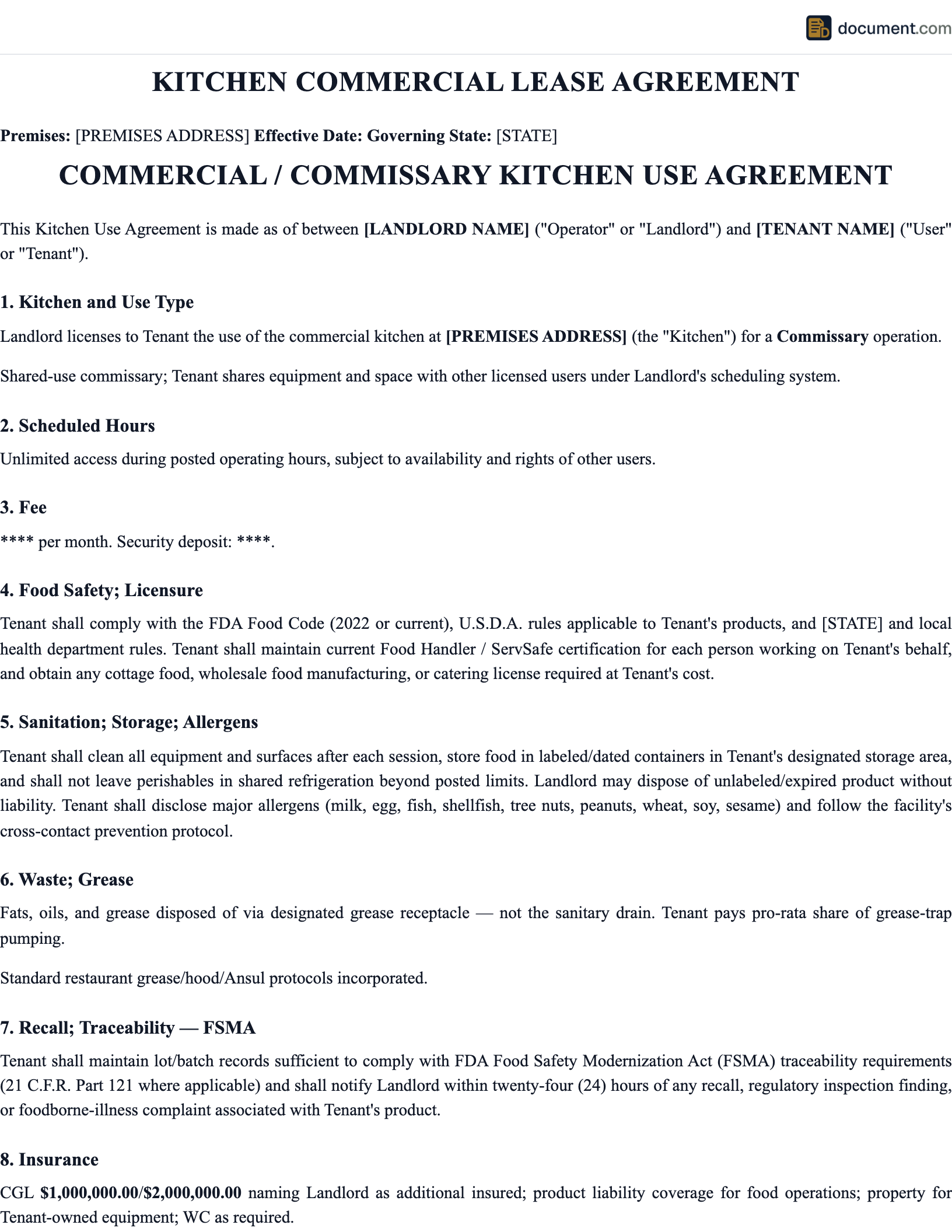
Sample Kentucky Kitchen Lease Agreement
Below is a preview of our Kentucky-specific template. Your customized document will include all fields and provisions required for filing in any Kentucky county.
KITCHEN LEASE AGREEMENT
STATE OF KENTUCKY
Legal Document Template
FACILITY OWNER
Name: [Full Legal Name]
Facility: [Kitchen Name]
Address: [Facility Address]
KITCHEN TENANT
Name: [Full Legal Name / Business]
Business Type: [Restaurant/Catering/Production]
Health Permit #: [Number]
KITCHEN SPECIFICATIONS
Total SF: [Square Feet]
Schedule: [Days/Hours]
Equipment: [See Inventory Addendum]
Storage: [Allocated Space]
FINANCIAL TERMS
Monthly Rent: $[Amount]
Schedule Rate: $[Amount]/hour
Security Deposit: $[Amount]
Equipment Deposit: $[Amount]
Kentucky Kitchen Lease Agreement FAQ
Answers to common questions about filing a kitchen lease agreement in Kentucky, including requirements, fees, and procedures.
Official Kentucky Resources
Use these official state resources to verify requirements, find your local filing office, and access government forms for Kentucky.
Related Kentucky Documents
Depending on your situation, you may need additional documents alongside your Kentucky kitchen lease agreement.
Create your Kentucky Commercial Kitchen Lease Agreement in under 5 minutes.
Answer a few questions and download a Kentucky-compliant document, ready for the state agency.