
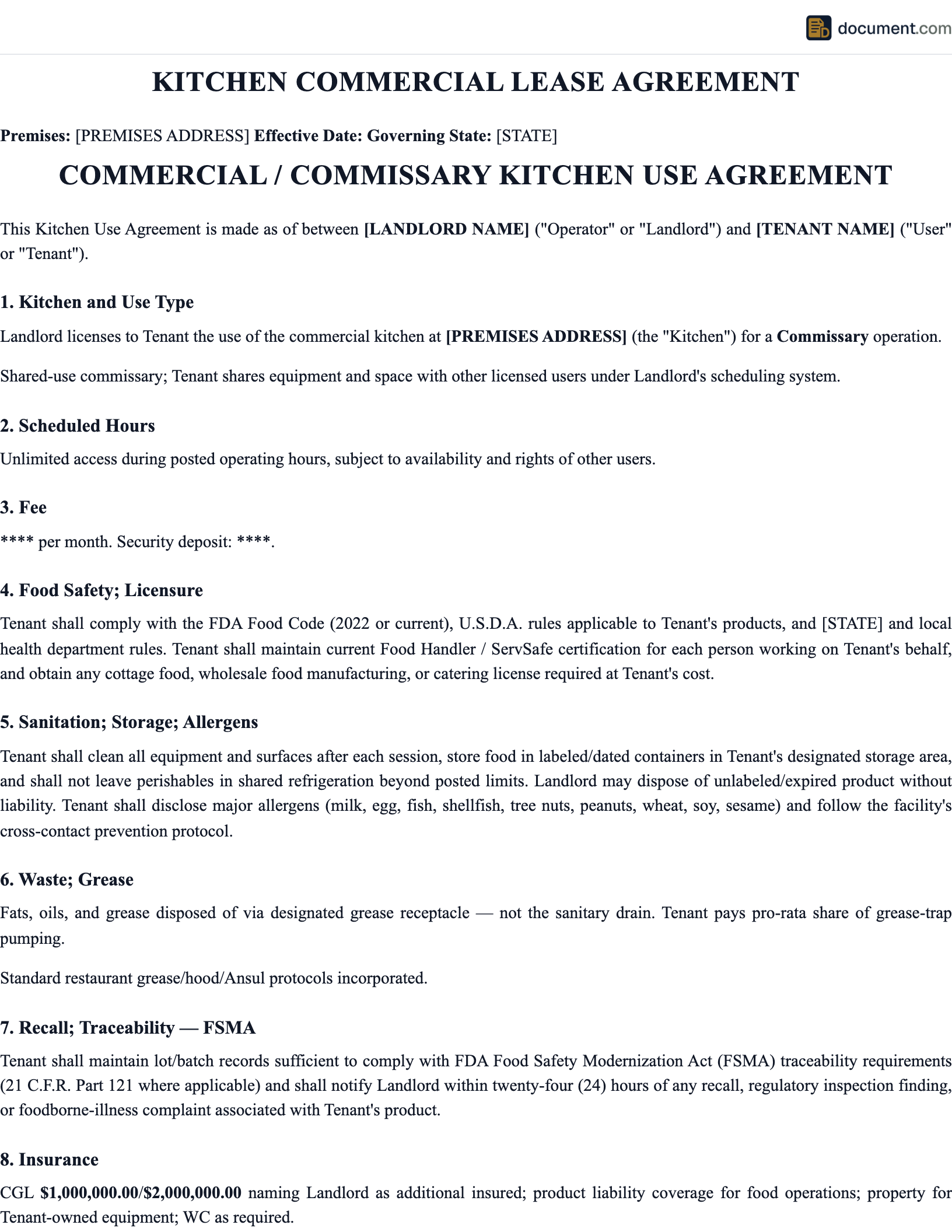



Kansas Kitchen Lease Agreement Overview
Shared and ghost kitchen operations in Kansas are growing, driven in part by food truck culture in Wichita and Kansas City, a robust agricultural catering market in western Kansas, and the rise of delivery-only restaurant concepts in suburban Johnson County. What unites these diverse operations is a common regulatory foundation: the Kansas Department of Health and Environment licenses and inspects shared kitchen facilities just as it does traditional restaurants, and every operator using the space needs their own individual food service establishment permit.
A Kansas kitchen lease differs from a standard commercial lease in several important ways. The agreement needs to address scheduling, cold storage allocation, equipment liability, commissary designation for mobile food units, and the continuous maintenance of the facility's KDHE license. Kansas also imposes sales tax on commercial rent, which applies to shared kitchen agreements. Operators in agricultural communities should pay particular attention to seasonal scheduling provisions, since demand for licensed kitchen space can spike sharply during harvest events and county fair catering season.
$21
Filing fee
Required
Notarization
0
Witnesses required
Register
Filing office
Kansas Shared Kitchen Lease Requirements
Kansas shared kitchen leases need to address facility licensing, individual tenant permits, scheduling, storage, and equipment liability. A lease that covers only rent and term leaves both facility owners and kitchen tenants exposed to operational and legal gaps.
KDHE Facility License is Non-Transferable
The KDHE food service establishment license belongs to the facility owner, not the tenants. If the facility fails to maintain its license, all tenants operating inside it are effectively unlicensed. The lease should require the owner to notify tenants immediately of any KDHE compliance action and give tenants a remedy, such as rent suspension, if the facility loses its license for more than a defined number of days.
Key Provisions for Kansas Kitchen Leases
- KDHE Facility License Status: The lease should represent that the facility holds a current KDHE food service establishment license and obligate the owner to maintain it
- Individual Tenant Permit Obligation: Each tenant must obtain and maintain their own KDHE food service establishment permit; the lease should confirm this obligation explicitly
- Commissary Designation: If the kitchen is the tenant's commissary for a food truck or mobile unit, the lease should state this and include provisions for equipment washing and supply storage
- Scheduling and Cold Storage: Attach a scheduling addendum with assigned hours and a cold storage allocation map showing each tenant's designated refrigeration space
- Equipment Inventory and Liability: Attach a signed equipment inventory listing condition at move-in, and specify tenant liability for damage caused by negligence
- Insurance Requirements: Require tenants to carry commercial general liability and product liability coverage, with the facility owner named as additional insured
- Sales Tax on Rent: Confirm whether the rental rate is inclusive or exclusive of Kansas sales tax on commercial lease payments
How to Execute a Kansas Kitchen Lease
Setting up a shared kitchen tenancy in Kansas requires coordinating the lease with KDHE permit applications and local business licensing. The steps below apply whether you are opening a ghost kitchen in Wichita or a catering commissary in a rural Kansas community.
Verify the Facility Holds a Current KDHE License
Before signing anything, ask the facility owner for a copy of their current KDHE food service establishment license. You can also verify license status through the KDHE online portal. A lapsed or conditional license signals problems that will affect your own permit application and your legal right to operate.
Negotiate the Lease with Scheduling and Storage Addenda
Draft the lease with a scheduling addendum that assigns your specific kitchen hours, identifies your cold storage allocation, and covers seasonal demand adjustments. The equipment inventory addendum should document the condition of all shared equipment you will use. These addenda are as important as the main lease body.
Execute the Lease and Obtain Your Insurance
Sign the lease and immediately obtain commercial general liability and product liability insurance. Provide the facility owner with a certificate of insurance showing them as an additional insured. Most Kansas shared kitchen operators carry at least $1 million per occurrence in liability coverage.
Apply for Your Individual KDHE Food Service Permit
Submit your own food service establishment permit application to KDHE with a copy of the signed lease as proof of your right to operate at the facility. KDHE will schedule an inspection. For food truck commissary uses, also submit documentation showing the facility address will be listed on your mobile food unit permit.
Obtain Local Business Licenses and Begin Operations
Obtain any city or county business licenses required in your jurisdiction. In Kansas, local licensing requirements vary significantly between incorporated cities and unincorporated county areas. Once your KDHE permit is issued and local licenses are in hand, you can begin operations during your scheduled kitchen hours.
Kansas Fees & Costs
Below is a breakdown of the typical costs associated with filing this document in Kansas. Actual fees may vary by county.
| Fee / Cost | Amount |
|---|---|
| Filing Fee | $21 first page |
| Notarization | $5 - $25 per signature |
| Certified Copy | $1 - $10 per page |
| Attorney Review (optional) | $150 - $500 |
Sample Kansas Kitchen Lease Agreement
Below is a preview of our Kansas-specific template. Your customized document will include all fields and provisions required for filing in any Kansas county.
KITCHEN LEASE AGREEMENT
STATE OF KANSAS
Legal Document Template
FACILITY OWNER
Name: [Full Legal Name]
Facility: [Kitchen Name]
Address: [Facility Address]
KITCHEN TENANT
Name: [Full Legal Name / Business]
Business Type: [Restaurant/Catering/Production]
Health Permit #: [Number]
KITCHEN SPECIFICATIONS
Total SF: [Square Feet]
Schedule: [Days/Hours]
Equipment: [See Inventory Addendum]
Storage: [Allocated Space]
FINANCIAL TERMS
Monthly Rent: $[Amount]
Schedule Rate: $[Amount]/hour
Security Deposit: $[Amount]
Equipment Deposit: $[Amount]
Kansas Kitchen Lease Agreement FAQ
Answers to common questions about filing a kitchen lease agreement in Kansas, including requirements, fees, and procedures.
Official Kansas Resources
Use these official state resources to verify requirements, find your local filing office, and access government forms for Kansas.
Related Kansas Documents
Depending on your situation, you may need additional documents alongside your Kansas kitchen lease agreement.
Create your Kansas Commercial Kitchen Lease Agreement in under 5 minutes.
Answer a few questions and download a Kansas-compliant document, ready for the state agency.