
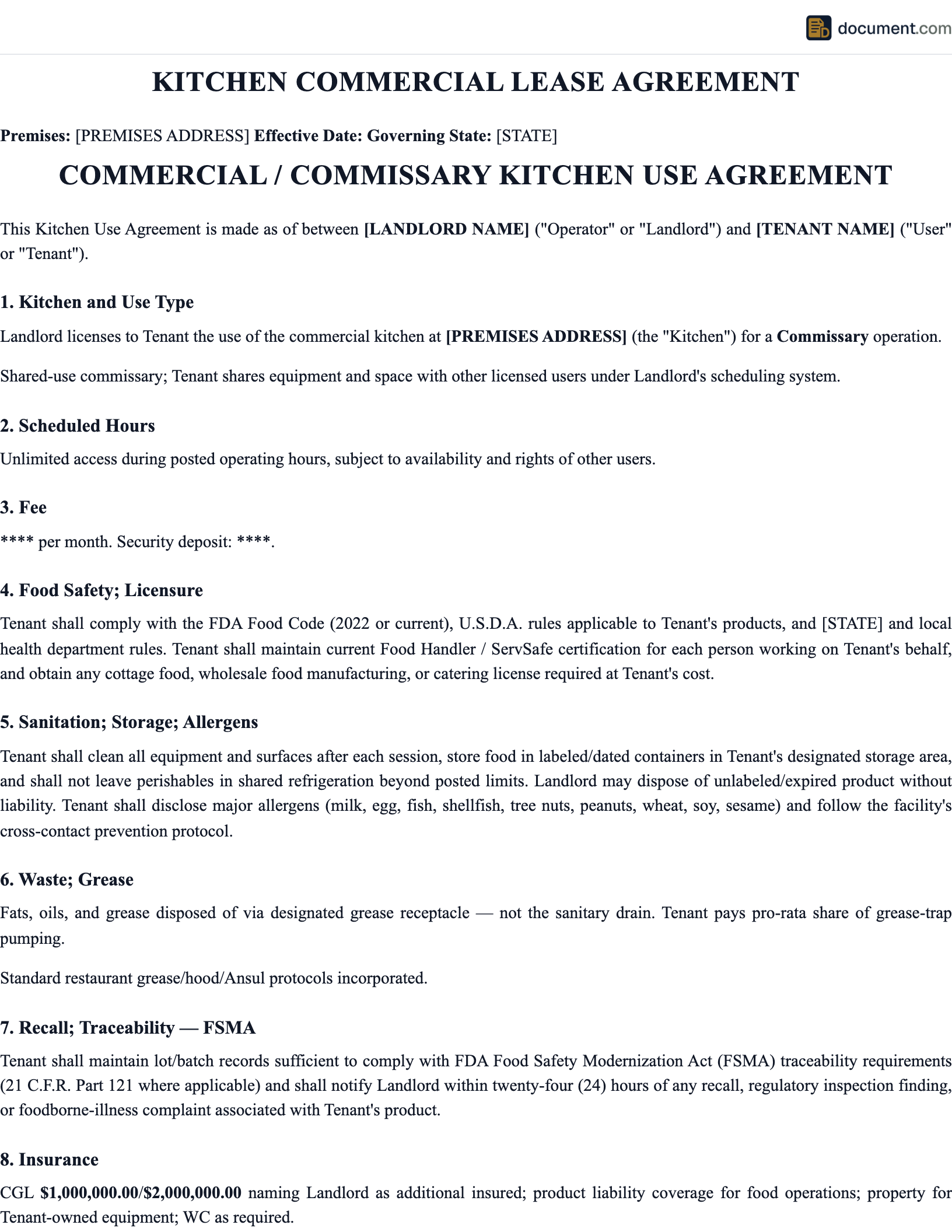



Arkansas Kitchen Lease Agreement Overview
Shared kitchen facilities in Arkansas operate under the Arkansas Department of Health's food establishment permitting framework. Whether the facility runs as a commissary kitchen, a ghost kitchen, or a catering prep space, the facility itself must hold an ADH food establishment permit, and individual users typically need their own food handler credentials and business licenses. Because Arkansas has a patchwork of dry counties and municipalities, kitchen tenants who produce alcoholic products for delivery or catering must also verify DFA ABC compliance for their specific use case.
The Little Rock and Fayetteville markets have active shared kitchen communities driven by food entrepreneurs, caterers, and cottage food producers looking for a licensed space to scale. The cottage food exemption in Arkansas allows certain home-based producers to sell directly to consumers, but those who want to sell through farmers markets at scale or supply wholesale accounts generally need a licensed commissary. Shared kitchen leases in Arkansas need to address ADH permit compliance, storage allocation, scheduling, equipment liability, and how the agreement handles termination if a user's permit lapses or triggers a health inspection violation at the facility.
$15
Filing fee
Required
Notarization
0
Witnesses required
Circuit
Filing office
Arkansas Requirements
An Arkansas shared kitchen lease needs to address ADH permit compliance at the facility level, storage allocation, scheduling, equipment maintenance responsibility, and what happens if a user's permit lapses or triggers a health inspection problem at the facility. Arkansas has no commercial tenant statute that protects kitchen tenants, so the written lease is the only document creating these protections.
Arkansas Shared Kitchen Note
The facility must hold an ADH food establishment permit. Individual users typically need their own food handler credentials and local business licenses. In dry counties and municipalities, kitchen users producing alcoholic products for catering or delivery need to confirm DFA ABC Division compliance for their specific use case before signing. Cottage food producers who need a commissary for wholesale or farmers market scale should confirm the facility's ADH permit covers their product category.
Key Lease Provisions
- ADH Permit Compliance: The lease should state that the facility holds a current ADH food establishment permit and specify the operator's obligation to notify users if the permit status changes
- Storage Allocation: Define each user's dedicated dry, refrigerated, and frozen storage space in square footage or shelf/bin counts, with a process for resolving storage disputes
- Scheduling and Equipment Access: Establish prep block scheduling, advance booking requirements, and which equipment is available during each block to avoid conflicts among users
- Equipment Liability: Clarify who is responsible for damage to shared equipment and whether the facility carries equipment breakdown insurance or whether tenants are liable for repair costs above a set threshold
- Termination for Health Violations: Include a provision allowing facility termination of a user's access if the user causes an ADH inspection deficiency that puts the facility's permit at risk, with reasonable notice and cure rights
- Dry County and ABC Compliance: Confirm in writing whether alcohol-related production or catering is permitted at the facility and what DFA ABC documentation the user must maintain
How to Execute an Arkansas Shared Kitchen Lease
Signing a shared kitchen lease in Arkansas requires confirming the facility's permit status, negotiating the right operational terms, and making sure your own licenses are in place before your first prep session.
Verify the Facility's ADH Permit
Ask the facility operator for a copy of the current ADH food establishment permit before signing anything. Confirm the permit covers the type of production you plan to do, whether that is catering prep, cottage food production at scale, or ghost kitchen delivery orders.
Negotiate Storage, Scheduling, and Equipment Terms
Get your storage allocation in writing with specific dimensions or bin counts. Confirm your scheduling blocks in the lease document rather than in a separate schedule that can be changed unilaterally. Clarify which equipment you have access to and what the liability is for damage above normal wear.
Review and Sign the Lease
Have an attorney review the lease before signing if your operation involves significant inventory, equipment investment, or catering contracts that depend on facility access. Because Arkansas provides minimal statutory protection for commercial tenants, the written agreement is your entire legal safety net.
Obtain Your Arkansas Business License and Food Permits
Secure your Arkansas business license and any ADH food handler credentials required for your operation. If you are in a dry county and your catering or production involves alcohol, confirm DFA ABC compliance before your first event or delivery. Farmers market sellers should confirm with the relevant market that their products qualify under Arkansas cottage food rules or ADH permitting.
Document the Facility Condition at Move-In
Photograph and document the condition of your dedicated storage area and any shared equipment you will use before your first session. Keep these records in case there is a dispute about equipment damage or deposit deductions at the end of your lease term.
Arkansas Shared Kitchen Costs
The figures below reflect typical costs for shared kitchen tenants in Arkansas. Rates vary between Little Rock, Fayetteville, and smaller markets.
| Fee / Cost | Typical Range |
|---|---|
| Hourly Kitchen Rate | $12 - $28/hour (varies by market and facility quality) |
| Monthly Membership | $200 - $600/month for block-hour packages |
| ADH Food Establishment Permit (facility) | $100 - $400/year (facility operator typically bears this cost) |
| Arkansas Business License | $50 - $150/year depending on municipality |
| Cold Storage Allocation | $30 - $100/month for dedicated refrigerated or frozen space |
| General Liability Insurance | $400 - $1,200/year (most facilities require at least $1M CGL) |
Arkansas imposes a 6.5% state sales tax on prepared food sales. Kitchen tenants selling finished food products at retail, through delivery apps, or at farmers markets should account for the applicable state and local sales tax rates when pricing their products. Local rates vary by city and county on top of the state base rate.
Sample Arkansas Kitchen Lease Agreement
Below is a preview of our Arkansas-specific template. Your customized document will include all fields and provisions required for filing in any Arkansas county.
KITCHEN LEASE AGREEMENT
STATE OF ARKANSAS
Legal Document Template
FACILITY OWNER
Name: [Full Legal Name]
Facility: [Kitchen Name]
Address: [Facility Address]
KITCHEN TENANT
Name: [Full Legal Name / Business]
Business Type: [Restaurant/Catering/Production]
Health Permit #: [Number]
KITCHEN SPECIFICATIONS
Total SF: [Square Feet]
Schedule: [Days/Hours]
Equipment: [See Inventory Addendum]
Storage: [Allocated Space]
FINANCIAL TERMS
Monthly Rent: $[Amount]
Schedule Rate: $[Amount]/hour
Security Deposit: $[Amount]
Equipment Deposit: $[Amount]
Arkansas Kitchen Lease Agreement FAQ
Answers to common questions about filing an kitchen lease agreement in Arkansas, including requirements, fees, and procedures.
Official Arkansas Resources
Use these official state resources to verify requirements, find your local filing office, and access government forms for Arkansas.
Related Arkansas Documents
Depending on your situation, you may need additional documents alongside your Arkansas kitchen lease agreement.
Create your Arkansas Commercial Kitchen Lease Agreement in under 5 minutes.
Answer a few questions and download a Arkansas-compliant document, ready for the state agency.