



Alabama Kitchen Lease Agreement Overview
Shared commercial kitchens and ghost kitchen operations in Alabama sit at the intersection of real estate law and food safety regulation. The Alabama Department of Public Health requires all food preparation facilities to hold a valid food establishment permit, and any shared kitchen must operate in a way that allows each user to be individually accounted for during inspections. That regulatory reality has to be reflected in your lease agreement before you start cooking.
Alabama has seen steady growth in ghost kitchen and commissary kitchen operations, especially in the Birmingham, Huntsville, and Mobile markets, where delivery demand has pushed food entrepreneurs toward shared infrastructure rather than standalone buildouts. A commercial kitchen lease in Alabama needs to address ADPH permit compliance, user scheduling, storage allocation, cold storage management, equipment liability, and insurance requirements. Alabama has no dedicated shared kitchen statute, so the lease fills every gap.
$13
Filing fee
Required
Notarization
0
Witnesses required
County
Filing office
Alabama Requirements
A shared kitchen lease in Alabama needs to satisfy both landlord-tenant law requirements and the operational realities of a multi-user food production facility. Because Alabama has no dedicated statute governing shared kitchens, every operational and compliance detail must be in the written lease.
Alabama Shared Kitchen Note
The Alabama Department of Public Health requires the facility owner to maintain a valid food establishment permit, but each individual user may also need their own permit depending on the nature of their operation. Confirm permit requirements with the county health department before signing the lease, and ensure the lease addresses what happens if a user's activities cause a facility-wide permit suspension.
Key Lease Provisions
- ADPH Permit Compliance: The lease should confirm the facility holds a current ADPH food establishment permit and specify who bears the cost of permit renewal and any compliance upgrades
- Storage Allocation: Define each tenant's dedicated dry, refrigerated, and frozen storage by cubic feet or labeled zones to prevent ADPH cross-contamination findings
- Prep Schedule: Set minimum scheduling notice, block length, overtime fees, and a process for resolving conflicts between users needing the same equipment simultaneously
- Equipment Liability: Assign responsibility for damage to shared equipment and require each tenant to carry general liability insurance naming the facility owner as additional insured
- Cleaning Obligations: Specify cleaning standards after each use, who supplies cleaning products, and how the facility handles a user who fails to clean to ADPH standards
- Termination for Health Violations: Include a provision allowing either party to terminate if a user's practices result in a health department notice of violation that cannot be remedied within a defined period
How to Execute an Alabama Kitchen Lease
Setting up a shared kitchen arrangement in Alabama requires aligning the lease terms with ADPH permit status and the facility's operational rules before you begin using the space.
Confirm the Facility's ADPH Permit Status
Before signing anything, verify that the shared kitchen holds a current, active Alabama Department of Public Health food establishment permit. Ask for a copy of the most recent inspection report and note any outstanding violations.
Negotiate Storage, Schedule, and Equipment Terms
Agree in writing on your storage allocation, weekly time blocks, which equipment you can use, and how overtime or extended sessions are billed. Shared kitchen disputes in Alabama almost always trace back to vague scheduling and storage language.
Review and Sign the Lease
Both parties sign the kitchen lease agreement. Ensure the lease includes insurance requirements, cleaning obligations, a process for handling health violations, and termination rights for both sides.
Obtain Your Own Business Licenses
Depending on your operation type, you may need your own county health permit or mobile food vendor license in addition to the facility's permit. Confirm requirements with the county health department where you will be selling or delivering food.
Document Facility Condition at Move-In
Photograph shared equipment and storage areas before your first session. Note any pre-existing damage in writing and provide a copy to the facility owner. This protects you from liability for damage you did not cause.
Alabama Kitchen Lease Costs and Tax Considerations
Shared kitchen costs in Alabama typically combine a base hourly or monthly rate with additional charges for cold storage, extended sessions, and permit-related compliance costs. Budget for these items as part of your total operating cost.
| Cost Item | Typical Range |
|---|---|
| Shared Kitchen Hourly Rate | $15 - $35/hour depending on facility and equipment |
| Monthly Block Rate | $300 - $800/month for reserved blocks |
| ADPH Food Establishment Permit (facility) | $150 - $500/year (facility owner cost) |
| Dedicated Cold Storage Add-On | $50 - $150/month for reserved refrigeration |
| General Liability Insurance (tenant) | $500 - $1,500/year for food business policy |
Rental payments for shared kitchen time are generally deductible as an ordinary business expense. Alabama prepared food sales are subject to the 4% state sales tax plus local rates. If you are operating as a ghost kitchen, keep clear records distinguishing kitchen rental costs from food costs and delivery costs, as these have different tax treatment.
Sample Alabama Kitchen Lease Agreement
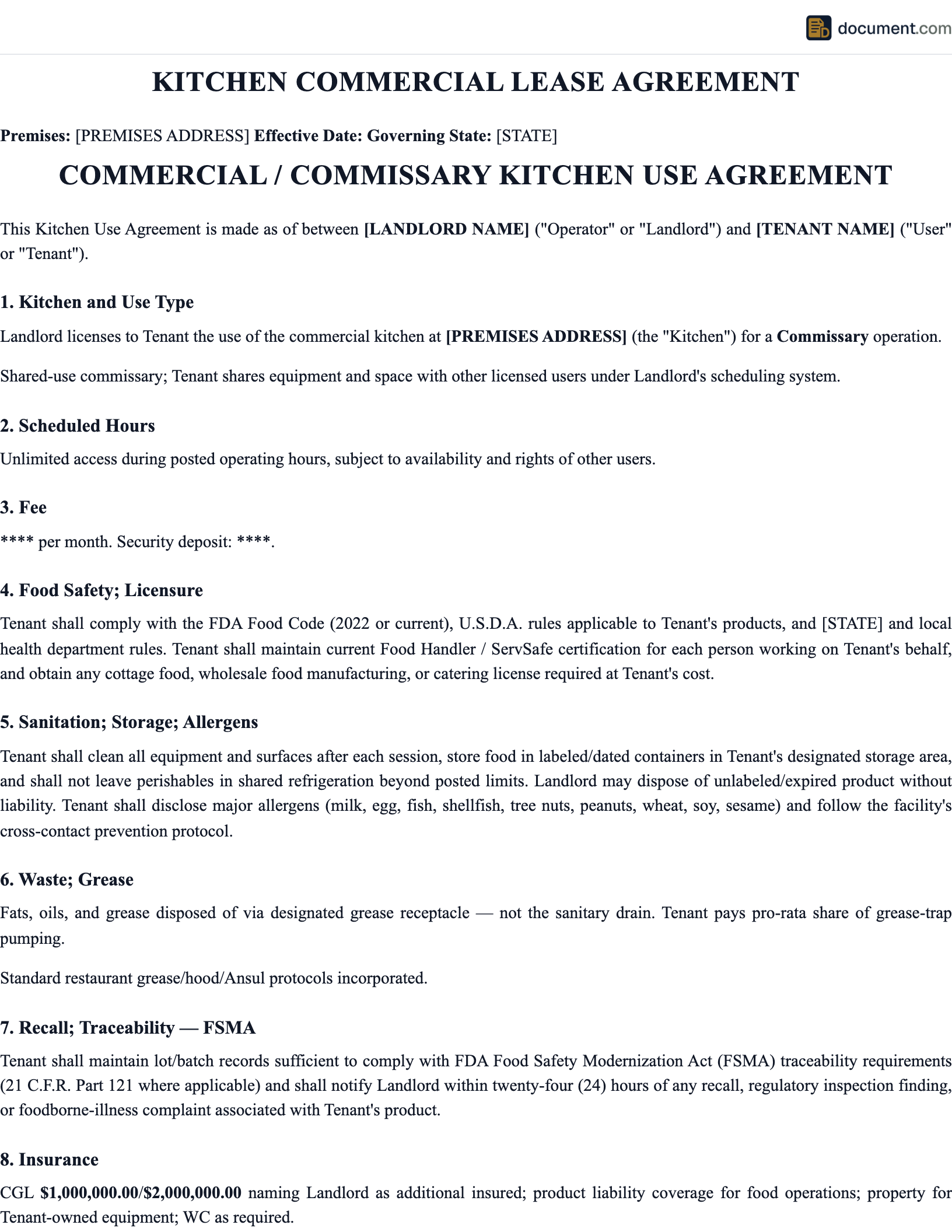
Below is a preview of our Alabama-specific template. Your customized document will include all fields and provisions required for filing in any Alabama county.
KITCHEN LEASE AGREEMENT
STATE OF ALABAMA
Legal Document Template
FACILITY OWNER
Name: [Full Legal Name]
Facility: [Kitchen Name]
Address: [Facility Address]
KITCHEN TENANT
Name: [Full Legal Name / Business]
Business Type: [Restaurant/Catering/Production]
Health Permit #: [Number]
KITCHEN SPECIFICATIONS
Total SF: [Square Feet]
Schedule: [Days/Hours]
Equipment: [See Inventory Addendum]
Storage: [Allocated Space]
FINANCIAL TERMS
Monthly Rent: $[Amount]
Schedule Rate: $[Amount]/hour
Security Deposit: $[Amount]
Equipment Deposit: $[Amount]
Alabama Kitchen Lease Agreement FAQ
Answers to common questions about filing an kitchen lease agreement in Alabama, including requirements, fees, and procedures.
Official Alabama Resources
Use these official state resources to verify requirements, find your local filing office, and access government forms for Alabama.
Related Alabama Documents
Depending on your situation, you may need additional documents alongside your Alabama kitchen lease agreement.
Create your Alabama Commercial Kitchen Lease Agreement in under 5 minutes.
Answer a few questions and download a Alabama-compliant document, ready for the state agency.