



What Is a College Roommate Agreement?
A college roommate agreement is a written contract among students sharing a dorm room or off-campus apartment that allocates rights and obligations the master lease does not address: study hours, guest policy, cleaning duties, expense splits, and the procedure for replacing a departing roommate. Off-campus, when the roommates are co-tenants on a single lease, joint and several liability attaches under URLTA § 4.301 and most state landlord- tenant statutes, exposing each co-tenant to the full rent and damages regardless of any internal split. The roommate agreement does not bind the landlord, but it provides a contractual basis for one roommate to recover contribution from another in small-claims court.
On-campus, the university housing agreement governs the legal relationship between the student and the institution. Residence-life rules, conduct codes, and Title IX procedures take precedence over private roommate agreements. Universities typically supply template roommate agreements through the residence life office and use them as the first reference when resident advisors mediate disputes. Records of the process are protected as education records under the Family Educational Rights and Privacy Act, 20 U.S.C. § 1232g, and may not be disclosed to parents of students 18 or older without written consent under 34 CFR § 99.5.
Off-campus, several legal regimes layer onto the agreement. Parental guaranties (typical for undergraduate rentals) make the parent personally liable for the student's lease obligations and must be in writing under the Statute of Frauds (Restatement § 110(1)(b)). Sublet and assignment require landlord consent under most leases; New York Real Property Law § 226-b conditions consent on reasonableness for buildings of four or more units. State eviction procedures apply to roommate defaults. Most states cap small-claims jurisdiction between $5,000 and $12,500 (California $12,500 as of 2024), the typical venue for one roommate to sue another for unpaid rent contribution.
Joint and several liability and parental guaranties
When co-tenants sign a single master lease, joint and several liability gives the landlord the option to pursue any one tenant (or the parental guarantor) for the full lease obligation. State examples: California Civ. Code § 1431.2 imposes joint and several liability for breach of contract; New York General Obligations Law § 15-105 governs apportionment among co-obligors. Parental guaranties extend the exposure to the parent's personal assets. The roommate agreement should allocate contribution rights so that a paying roommate or guarantor can recover from the defaulting party. Some landlords use separate per-room leases (common in purpose-built student housing) to eliminate joint liability; each roommate is responsible only for their own rent and a pro-rata share of common-area damages.
Sublet and assignment under state landlord-consent rules
Most leases prohibit sublet or assignment without written landlord consent. State rules vary on whether consent may be unreasonably withheld. New York Real Property Law § 226-b requires landlord consent for sublets in buildings of four or more units, with consent not unreasonably withheld; the landlord must respond within 30 days or consent is deemed granted. California Civ. Code § 1995.260 (commercial) imposes a reasonableness standard; California residential law generally allows the landlord to refuse without cause unless the lease expressly limits the discretion. The roommate replacement procedure should require the incoming roommate to complete the landlord's standard application, and a lease assignment or addendum should be executed by all parties; absent a novation, the departing roommate may remain liable on the lease.
Study Hours
Set quiet times and study-friendly environments for academic success
Guest Policies
Overnight guest limits, notice requirements, and common courtesy rules
Shared Expenses
Fair splitting of rent, utilities, groceries, and household supplies
Form Preview
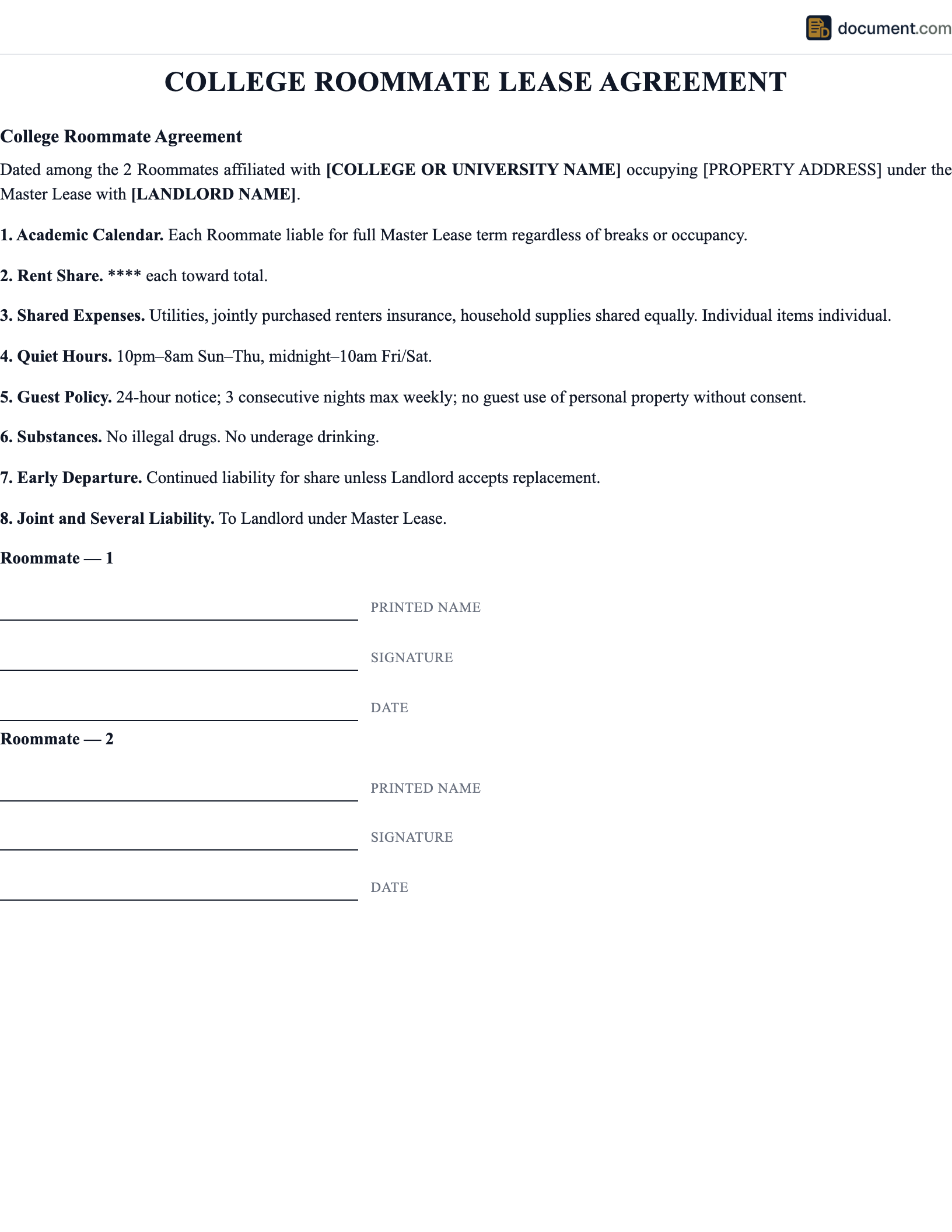
Below is a preview of the college roommate agreement. Your customized document will include all sections tailored to your specific living arrangement.
COLLEGE ROOMMATE AGREEMENT
Shared Living Agreement
This Roommate Agreement is entered into on[Date] between:
ROOMMATE 1:
Name: [Name]
ROOMMATE 2:
Name: [Name]
1. LIVING SPACE
Address: [Address/Room #]
Term: [Semester/Academic Year]
2. QUIET HOURS & STUDY TIME
Quiet hours: [Times]
How to Create a College Roommate Agreement
Sit Down Together Early
Have the conversation within the first week of moving in. Discuss sleep schedules, study habits, social preferences, and any pet peeves. Being upfront early prevents resentment later.
Define Quiet Hours and Study Time
Agree on specific quiet hours, headphone requirements, and how to handle noise during exam periods. Consider each person's class schedule and study preferences.
Set Guest and Overnight Visitor Rules
Establish limits on how many nights per week guests can stay, advance notice requirements, and any blackout periods such as midterms or finals.
Divide Expenses and Chores
Agree on how to split shared costs such as rent, utilities, internet, and supplies. Create a rotating cleaning schedule for common areas including kitchen, bathroom, and living room.
Sign and Schedule Check-Ins
Both roommates should sign the agreement and keep copies. Schedule a mid-semester check-in to discuss what is working and what needs to change.
Key Components
| Component | Details |
|---|---|
| Living Space | Room address, personal vs. shared areas, furniture arrangement |
| Semester Term | Start/end dates tied to academic calendar, break periods |
| Quiet Hours | Weeknight and weekend hours, exam period extensions |
| Guest Policy | Overnight limits, advance notice, exam blackouts |
| Shared Expenses | Rent, utilities, internet, groceries, supplies split |
| Cleaning Schedule | Rotating chores, standards, common area responsibilities |
| Conflict Resolution | Direct conversation, RA mediation, housing involvement |
Dorm vs. Off-Campus Considerations
Dorm Room
- University housing rules take precedence
- RA available for mediation
- Shared micro-kitchen and bathroom etiquette
- Room change options if irreconcilable
Off-Campus Apartment
- Formal lease obligations apply
- Joint liability for rent and damages
- Utility accounts and bill splitting
- Subletting provisions if someone leaves
Frequently Asked Questions
Resources
Create your College Roommate Lease Agreement in under 10 minutes.
Answer a few questions and download a compliant, attorney-drafted document ready for your state.