


Key Takeaways
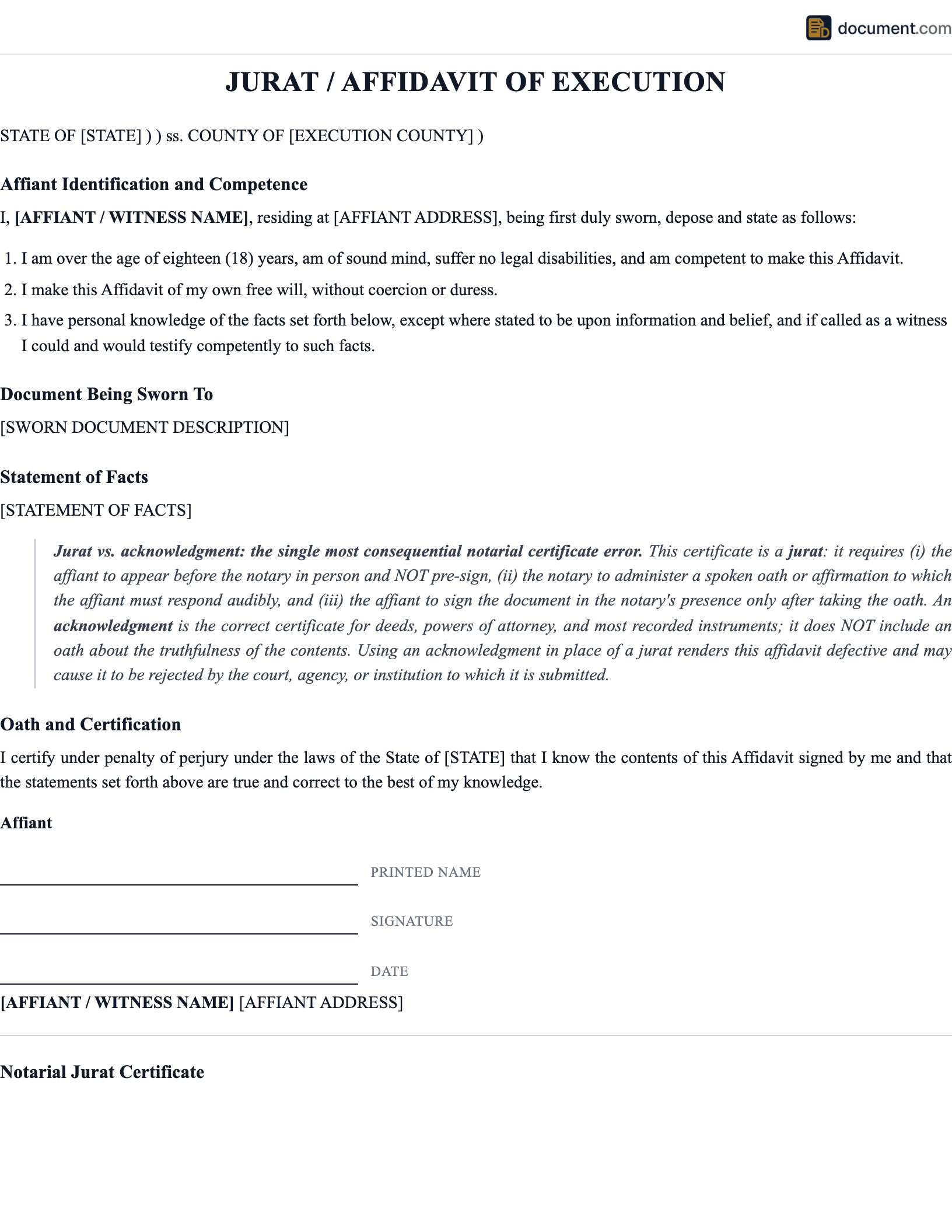
- •A jurat is the notarial certificate that says the signer swore or affirmed that the document's contents are true and signed in the notary's presence. The controlling language is 'subscribed and sworn before me.' It differs from an acknowledgment, which only confirms that the signer voluntarily signed the document without any oath about truthfulness.
- •An affidavit of execution is a sworn statement by a subscribing witness attesting that they personally observed the principal sign a document. For wills, it is often used to create a self-proving will, which means the probate court can admit the will without calling witnesses to testify. For deeds and other instruments, it supplies proof of execution when the principal later cannot appear.
- •The jurat is the right certificate whenever a document is an affidavit, a sworn declaration, a deposition, or any filing where the law or the receiving court or agency requires the signer to swear to the truth of the contents. If the document says 'sworn,' 'under oath,' or 'under penalty of perjury,' it needs a jurat, not an acknowledgment.
- •Self-proving will affidavits are permitted in all U.S. states except Ohio and the District of Columbia. Louisiana is the only state that requires a notarized will by default. For all others, a self-proving affidavit is optional but strongly recommended because it eliminates the need to locate and produce witnesses at probate.
- •Under the Revised Uniform Law on Notarial Acts (2018), adopted in many states, a jurat is formally called a 'verification on oath or affirmation.' The notary must administer a spoken oath or affirmation, the signer must respond audibly, and the signer must then sign in the notary's presence. A head nod or silent assent does not satisfy the oath requirement.
- •This page is general educational information, not legal advice. Notarial requirements vary by state and document type. Confirm your state's statute and the specific requirements of the court, county recorder, or institution that will receive your document before finalizing any notarial certificate.
Reviewed for accuracy by the document.com legal team. Educational information, not legal advice.
What Is Jurat and Affidavit of Execution?
A jurat is a notarial certificate that records two facts: the signer swore or affirmed under oath that the contents of a document are true, and the signer executed the document in the notary's presence. The name traces to the Latin verb jurare, to swear. The standard English form reads 'Subscribed and sworn to (or affirmed) before me this ___ day of [month], [year],' followed by the notary's signature, title, and commission expiration. That phrase is more than a formula. 'Subscribed' means the signer put their signature on the document at that moment, in front of the notary. 'Sworn' means the notary administered a verbal oath or affirmation and the signer acknowledged it aloud. Both acts have to happen together, in real time, before the notary.
The jurat should not be confused with an acknowledgment, which is the more common certificate attached to real estate deeds, powers of attorney, and contracts. An acknowledgment certifies that the signer appeared before the notary, presented identification, and declared that they signed the document voluntarily for its stated purpose. There is no oath about the truth of the contents. A signer can have signed an acknowledged document days before appearing before the notary, and the notary's certificate is still valid. With a jurat, the signing itself must happen in the notary's presence, and the oath must be administered before the pen touches the paper.
An affidavit of execution is a separate, related document. Rather than a certificate attached to a document, it is an independent sworn statement, signed by a witness who saw the principal sign the original document. The affidavit recites: the witness knows the principal, saw the principal sign the specific document on a specific date, the principal appeared to be of sound mind and under no duress, and the witness signed the original as an attesting or subscribing witness at the principal's request. The affidavit of execution is itself notarized with a jurat or, depending on the jurisdiction, a commissioner's certificate.
Practitioners use affidavits of execution most frequently in two settings. The first is wills: attaching an affidavit of execution (often called a self-proving affidavit when it covers both the testator's acknowledgment and the witnesses' sworn statements) allows a will to be admitted to probate in most states without requiring the subscribing witnesses to appear and testify. The second is deeds and other recorded instruments: when a grantor or other party who signed a deed is later unavailable, an affidavit by a subscribing witness can supply the proof of execution that a title company or recorder needs to clear the chain of title.
Both the jurat and the affidavit of execution belong to the same family as the general affidavit, which is any sworn written statement attesting to facts. The practical difference is scope and function: a jurat is a certificate that can attach to any affidavit or sworn statement, while an affidavit of execution is a specific, stand-alone document attesting to how another document was signed. A jurat certifies the truth of what is said; an affidavit of execution certifies that a signing happened, when, and with what witnesses present.
Why This Matters Now
Jurats and affidavits of execution are not new. Their forms have been part of Anglo-American practice for centuries. What has changed is the volume of transactions that require them and the number of contexts where the wrong certificate can cause serious, expensive problems. Remote online notarization has expanded rapidly since 2020 and is now permitted in the majority of states, which has made the distinction between jurat and acknowledgment more, not less, important: different platforms and state statutes handle each type of notarial act differently, and a remote jurat conducted without a proper oath is a defective notarization.
Courts and county recorders are enforcing certificate requirements more closely than in prior decades. Recording offices in many jurisdictions now reject instruments with missing or incorrect notarial certificates, rather than accepting them with a defect noted. A deed recorded with an acknowledgment certificate where the applicable statute required a jurat, or vice versa, can leave a cloud on title that requires corrective instruments and legal proceedings to clear.
Self-proving will affidavits have become standard estate planning practice, but many older wills lack them. As baby boomers' estates move through probate, the gap shows up: the will was signed, the witnesses are now dead or have moved across the country, and the estate has to go through the more involved process of proving the will through other means. An affidavit of execution prepared at signing would have prevented months of delay and additional expense.
The proliferation of new document types, particularly digital and electronic signatures, has also made the proof-of-execution question more live. When someone signs a PDF with a digital certificate, proving that the underlying instrument was executed with the same formalities as a wet-ink signature often requires an attesting witness to swear to what happened. Lenders, title companies, and courts are asking for affidavits of execution more often in electronic transaction contexts.
Finally, the Revised Uniform Law on Notarial Acts, which the Uniform Law Commission finalized in a 2018 version and updated in 2021, has been adopted in many states and has standardized some certificate language and procedural requirements. States that have adopted it now use a consistent definition for 'verification on oath or affirmation' (the RULONA term for jurat) that is technically narrower than the looser usage in older state statutes. Practitioners who relied on older forms may find their certificates technically deficient in adopting states.
The Legal Backbone
Revised Uniform Law on Notarial Acts (RULONA, 2018/2021 version)
The Uniform Law Commission's Revised Uniform Law on Notarial Acts defines 'verification on oath or affirmation' as the notarial act that many states call a jurat. Under RULONA, a notarial officer performing a verification must determine the individual's identity from personal knowledge or satisfactory evidence, administer an oath or affirmation to the individual, and take the verification in the individual's presence, meaning the signer signs in front of the notary after taking the oath. The model certificate form reads: 'Signed and sworn to (or affirmed) before me on [date] by [name of individual].' Many states have enacted RULONA or a close variant; check your state's notary statute to confirm whether your jurisdiction uses the RULONA form or an older state-specific form.
California Government Code sections 8202 and 8205 (jurat)
California's jurat statute, Government Code section 8202(a), governs the form and execution of a jurat in the state. The notary must administer an oath or affirmation to the signer, the signer must sign the document in the notary's presence, and the notary must complete the jurat certificate. Government Code section 8205 sets out the notary's duties, including the requirement to identify the signer and maintain a journal entry for every jurat. California specifically limits proof of execution by subscribing witness to acknowledgments only; it cannot be used as a substitute for a jurat under California Civil Code section 1191. For instruments affecting real property, California requires an acknowledgment, not a jurat, for recording purposes, though jurats are required for affidavits filed with courts and in many other sworn-statement contexts.
Self-proving will affidavits: Uniform Probate Code and state variants
Section 2-504 of the Uniform Probate Code provides a model self-proving will procedure in which both the testator and the attesting witnesses swear before a notarial officer, in a single combined affidavit, that the will was signed with proper testamentary formalities. The UPC form allows this combined affidavit to be executed at the time of signing or at any later date. Most states that have adopted the UPC or a similar self-proving will statute follow this model, though some require the testator and witnesses to sign only at the time of original execution. Virginia Code section 64.2-452, for example, provides a detailed certificate form in which the notarial officer certifies that the testator acknowledged the will, declared it to be their last will executed freely and voluntarily, and that the witnesses signed in the testator's presence, and that the testator appeared to be of sound and disposing mind. The self-proving affidavit, when properly executed, allows the will to be admitted to probate under Virginia law as if it had been proved by live testimony.
State statutes on proof of execution and subscribing witnesses
Several states expressly authorize a subscribing witness to appear before a notary and prove the execution of an instrument when the principal cannot appear. California Civil Code section 1191 allows proof of execution by subscribing witness for acknowledged documents, but excludes real property instruments, mortgages, deeds of trust, and powers of attorney. Florida Statutes section 117.05(13) allows a witness to take an oath and sign an affidavit attesting to the principal's signature. Texas Civil Practice and Remedies Code section 121.004 permits similar proof but restricts it for certain real estate documents. States that have not adopted a statutory provision for this procedure may not recognize it, so confirming local law before relying on a subscribing-witness affidavit for proof of execution is essential. North Carolina General Statute section 31-35, for instance, addresses the use of witness affidavits as evidence when a subscribing witness to a will is dead, incompetent, or absent from the state, and allows the affidavits taken by the clerk during probate admission to serve as prima facie evidence of due execution.
Washington State: RCW 42.45.140 short form certificate for verification on oath or affirmation
Washington has enacted the Revised Uniform Law on Notarial Acts as Chapter 42.45 RCW. RCW 42.45.010 is the definitions section and defines 'verification on oath or affirmation' as a declaration made by an individual on oath or affirmation before a notarial officer that a statement in a record is true. The short form certificates for notarial acts, including the jurat, are provided in RCW 42.45.140. The statutory short form for a verification on oath or affirmation reads: 'State of ... County of ... Signed and sworn to (or affirmed) before me on (date) by (name(s) of individuals making statement).' followed by the notary's signature, stamp, title, and commission expiration date. This is the form Washington notaries must use for jurats; any certificate citing RCW 42.45.010 as the source of the certificate form is mislabeled because that section contains only definitions.
Illinois: 5 ILCS 312/3-101 and 6-103 — commission expiration date on every notarial certificate
The Illinois Notary Public Act (5 ILCS 312) requires the commission expiration date to appear on every notarial certificate, including jurats, through a two-provision chain. Section 3-101 requires every notary's official rubber stamp seal to contain the words 'Notary Public,' 'State of Illinois,' and 'My commission expires (commission expiration date).' Section 6-103 requires the official seal to be affixed to every notarial certificate. Because the seal must appear on every certificate and the seal must include the commission expiration date, the expiration date appears on every Illinois jurat certificate. Section 6-105 provides the short form for a jurat (called 'verification upon oath or affirmation') as: 'Signed and sworn (or affirmed) to before me on (date) by (name/s of person/s making statement),' followed by the notary's signature and official seal.
Federal and court contexts: affidavits, declarations, and the jurat requirement
In federal civil practice, 28 U.S.C. section 1746 permits a person to use an unsworn declaration under penalty of perjury as a substitute for a sworn affidavit before a notary, provided the declaration is signed and dated and includes language substantially as follows: 'I declare (or certify, verify, or state) under penalty of perjury that the foregoing is true and correct. Executed on [date].' This federal statute means that federal court filings often do not require a notarized jurat; a self-executed declaration under section 1746 suffices. State courts vary widely; many still require a notarized jurat for affidavits filed in support of motions or in response to summary judgment. The U.S. Department of State's Foreign Affairs Manual, 7 FAM 840, separately governs acknowledgments and attestations of witness to execution of instruments by consular officers abroad, addressing the form of certificate a consular officer completes when witnessing an acknowledgment or attestation outside the United States.
The jurat versus acknowledgment distinction: why it matters every time
The single most common notarial error is attaching an acknowledgment certificate to a document that requires a jurat, or a jurat to one that needs only an acknowledgment. The consequences range from a minor delay to an instrument that is legally void or unrecordable. Understanding which certificate goes with which document type is the core skill that protects a transaction.
Reach for a jurat when the signer is attesting to the truth of the contents of the document. Affidavits of every kind, verified complaints, sworn financial disclosures, declarations in support of motions, immigration forms that require a sworn statement, and applications to government agencies that ask the signer to swear or certify the accuracy of the information all call for a jurat. The signal words in the document are 'sworn,' 'under oath,' 'verified,' or 'under penalty of perjury.' When you see those words, the document needs a jurat.
Reach for an acknowledgment when the point is to prove that the signer executed the document voluntarily and that the signature is genuine, without requiring the signer to swear to the truth of the contents. Deeds, mortgages, deeds of trust, assignments, powers of attorney, and most contracts are acknowledged, not sworn. For most instruments that will be recorded in a land records office, an acknowledgment is both required and sufficient. Substituting a jurat will not work because the recording statute specifies an acknowledgment.
A subscribing-witness affidavit uses a jurat for the witness's own sworn statement, even though the original instrument itself may have required an acknowledgment. This is a common point of confusion. The deed the witness saw signed requires an acknowledgment from the grantor. The affidavit the witness signs about having watched the grantor sign uses a jurat because the witness is swearing to the truth of what they saw. The two certificates serve two different documents.
For a self-proving will affidavit, the operative certificate is almost always a jurat or a combined form that includes both the testator's acknowledgment and the witnesses' sworn statement. The testator acknowledges the will (an acknowledgment). The witnesses swear that they saw the testator sign, that the testator appeared to be of sound mind, and that the formalities were observed (a jurat for their sworn attestation). Some state statutes require a single combined certificate; others allow separate notarial acts.
Remote online notarization raises the same rules in a different environment. A remote jurat performed through an RON platform still requires the notary to administer a verbal oath, the signer to respond audibly, and the signer to sign in the notary's audiovisual presence. RON platforms that offer only acknowledgment capabilities cannot perform a jurat. Confirm the platform and the state's RON statute before using a remote notarization for any jurat-required document.
One more thing that the certificate language does not solve on its own: a notarial certificate is only as strong as the underlying identification. A jurat performed after a careful oath and with proper ID verification provides meaningful evidentiary weight. A jurat where the notary filled in the certificate without actually administering an oath or verifying identity is a defective notarization regardless of what the certificate says. The language must match what actually happened.
When You Need This
You are signing an affidavit of any kind, a verified complaint, a sworn application, or a declaration for a court or government agency that requires the contents to be sworn to under oath or under penalty of perjury.
You are executing a self-proving will affidavit at the time your will is signed. Adding the affidavit creates a self-proving will that most states can admit to probate without calling the attesting witnesses to testify, which saves significant time and expense when the estate is later administered.
You are a subscribing witness who watched a testator sign a will, or watched a grantor sign a deed, and the principal is no longer available to appear before a notary. Your sworn affidavit of execution can supply the necessary proof of the instrument's valid execution.
A title company, lender, or estate attorney has asked for an affidavit of execution because the person who signed the original instrument, whether a deed, contract, or power of attorney, died, became incapacitated, or cannot be located, and a subscribing witness to the original signing is available.
You are preparing a sworn financial disclosure, a verified complaint for a lawsuit, or an immigration form that instructs you to swear or certify the accuracy of the information on the form.
You are a notary completing a certificate for a document that says 'sworn and subscribed' or 'subscribed and sworn to before me,' and you need to ensure the underlying procedure matches the certificate language: the oath must be administered verbally, the signer must respond audibly, and the signer must sign in your presence after the oath.
You are dealing with an older will that lacks a self-proving affidavit and the estate is in probate. In many states, a witness who is still living can execute a late affidavit of execution that, while not eliminating the need for some probate procedures, can provide competent evidence of due execution.
How to Fill Out Jurat and Affidavit of Execution
1. Identify which certificate or document your transaction needs
Before any drafting or appointment scheduling, read the document itself and confirm whether it requires a jurat, an acknowledgment, or a freestanding affidavit of execution. Look for the signal words: 'sworn,' 'under oath,' 'verified,' or 'under penalty of perjury' mean a jurat. Language like 'acknowledged' or 'executed voluntarily' points to an acknowledgment. If you are creating a self-proving will affidavit, confirm your state's specific form requirements, because many states provide the exact certificate language by statute and deviation from the statutory form can create a defective instrument.
2. Gather all required parties and documents before the notary appointment
For a jurat, the signer must be present and must not sign the document before arriving. Signing before the appointment makes the jurat defective because the signer did not sign in the notary's presence. Bring government-issued photo identification. For an affidavit of execution in a will context, both the testator and the attesting witnesses ideally sign the affidavit at the same time the will is executed and in front of the same notary, though the law of most states permits the affidavit to be executed later. For a freestanding subscribing-witness affidavit for a deed or other instrument, the witness should bring the original signed instrument and their own identification.
3. Draft the affidavit with accurate, specific facts
An affidavit of execution should state: the witness's full name, address, and capacity; the name of the principal; the specific document the principal signed, identified by type, date, and parties; the date the witness observed the signing; the location of the signing; that the principal appeared to be of sound mind and acting voluntarily; that the witness signed the document as a subscribing witness at the principal's request; and, for a will affidavit, any additional formalities your state requires (for example, whether the testator declared the instrument to be their will). Do not add legal conclusions or facts the witness did not observe. The strength of the affidavit comes from its precision, not from conclusory language.
4. Administer the oath or affirmation before the signer signs
The notary must administer a spoken oath or affirmation before the signer places their signature on the jurat document. A typical form is: 'Do you swear (or affirm) that the contents of this document are true and correct to the best of your knowledge and belief?' The signer must respond audibly, not by nodding. Only after the signer confirms the oath should they sign the document. For an affidavit of execution, a typical oath is: 'Do you swear or affirm that the statements you are about to make in this affidavit are true and correct?' Confirm that your state's statute does not require specific oath language before departing from this general form.
5. Complete the notarial certificate with the correct form
The jurat certificate must state the date and place of the notarization, the signer's name, the notary's signature, title, jurisdiction, and commission expiration date. Many states require an official seal or stamp. Use your state's statutory form if one is provided; if your state has adopted RULONA, the form reads 'Signed and sworn to (or affirmed) before me on [date] by [name of individual].' For a self-proving will affidavit, use the exact statutory form your state provides. Substituting a substantially similar but not identical form can create grounds for a later challenge during probate, particularly in states with strict compliance requirements.
6. Record your journal entry and maintain your records
Most states require notaries to keep a journal of every notarial act, including jurats and acknowledgments. The journal entry should record the date, the type of act, the name of the signer, the document type, the identification presented, the fee charged, and the signer's signature or thumbprint in the jurisdictions that require it. For notarial acts relating to wills, keep the journal record with particular care; wills are challenged years and sometimes decades after execution, and the journal entry can be the only contemporaneous record of what occurred at the signing.
7. Deliver and store the executed documents appropriately
For a self-proving will affidavit, attach it to the original will or incorporate it into the will document at the time of signing. Store the original will in a secure location, such as a fireproof safe, a bank safe deposit box, or with the estate attorney. For an affidavit of execution relating to a deed or other recorded instrument, deliver the original to the county recorder or land records office along with the original instrument if the affidavit needs to be recorded, or provide it to the title company for their file. Keep copies of every executed jurat document and affidavit. In a probate or title dispute, the original notarized document is the evidentiary anchor.
Key Terms Defined
- Jurat
- A notarial certificate attesting that the signer swore or affirmed under oath that the document's contents are true and that the signer executed the document in the notary's presence. The standard language is 'subscribed and sworn to (or affirmed) before me.' Under the Revised Uniform Law on Notarial Acts, this act is called a 'verification on oath or affirmation.' Compare with acknowledgment.
- Acknowledgment
- A notarial certificate attesting that the signer appeared before the notary, was identified, and declared that they voluntarily signed the document for its stated purpose. No oath about the truthfulness of the document's contents is required. An acknowledgment is the standard certificate for deeds, mortgages, powers of attorney, and most recorded instruments. The signal phrase is 'acknowledged before me.'
- Affidavit of execution
- A sworn statement by a subscribing witness or attesting witness attesting to the circumstances under which the principal signed a specific document. The affidavit recites the witness's observation of the signing, the date and location, and any required formalities (such as testamentary capacity and freedom from duress for a will). It is the affiant's own sworn statement, not a notarial certificate attached to the original instrument.
- Subscribing witness
- A person who signs a document as a witness to the principal's execution of that document. The subscribing witness observes the principal sign, then signs the instrument themselves in the principal's presence. For wills, most states require two subscribing witnesses. A subscribing witness who later executes an affidavit of execution swears to the facts of the original signing.
- Self-proving will
- A will that has attached to it a notarized affidavit executed by the testator and the attesting witnesses, usually at the time of signing, in which they swear under oath that the will was signed with all required testamentary formalities. A self-proving will can be admitted to probate in most states without requiring the witnesses to testify, which is valuable when witnesses are deceased, unavailable, or difficult to locate.
- Verification on oath or affirmation
- The term used in the Revised Uniform Law on Notarial Acts (RULONA) for the notarial act that most states call a jurat. The notarial officer must determine the individual's identity, administer an oral oath or affirmation, and take the individual's signature in the officer's presence. The model certificate form reads: 'Signed and sworn to (or affirmed) before me on [date] by [name].'
- Proof of execution
- The legal process of demonstrating that a document was signed by the person whose signature it bears, with all required formalities. Proof of execution can be established by the signer's own acknowledgment, by a subscribing witness's sworn affidavit, or by self-proving affidavit. It is distinct from proving the contents of the document, which requires other evidence.
- Notarial certificate
- The completed written statement that a notary public attaches to or includes in a document to certify the type of notarial act performed. For a jurat, the certificate records the oath, the signing in the notary's presence, the date, and the notary's identifying information. For an acknowledgment, the certificate records the signer's voluntary execution. Under most state statutes, the specific language of the certificate is prescribed or closely guided by statute.
Related Documents
Jurat vs. acknowledgment
A jurat requires the signer to take an oath about the truth of the document's contents and to sign in the notary's presence. An acknowledgment requires the signer to confirm voluntary execution of the document, and the signer may have signed before appearing before the notary. Jurats are for sworn statements, affidavits, and anything requiring an oath. Acknowledgments are for deeds, powers of attorney, contracts, and most instruments being recorded. Using the wrong certificate type can void or cloud an instrument.
Affidavit of execution vs. self-proving will affidavit
An affidavit of execution is a broad term for any sworn statement by a witness attesting to how an instrument was signed. A self-proving will affidavit is a specific type of affidavit of execution that follows the statutory form required in a particular state, typically covers both the testator's acknowledgment and the witnesses' sworn statements, and allows the will to be admitted to probate without live witness testimony. Every self-proving affidavit is an affidavit of execution, but not every affidavit of execution is a self-proving affidavit.
Jurat vs. unsworn declaration under 28 U.S.C. section 1746
In federal court proceedings, 28 U.S.C. section 1746 allows a person to substitute a signed unsworn declaration under penalty of perjury for a notarized affidavit. The declaration must include language substantially to the effect of 'I declare under penalty of perjury that the foregoing is true and correct' and must be dated and signed. Because no notary is required, section 1746 declarations are faster and cheaper than notarized jurats. However, section 1746 applies only where federal law governs the proceeding; state courts, government agencies, and private transactions may still require a notarized jurat.
Affidavit of execution vs. affidavit of identity
An affidavit of execution addresses how a specific instrument was signed, who the signers were, and what formalities were observed. An affidavit of identity addresses who the affiant is, reconciling different names or identification records to confirm that two records refer to the same person. They are related only in that both are sworn affidavits; their function and use cases are distinct. Title companies sometimes request both: an affidavit of execution to prove the deed was properly signed, and an affidavit of identity to confirm that the grantor on the old deed and the seller on the current transaction are the same person.
Legal Authorities & Sources
This page is grounded in primary law. The statutes and official resources below are the authorities behind the guidance above. Verify the current text of any statute before relying on it.
- Washington RCW 42.45.140 — short form certificates for notarial acts including jurat (verification on oath or affirmation)
- Washington RCW 42.45.010 — definitions including 'verification on oath or affirmation'
- 5 ILCS 312/3-101 (Illinois Notary Public Act) — official seal must include commission expiration date
- 5 ILCS 312/6-103 (Illinois Notary Public Act) — official seal required on every notarial certificate
- Cornell Law School LII: Jurat (Wex legal dictionary)
- National Notary Association: Key differences between acknowledgment and jurat certificates
- Uniform Law Commission: Revised Uniform Law on Notarial Acts (2021)
- California Government Code section 8202 (jurat requirements)
- California Civil Code section 1191 (proof of execution by subscribing witness)
- Virginia Code section 64.2-452 (self-proved wills; affidavits of witnesses)
- North Carolina General Statute section 31-35 (affidavit of witness as evidence in will proceedings)
- 28 U.S.C. section 1746 (unsworn declarations under penalty of perjury)
- California Lawyers Association: Difference between a jurat and an acknowledgement
- Notary Jurat definition and requirements (National Notary Association)
Frequently Asked Questions
Create your Jurat and Affidavit of Execution in minutes.
Answer a few questions and download a clear, attorney-drafted document that cites the controlling law and is ready to sign.