


Key Takeaways
- •A work-for-hire label does not automatically transfer copyright in a commissioned manuscript.
- •Assignment and exclusive licensing need a clear scope and effective trigger; cancellation must respect existing rights.
- •Tool approval, confidential inputs and model training are different permissions.
- •An AI inventory supports factual review but is not a registration application or a guarantee of copyright.
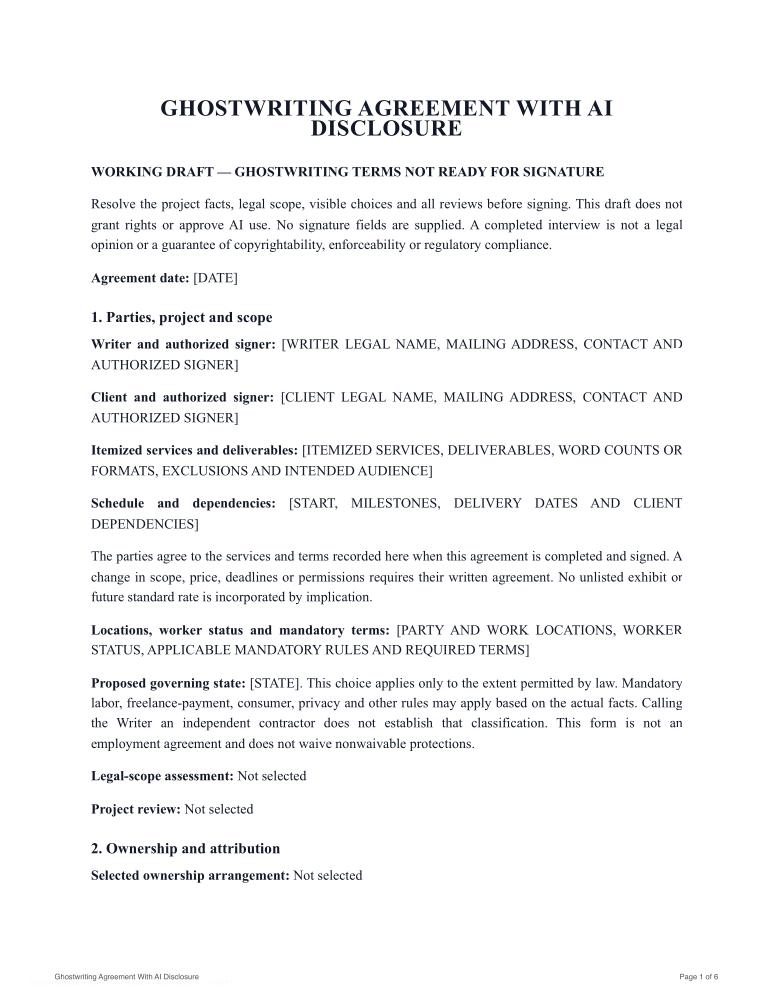
- •Complete actual payment and legal-scope terms before signing. Generic samples and working drafts remain unsigned.
Reviewed for accuracy by the document.com legal team. Educational information, not legal advice.
What Is Ghostwriting Agreement With AI Disclosure?
A ghostwriting agreement sets the services, payment, ownership and publication responsibilities between a writer and a client. AI provisions add decisions about tools, inputs, approvals, records and human review.
The agreement should describe actual deliverables and excluded material. A client’s source documents, a writer’s existing material and third-party content do not all become freely transferable merely because they appear in a project.
This builder provides assignment, qualifying commissioned work-for-hire with fallback assignment, and exclusive-license paths. Each requires the actual scope and supporting facts. It is not an employment agreement or a substitute for jurisdiction-specific advice.
Match the agreement to how the work is created
Ghostwriting may combine original writing, client interviews, research, licensed material and AI assistance. Keep those sources distinct so the rights and publication claims match reality.
Payment and ownership need to work together. Specify when each installment is due, what triggers a transfer, and what happens to paid deliverables if the engagement ends. Avoid circular requirements in which payment and delivery each depend on the other occurring first.
Legal points that need precise treatment
Work made for hire is a legal category
Copyright Office guidance distinguishes employee work within employment duties from specially commissioned work in a statutory category under a signed agreement. A standalone manuscript is not automatically eligible. If the parties use the commissioned-work option, record the actual category and facts; distinguish statutory ownership from a fallback assignment triggered by payment or delivery.
Transfers require scope and authority
Section 204 generally requires an authorized signed writing for a copyright ownership transfer. Exclusive licenses also need careful scope. Section 203 can permit termination of certain author grants despite contrary contract language; eligibility and notice requirements matter. The builder does not claim every grant is permanently irrevocable.
Human expression and AI are not all-or-nothing
The Copyright Office explains that sufficient human expression may be protected even when AI assists, while prompts alone do not establish authorship of machine output. Its registration guidance requires exclusion of more-than-de-minimis AI-generated material. A tool-use inventory helps document facts but cannot itself establish ownership, registration eligibility or a sufficient application.
Registration does not guarantee remedies
Section 411 generally requires registration before a federal infringement suit involving a United States work, with exceptions. Section 412 restricts statutory damages and attorney fees based on registration and infringement timing, including a publication-related grace rule. Actual dates and statutory exceptions must be assessed; filing does not automatically unlock every remedy.
Freelance payment rules can be mandatory
For covered New York engagements, General Business Law sections 1411 and 1412 address timely compensation and written contracts. Required details include party mailing addresses, service values, compensation method, payment timing and the service-list submission date. The hiring party must retain the agreement for at least six years. Other locations may impose different protections; a governing-law choice alone does not settle coverage.
Endorsement disclosures cannot cure false experience
FTC guidance permits truthful prewritten endorsements but warns against misleading representations. Its reviews rule addresses fake or false testimonials and prohibited review practices. An AI or sponsorship label is not permission to invent a customer’s experience. The agreement should allocate fact checking, substantiation and disclosures without claiming an automatic fine for every publication.
Forums have limits
Federal copyright jurisdiction cannot be assigned to state courts by contract. The Copyright Claims Board handles eligible claims through a voluntary process, with statutory limits and opt-out rights. A CCB option is not a mandatory forum for every contract dispute. Arbitration requires actual negotiated scope and procedural terms rather than a bare state name.
Decisions to make before signing
Describe the parties, authorized signers, deliverables, itemized services, audience, schedule and dependencies. Identify actual work locations and worker-classification issues. Do not use an independent-contractor label as a substitute for the applicable legal tests.
Choose the intended ownership arrangement. Specify included deliverables, territory, duration, rights, excluded drafts and permissions for existing or third-party materials. State what internal review is permitted before a transfer becomes effective.
Set attribution and portfolio rules without inventing a worldwide moral-rights waiver. Ghostwriting under a client’s byline must not become a false statement about credentials, legal authorship or personal experience.
Choose no generative AI, currently approved tools, or approval before use. Identify actual accounts, configurations, tasks and safeguards. If approval is still needed, a later inventory must not retroactively authorize the use.
Choose confidential-input permissions separately. Review privacy, retention, logs, suppliers and deletion for the actual workflow. This agreement does not authorize model training simply because a tool is approved.
Define confidentiality exclusions and duration, incident handling, lawful disclosures and return or deletion. Preserve legally protected reporting and the DTSA immunity notice without a prior-approval condition.
Record amounts or formulas, currency, itemized values, due dates, deposit credits, refunds and processing deadlines. Include objective acceptance criteria, revision rounds and written approval for extra work. Silence is not automatically final acceptance.
Specify cancellation, earned compensation, credits, partial delivery and existing rights. An additional cancellation formula needs its own legal and cost-basis review; it must not duplicate recovery or seize client-owned materials.
Choose whether to add indemnity or liability limits. If selected, identify scope, floor, exceptions, defense and settlement procedures. A cap should not silently become zero before payment, and no clause can eliminate mandatory liability.
Name the registration coordinator and actual claimant, publication checks, precise dispute process and incorporated schedules. Keep draft status until legal scope, choices and reviews are resolved.
When this agreement may fit
A writer creates a manuscript, article series, speech or other defined content for publication by a client.
The parties want an assignment or exclusive license with a clear payment or acceptance trigger.
The project needs explicit AI permissions and source records.
The engagement is a genuine services arrangement whose worker, payment and publication requirements have been assessed. Use separate appropriate terms where employment or another specialized relationship applies.
How to Fill Out Ghostwriting Agreement With AI Disclosure
1. Define the engagement
List actual services, deliverables, locations, parties, signers and dates.
2. Agree on rights and payment
Choose the ownership path, trigger, price, acceptance and cancellation treatment.
3. Set AI and publication controls
Specify tools, inputs, safeguards, human review, permissions and factual disclosures.
4. Review and execute
Resolve mandatory law, registration, remedies and forums. Confirm every referenced schedule and give both parties a complete signed copy.
Key Terms Defined
- Assignment
- A transfer of specified ownership rights by a person authorized to grant them.
- Exclusive license
- A grant of specified exclusive rights, with ownership and excluded rights otherwise retained.
- Work made for hire
- A statutory category determined by the facts and applicable requirements, not merely a contract label.
- AI inventory
- A factual record of tools, inputs, generated material and human contributions; not an official registration.
Related Documents
Writing services agreement
May cover the service relationship without addressing client bylines or detailed AI workflows.
Copyright assignment
Focuses on a rights transfer; services, milestones and publication duties still need terms.
NDA AI addendum
Amends an existing confidentiality agreement but does not by itself set writing fees or transfer copyright.
AI content policy
Sets organizational standards. A project agreement must identify the actual parties, work and obligations.
Legal Authorities & Sources
This page is grounded in primary law. The statutes and official resources below are the authorities behind the guidance above. Verify the current text of any statute before relying on it.
- Copyright Office: works made for hire
- Copyright Office: human authorship and AI, Part 2
- Copyright Office: AI registration guidance
- 17 USC 203: statutory termination of grants
- 17 USC 204: signed copyright transfers
- 17 USC 411: registration and infringement proceedings
- 17 USC 412: registration timing and remedies
- 28 USC 1338: federal copyright jurisdiction
- Copyright Claims Board: voluntary participation and limited claims
- FTC: Endorsement Guides questions and answers
- FTC: consumer reviews and testimonials rule
- New York General Business Law 1412: written freelance contracts
- New York General Business Law 1411: freelance compensation
- 18 USC 1833: protected trade-secret disclosures and notice
Frequently Asked Questions
Create your Ghostwriting Agreement With AI Disclosure in minutes.
Answer a few questions and download a clear, attorney-drafted document that cites the controlling law and is ready to sign.