
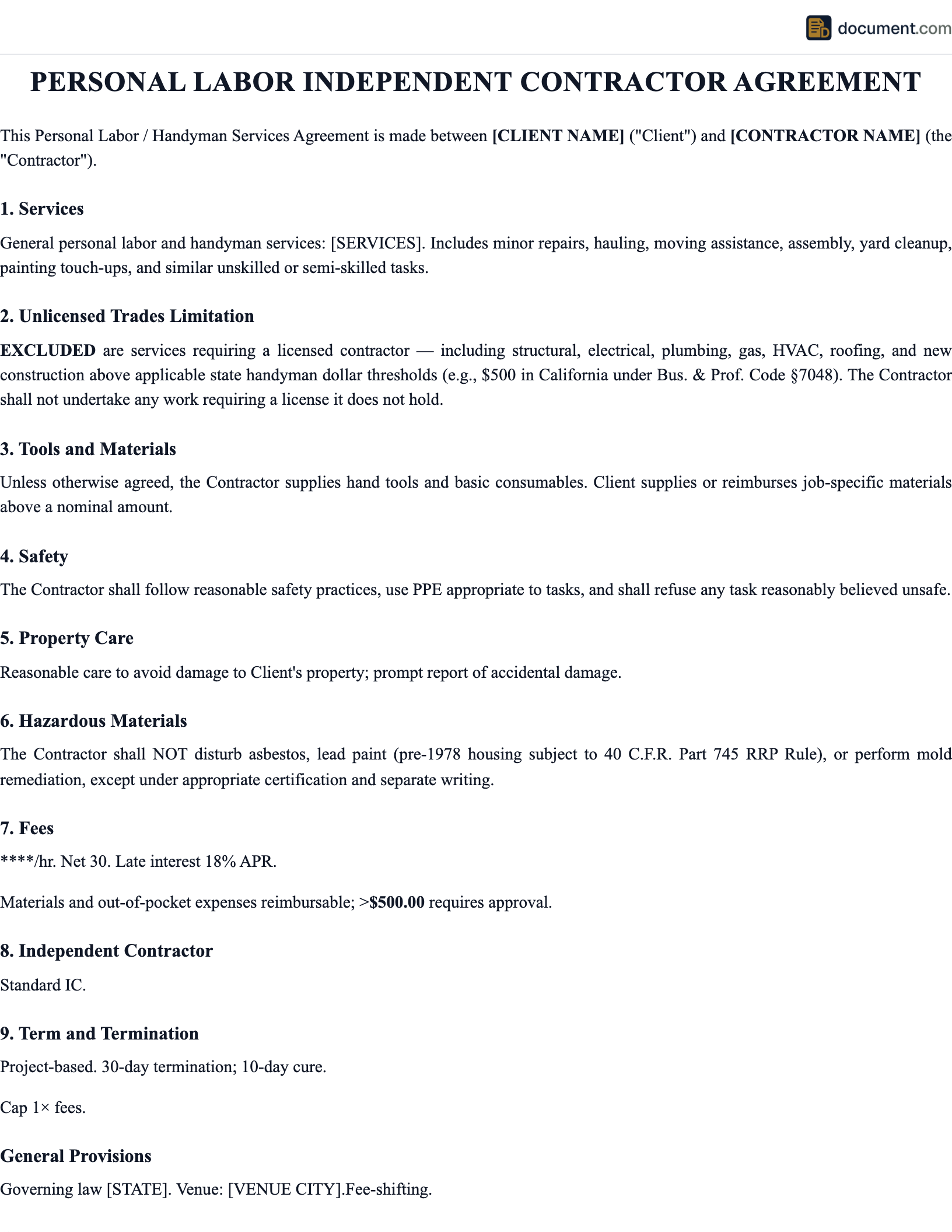



What Is a Personal Service Contract?
A personal service contract for personal labor is a written independent-contractor agreement between an individual or household and a worker who performs hands-on tasks. The scope covers housekeeping, yard work, moving and hauling, furniture assembly, painting, event staffing, errands, elder-care assistance, and seasonal maintenance. The agreement establishes the worker as an independent contractor under the IRS common-law control test (Rev. Rul. 87-41) and the DOL economic-realities test (29 C.F.R. Part 795, March 11, 2024 final rule), allocates injury and property-damage liability, and triggers IRS Form 1099-NEC reporting once aggregate annual payments reach $600 under IRC § 6041A.
The contract is the primary documentary defense against worker misclassification. Where the parties' written agreement, payment structure, and conduct align with contractor status, the IRS and state agencies usually respect the classification. Where the conduct contradicts the contract (the household sets daily schedules, supplies tools, dictates the cleaning method, and pays a fixed hourly wage), the IRS will reclassify under the substance- over-form principle and assess back FICA, FUTA, and state unemployment contributions plus penalties under IRC § 3509 of up to 100 percent of unpaid taxes. California, New Jersey, and Massachusetts apply the stricter ABC test, which presumes employment unless the hiring entity proves three independent factors.
Beyond classification, the contract addresses two recurring loss exposures. First, worker injuries: most state workers' compensation acts exclude bona fide ICs and casual domestic workers, but the household remains exposed under premises- liability law for known hazards. The contract should include a hold-harmless clause and assumption-of-risk language limited to ordinary negligence, since Tunkl v. Regents, 60 Cal. 2d 92 (1963), and similar decisions void releases of gross negligence as against public policy. Second, property damage: the worker's general-liability policy or the homeowner's policy may cover incidents, but a written reporting and remedy clause shifts the contractual baseline.
The DOL ABC test, Dynamex, and AB 5
Six states apply the ABC test for wage-and-hour purposes: California (Lab. Code § 2775), Massachusetts (M.G.L. ch. 149 § 148B), New Jersey (N.J.S.A. 43:21-19(i)(6)), Connecticut (Conn. Gen. Stat. § 31-222(a)(1)(B)(ii)), Illinois (820 ILCS 185/10 for construction), and Virginia (Va. Code § 40.1-28.7:7). The worker is presumed an employee unless the hiring party proves all three prongs: (A) freedom from control and direction in fact and under the contract; (B) the work is outside the usual course of the hiring entity's business; (C) the worker is engaged in an independently established trade. AB 5 codified Dynamex into California statutory law and added narrow occupation-specific exemptions. The personal-labor contract does not displace the ABC test, but it documents prong A (control language) and prong C (worker's other clients, business registration).
Workers' comp waivers and state exclusions
Most state workers' compensation acts exclude casual domestic workers and bona fide independent contractors from mandatory coverage. Florida Stat. § 440.05 permits a sole-proprietor exemption filed with the Division of Workers' Compensation. California Lab. Code § 3352 lists specific exclusions including casual employment. New York Workers' Comp. Law § 2(4) excludes domestic workers in private homes working fewer than 40 hours per week. The contract should require the worker to confirm in writing that no workers' comp coverage attaches to the household, and that the worker bears responsibility for own health and disability insurance. Where the worker carries general-liability coverage, the contract should require an additional-insured endorsement on the policy.
Liability Protection
Hold-harmless provisions and insurance requirements for physical labor.
Clear Scope
Defined tasks prevent scope creep and payment disputes.
IC Compliance
Proper classification protects against IRS and state labor penalties.
Personal Service Contract Form Preview
Personal Service Contract
Independent Contractor Agreement for Personal Labor
Section 1: Parties
Section 2: Services
Section 3: Liability
Service Provider assumes risk of personal injury and agrees to hold Client harmless from claims arising from Provider's performance of services.
Key Components
| Component | Description |
|---|---|
| Parties & Location | Legal names of client and worker, service location address |
| Scope of Work | Detailed description of tasks, materials, and expected outcome |
| Schedule | Start date, work hours, completion deadline, and weather contingencies |
| Compensation | Hourly rate or flat fee, payment timing, and materials cost allocation |
| IC Status | Independent contractor acknowledgment and tax responsibility |
| Equipment & Supplies | Who provides tools, materials, protective gear, and transportation |
| Liability & Insurance | Hold-harmless clause, insurance requirements, and property damage provisions |
| Property Access | Key/code access, supervised vs. unsupervised work, and alarm instructions |
| Termination | Right to terminate, payment for completed work, and cure period |
| Signatures | Both parties sign and date the agreement |
How to Create a Personal Service Contract
Identify both parties
Full legal names and contact information of the client and the service provider. Include the service location address.
Describe the work in detail
List every task included (and explicitly exclude tasks not covered). Be specific: 'Move contents of 2-bedroom apartment from 123 Main St to 456 Oak Ave' is better than 'Moving help.'
Set the schedule
Start date, estimated work hours per day, and completion deadline. Include contingencies for weather delays or unforeseen complications.
Define compensation
Hourly rate or flat project fee, payment method, payment timing (on completion, weekly, or milestone-based), and who pays for materials.
Address liability and safety
Hold-harmless clause for worker injuries, property damage reporting process, insurance requirements (if any), and known hazard disclosures.
Include IC status and tax terms
Express statement of independent contractor status, worker's tax responsibility, and W-9 collection.
Sign the agreement
Both parties sign and retain a copy. For recurring arrangements, attach a schedule of services.
Common Uses
Housecleaning
Regular or one-time deep cleaning, move-out cleaning, and post-construction cleanup.
Moving & Hauling
Residential moves, junk removal, furniture delivery, and storage unit organization.
Yard Work & Cleanup
Seasonal cleanup, mulching, garden bed preparation, bush trimming, and debris removal.
Event Staffing
Setup, breakdown, serving, bartending, and valet parking for private events.
General Handyman
Furniture assembly, minor repairs, picture hanging, shelf installation, and organization.
Personal Assistance
Errands, grocery shopping, driving, organizing, and seasonal task support.
Worker Classification
Classification controls every downstream tax and labor obligation. The IRS applies the common-law control test under Rev. Rul. 87-41 across roughly 20 factors grouped into behavioral control, financial control, and relationship type. The DOL applies the economic-realities test under 29 C.F.R. Part 795 (March 11, 2024 final rule) through six factors examining opportunity for profit or loss, investment by the worker, permanence of the relationship, degree of control, integration into the hiring party's business, and skill and initiative. Six states apply the stricter ABC test described above. For personal-labor engagements, the most decisive factors are:
Household-employer thresholds and Schedule H
When the worker is reclassified as a household employee, the household becomes a household employer under IRS Publication 926. The 2025 threshold is $2,800 in cash wages per worker per year; once exceeded, the household must withhold the employee's 7.65 percent share of FICA, pay the employer's matching 7.65 percent, and pay FUTA on the first $7,000 of wages at 6.0 percent (with state credit reducing the federal rate to 0.6 percent in most states). Annual reconciliation is on Schedule H filed with the household's Form 1040. Most states require separate quarterly state unemployment insurance returns and may require workers' comp coverage for household employees (California, New Jersey, New York mandate coverage; Texas does not).
Control
Does the client control how the work is performed, or only the desired result? ICs control their own methods.
Equipment
Does the worker provide their own tools and supplies? ICs typically invest in their own equipment.
Multiple Clients
Does the worker serve multiple clients? ICs are available to the general public, not exclusive to one client.
Household Employee Rules
If you pay a household worker $2,700+ per year and control how they work, they may be a household employee subject to nanny tax (IRS Publication 926).
Frequently Asked Questions
Official Resources
IRS Publication 926 - Household Employer
Tax guide for household employers covering nanny-tax rules and thresholds.
IRS - Independent Contractor Defined
Worker classification guidance for personal service engagements.
DOL - Employment Relationship
Department of Labor guidance on the economic reality test.
OSHA - Workplace Safety
Safety standards applicable to physical labor and working conditions.
SBA - Hiring & Contracting
Small Business Administration resources for engaging workers.
IRS Form W-9
Taxpayer identification form required before paying a contractor $600+.
Create Your Personal Service Contract
Answer a few questions and download a professional personal service agreement that protects both you and your worker.
Create DocumentNo account required. Free to create and preview.