
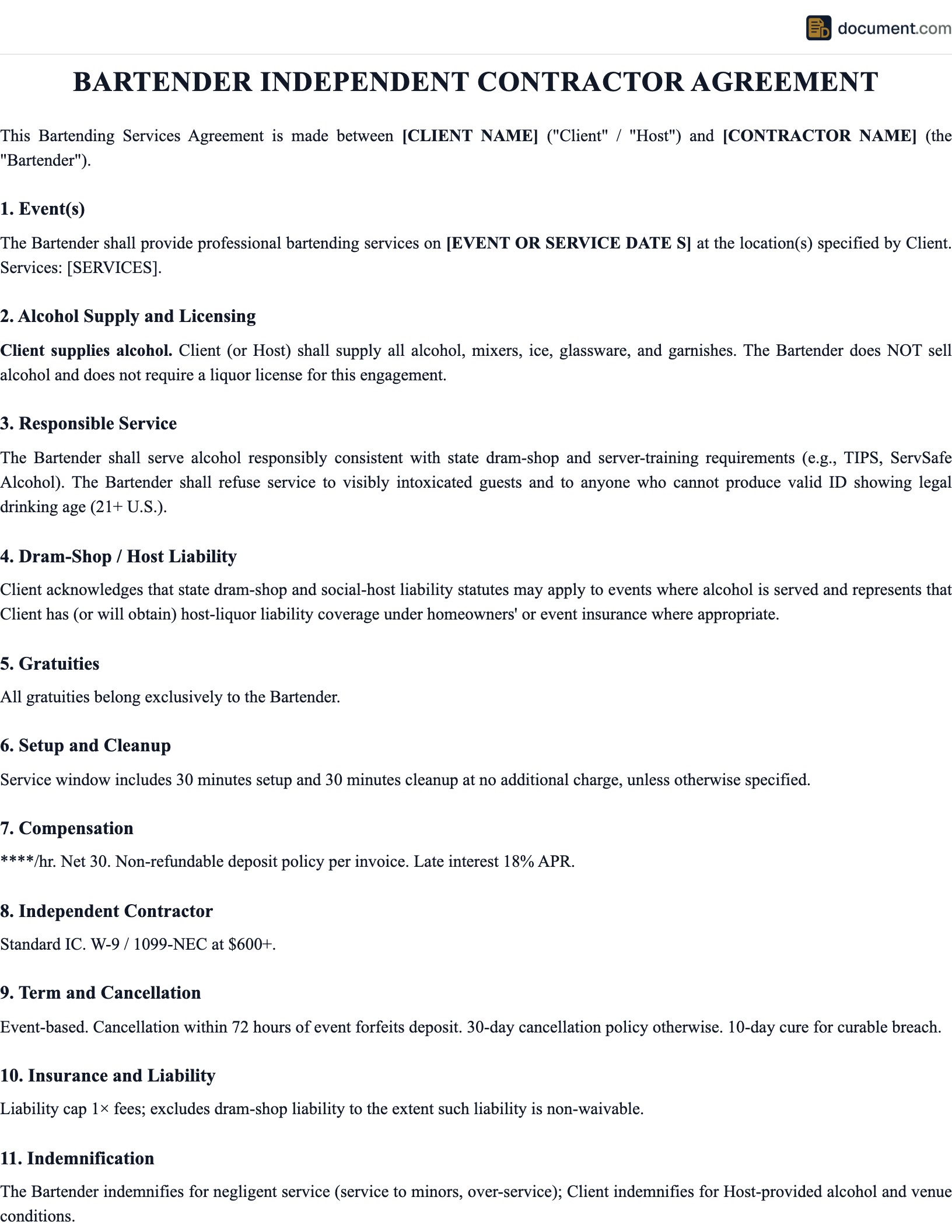



What Is a Bartending Contract?
A bartending contract for independent contractors is a written agreement between a client — typically an event host, wedding planner, corporate event coordinator, or venue operator — and a freelance bartender who provides mobile or event bartending services outside of a traditional employer-employee relationship. The freelance bartending industry has grown significantly as weddings, corporate events, and private parties increasingly hire independent bartenders rather than relying on venue-provided staff. This contract governs the terms of that engagement and addresses the unique legal, regulatory, and practical considerations that arise when alcohol service is involved.
What makes bartending contracts distinct from other independent contractor agreements is the overlay of liquor regulation. Every state regulates the service of alcohol through its Alcohol Beverage Control (ABC) agency, and these regulations create obligations that flow directly into the contract. Dram shop liability — which holds alcohol servers responsible for injuries caused by intoxicated patrons they served — adds a layer of legal risk that does not exist in most other contractor relationships. The bartender's obligation to check identification, refuse service to visibly intoxicated guests, and comply with state-specific serving laws must be documented in the contract and cannot be waived by the client.
The contract also addresses practical event logistics that can make or break the bartender's performance: who provides the alcohol, mixers, ice, and glassware; the physical bar setup and breakdown timeline; guest count and drink calculation formulas; signature cocktail menus and specialty drink preparation; gratuity handling; and contingency plans for weather disruptions at outdoor events. A thorough bartending contract transforms what could be a chaotic, dispute-prone arrangement into a professional engagement with clear responsibilities on both sides.
Liquor Liability
Addresses dram shop laws, insurance, and responsible service obligations.
Clear Compensation
Defines flat fees, hourly rates, gratuity policies, and overtime terms.
Event Planning
Covers supply lists, setup/breakdown, guest counts, and weather contingencies.
Bartending Contract Form Preview
Bartending Service Agreement
Independent Contractor Event Bartending
1. EVENT DETAILS
Event Date: Event Type: Location: Expected Guest Count:
2. SERVICES AND SUPPLY RESPONSIBILITIES
Bartender shall provide professional bartending services including drink preparation, responsible alcohol service, and bar area maintenance. Alcohol and supplies shall be provided by: .
3. LIQUOR LIABILITY
Bartender shall comply with all applicable state and local liquor laws, check identification for all guests appearing under 30 years of age, and refuse service to visibly intoxicated persons.
CLIENT SIGNATURE
BARTENDER SIGNATURE
Key Components
| Component | Purpose | Key Details |
|---|---|---|
| Event Specifications | Defines the scope of the engagement | Date, time, location, guest count, indoor/outdoor, event type (wedding, corporate, private) |
| Supply Responsibilities | Clarifies who provides what | Alcohol, mixers, garnishes, ice, glassware, portable bar, cocktail napkins, straws |
| Compensation | Documents fees and payment terms | Flat fee or hourly rate, deposit amount, final payment timing, overtime rate |
| Gratuity Policy | Prevents tip disputes | Tip jar permitted/prohibited, included gratuity percentage, tip splits with assistants |
| Liquor Liability | Allocates alcohol service risk | Insurance requirements, dram shop compliance, ID verification, right to refuse service |
| Setup & Breakdown | Defines on-site time commitment | Arrival time, setup duties, last call timing, cleanup scope, equipment removal |
| Cancellation Terms | Protects both parties | Notice requirements, deposit forfeiture, weather contingency, rescheduling options |
| Insurance | Ensures adequate coverage | General liability, liquor liability, auto insurance, additional insured requirements |
How to Create a Bartending Contract
Document Event Details
Record the event date, start and end times, venue name and address, indoor/outdoor designation, expected guest count, event type (wedding, corporate, milestone birthday, etc.), and the name and contact information for the on-site event coordinator who will be the bartender's primary point of contact.
Define Supply Responsibilities
Create a detailed supply list specifying who provides: spirits (vodka, gin, rum, tequila, whiskey, bourbon), wine (red, white, sparkling), beer (domestic, craft, import), mixers (tonic, soda, juice, syrups), garnishes (citrus, olives, cherries), ice (quantity based on 1.5 lbs per guest), glassware, bar tools, and the physical bar structure.
Set Compensation and Payment Schedule
Establish the fee structure (flat fee for the event or hourly rate), deposit amount (typically 25-50% due at signing), balance due date (commonly 7-14 days before the event), overtime rate (typically 1.5x hourly for extensions beyond the contracted end time), and payment method.
Address Liquor Liability and Compliance
Include provisions for state-specific dram shop compliance, ID verification procedures, cut-off protocols, the bartender's right to refuse service, insurance requirements and certificate of insurance delivery timeline, and indemnification provisions addressing the client's liability for overriding the bartender's service decisions.
Draft Cancellation and Weather Terms
Specify the deposit refund policy based on cancellation timing (full refund 30+ days out, 50% refund 14-29 days, no refund under 14 days is standard), weather contingency plans for outdoor events, and rescheduling terms including any rebooking fees or date-change penalties.
Execute Before the Event
Both parties should sign the agreement well before the event date — ideally at the time of booking. Attach any supplementary documents: the bar menu, supply list, venue access requirements, and certificate of insurance. Provide copies to both parties and the venue coordinator if required.
Liquor Liability & Dram Shop Laws
Liquor liability is the single most significant legal risk in a bartending engagement and the primary reason that a written contract is essential. Dram shop laws — named after the 18th-century term for establishments that sold gin by the "dram" — impose civil liability on alcohol servers for injuries caused by intoxicated patrons they served. As of 2024, 43 states and the District of Columbia have enacted some form of dram shop statute, and the remaining states may impose liability through common-law negligence theories.
The scope of dram shop liability varies dramatically across states. In Texas, a server who provides alcohol to a "obviously intoxicated" person is liable for damages caused by that person. In California, the Dram Shop Act (Civil Code Section 1714) generally protects servers from liability for serving adults, holding that the consumption — not the service — is the proximate cause of injury, but liability still attaches for serving minors. New York's General Obligations Law Section 11-101 imposes liability for selling or assisting in procuring alcohol for a visibly intoxicated person. Illinois's Liquor Control Act creates a cause of action against any person who sells or gives alcohol to an intoxicated person.
For independent contractor bartenders, the contract must address who bears liability when an intoxicated guest causes an injury or accident after the event. Typically, the bartender assumes liability for their own serving decisions (serving a visibly intoxicated guest, failing to check IDs), while the client assumes liability for their own conduct (providing alcohol to guests directly, overriding the bartender's decision to cut off a guest, failing to arrange safe transportation for guests). The indemnification provisions should reflect this allocation clearly.
Social Host Liability
In addition to dram shop liability (which applies to commercial servers), many states impose social host liability on individuals who serve alcohol at private events. When a client hires an independent bartender for a private party, the question of whether the bartender, the client, or both are liable under social host statutes depends on state law. The contract should address this overlap explicitly and require both parties to carry appropriate insurance.
Contract Considerations by Event Type
Different event types present unique contractual considerations that should be reflected in the agreement:
| Event Type | Unique Considerations | Typical Fee Structure |
|---|---|---|
| Weddings | Signature cocktails, champagne toast timing, coordination with caterer, extended service hours | Flat fee per bartender ($200-500) + gratuity |
| Corporate Events | Brand compliance, premium pours, drink ticket systems, company liability concerns | Hourly ($40-75/hr per bartender) |
| Private Parties | Custom menus, smaller guest counts, residential venue logistics, parking considerations | Flat fee or hourly ($35-60/hr) |
| Festivals & Pop-Ups | Multi-day scheduling, temporary permits, high volume, cash handling, health dept compliance | Daily rate ($300-600) or per-drink commission |
Frequently Asked Questions
Official Resources
Authoritative resources on liquor licensing, responsible service, and bartending regulations.
TTB - Alcohol and Tobacco Tax and Trade Bureau
Federal agency regulating alcohol production, distribution, and trade practices.
TIPS Alcohol Training
Leading responsible beverage service certification program for bartenders and servers.
ServSafe Alcohol
National Restaurant Association alcohol server certification and training resources.
IRS - Worker Classification
IRS guidance on independent contractor vs. employee classification for bartenders.
NABCA - National Alcohol Beverage Control Association
Resources on state alcohol control systems and regulatory frameworks.
Responsibility.org
Resources on responsible alcohol consumption, impaired driving prevention, and safe serving.
Create Your Bartending Contract
Protect your event and your business with a professional bartending agreement covering liquor liability, fees, and compliance.
Create DocumentNo account required. Free to create and preview.