



Key Takeaways
- •A do-not-train AI opt-out notice is a set of layered signals, not a single document. The robust version combines a robots.txt block of AI crawlers, a machine-readable rights reservation, embedded image metadata, and, where personal data is involved, a privacy-law opt-out. Each layer covers a gap the others leave open.
- •In the EU, the reservation has real legal weight. Article 4(3) of the DSM Copyright Directive (EU) 2019/790 lets rightsholders opt their works out of text-and-data mining, and for online content the opt-out must be machine-readable. The AI Act, Regulation (EU) 2024/1689, Article 53(1)(c), now requires general-purpose AI providers to identify and comply with those reservations, an obligation that began applying on 2 August 2025.
- •In the United States there is no statute that forces an AI company to honor a do-not-train tag on copyrighted work. Your leverage is contract (website terms), technical blocking (robots.txt and access controls), and, for personal data, state privacy opt-outs under the CCPA, Colorado, Connecticut, and Texas laws.
- •Honoring robots.txt is voluntary. RFC 9309 standardizes the format but not compliance, so the file is a request, not a fence. OpenAI's GPTBot, Google-Extended, Anthropic's ClaudeBot, and Common Crawl's CCBot publish documented user-agent tokens you can disallow, but enforcement depends on the crawler choosing to obey.
- •The technical standards are converging. The IETF AIPREF working group, chartered January 2025, is building a common Content-Usage vocabulary attached through robots.txt and an HTTP header. IPTC added a machine-readable plus:DataMining property in October 2023. C2PA confirmed on 22 January 2026 that Content Credentials are a provenance standard and do not themselves carry a do-not-train assertion.
- •Litigation, not opt-out tags, is setting the boundaries. In 2025, judges in Bartz v. Anthropic and Kadrey v. Meta found AI training can be fair use, while Thomson Reuters v. Ross rejected it; Anthropic separately agreed to a 1.5 billion dollar class settlement over pirated books, and The New York Times v. OpenAI is proceeding in the Southern District of New York.
Reviewed for accuracy by the document.com legal team. Educational information, not legal advice.
What Is Do Not Train AI Opt-Out Notice?
A do-not-train AI opt-out notice is a combination of machine-readable signals and written declarations that tells AI developers and their web crawlers not to use your content or personal data to train, fine-tune, or otherwise build artificial intelligence models. It is not one form you sign and file. It is a stack: a robots.txt directive that names the AI crawlers and disallows them, a rights reservation in your site terms and metadata, embedded tags inside your image and video files, and, when the material involves personal information about you, a privacy-law opt-out request sent to the company. People reach for it after they realize their blog, portfolio, photo library, or face has probably already been swept into a training set, and they want to draw a line going forward.
No single law in the United States makes the tag binding on its own. That is the uncomfortable truth most templates skip. What gives the notice teeth varies by where you are and what you are protecting. In the EU, a properly expressed reservation under copyright law actually obligates AI providers to respect it. In the US, your force comes from your website's terms of service as a contract, from technically blocking access, and from consumer-privacy statutes that let you stop the sale, sharing, or processing of your personal data. The notice works best when you treat it as a layered defense rather than a magic incantation, because any one layer can be ignored by a crawler that decides the rules do not apply to it.
Why This Matters Now
The ground shifted because the web stopped being free for the taking. On 1 July 2025, Cloudflare, which sits in front of roughly a fifth of all websites, flipped the default: new domains it manages now block AI crawlers unless the owner opts in, and it launched a Pay Per Crawl marketplace letting publishers charge AI companies per page fetched. That single infrastructure change did more to operationalize do-not-train preferences overnight than years of voluntary robots.txt entries. Around it, the standards bodies moved. The IETF chartered its AIPREF working group in January 2025 to build a common vocabulary for AI usage preferences, attachable through robots.txt and a new Content-Usage HTTP header, after everyone admitted the existing tools were a patchwork.
The legal pressure is just as recent. The EU AI Act began applying its general-purpose AI obligations on 2 August 2025, and Article 53(1)(c) ties those models to the copyright opt-out in the older DSM Directive, so a machine-readable reservation in Europe is now something providers must address in a published policy. On the privacy side, the European Data Protection Board issued Opinion 28/2024 on 18 December 2024, confirming that when an AI developer relies on legitimate interest to train on personal data, the individual's right to object under GDPR Article 21 applies. Meta paused its EU AI training in mid-2024 after regulator pushback before resuming under an objection process. And the US courts spent 2025 drawing the copyright lines in real cases, which is why an opt-out filed today sits on top of a fast-moving and unsettled body of law rather than a finished one.
The Legal Backbone
robots.txt and the AI crawler user-agents (RFC 9309, voluntary)
The Robots Exclusion Protocol became a published IETF standard, RFC 9309, in September 2022, but the standard defines the file format, not an obligation to obey it. A robots.txt entry is a posted request that well-behaved crawlers honor and bad actors ignore. For a do-not-train notice this is the front line, because the major AI developers publish documented user-agent tokens you can disallow: OpenAI's GPTBot, Google's Google-Extended, Anthropic's ClaudeBot, Perplexity's PerplexityBot, and Common Crawl's CCBot, whose archive feeds many training sets. A complication worth knowing: companies now run split crawlers. Anthropic operates ClaudeBot for training, Claude-SearchBot for indexing, and Claude-User for real-time fetches, and disallowing one does not disallow the others. Blocking training crawlers while allowing search crawlers is a real choice you make line by line, and getting the tokens current matters because they change.
EU DSM Directive 2019/790, Article 3 and Article 4(3) (text-and-data-mining opt-out)
This is where the opt-out has actual copyright force, and only in the EU. Article 3 of Directive (EU) 2019/790 gives research organizations and cultural heritage institutions a TDM exception with no opt-out, so a non-commercial researcher can mine your work regardless of your tag. Article 4 extends a TDM exception to everyone else, including commercial AI developers, but with a carve-out: under Article 4(3) a rightsholder may expressly reserve the use of their works, and for content made publicly available online that reservation must be expressed by machine-readable means, such as metadata or the terms and conditions of a website. Reserve properly and the commercial TDM exception no longer applies to your work, which is the legal hook a do-not-train notice leans on in Europe. The open question litigated and debated since is what counts as machine-readable enough, which is exactly the gap the IETF and IPTC standards are trying to close.
EU AI Act, Regulation (EU) 2024/1689, Article 53(1)(c) (the compliance duty)
The AI Act took the older copyright opt-out and pointed an enforcement mechanism at it. Article 53(1)(c) requires providers of general-purpose AI models to put in place a policy to comply with Union copyright law and in particular to identify and comply, including through state-of-the-art technologies, with a reservation of rights expressed pursuant to Article 4(3) of Directive (EU) 2019/790. Put plainly: a company building a model like a large language model now has to have a policy for spotting and respecting your machine-readable do-not-train reservation, and that obligation started applying to general-purpose AI models on 2 August 2025. This is a duty about reservations expressed under EU copyright law, so it strengthens the EU layer of your notice; it does not create a US right. The phrase including through state-of-the-art technologies is doing heavy lifting and remains the subject of guidance and dispute.
Embedded metadata standards: IPTC Data Mining, TDMRep, and C2PA
For images and video the reservation can travel inside the file. IPTC added a Data Mining property to its Photo Metadata Standard in version 2023.1, released October 2023, stored in XMP as plus:DataMining, with controlled values that can signal that mining is prohibited, prohibited except for search indexing, or prohibited except for AI/ML training. The W3C community produced the TDM Reservation Protocol (TDMRep) as another machine-readable way to express an Article 4(3) reservation across a whole site or per resource. One point that confuses people: C2PA Content Credentials do not function as a do-not-train tag. The C2PA clarified on 22 January 2026 that its specification is a provenance and authenticity standard, recording where content came from and how it changed, and does not contain a standard TDM assertion, pointing instead to robots.txt, TDMRep, and licensing metadata for usage preferences. So embed IPTC or TDMRep for the opt-out and treat C2PA as the separate question of proving authenticity.
US privacy-law opt-outs and the FTC's model-deletion remedy
When the thing you are protecting is personal data rather than a copyrighted work, US state privacy laws give you a real opt-out, though none was written specifically for AI training. The California Consumer Privacy Act, as amended by the CPRA, lets you opt out of the sale and sharing of your personal information and request deletion, and the CPPA has signaled that deletion reaches information used to train models. Colorado, Connecticut, and Texas privacy laws require businesses to honor a universal opt-out mechanism such as Global Privacy Control, a browser-level signal that broadcasts your objection automatically. None of these forces a company to untrain a finished model. The closest US remedy is the FTC's algorithmic disgorgement, ordering deletion of models built on improperly collected data under Section 5 of the FTC Act, used in matters including Cambridge Analytica (2019), Everalbum (2021), WW/Kurbo (2022), and Rite Aid (2023). That is an enforcement tool the agency wields, not a button you press.
States with a Comprehensive Consumer-Privacy Law
A growing number of states now have a comprehensive consumer-privacy law that governs how personal data, including data used by AI, may be collected and used. The states below have one in force or enacted.
| State | Comprehensive privacy law |
|---|---|
| California | California Consumer Privacy Act (CCPA), California Civil... |
| Virginia | Virginia Consumer Data Protection Act (VCDPA), Virginia... |
| Colorado | Colorado Privacy Act (CPA), C.R.S. § 6-1-1301 et seq. |
| Connecticut | Connecticut Data Privacy Act (CTDPA), Connecticut General... |
| Utah | Utah Consumer Privacy Act (UCPA), Utah Code § 13-61-101 et... |
| Montana | Montana Consumer Data Privacy Act (MCDPA), Montana Code... |
| Oregon | Oregon Consumer Privacy Act (OCPA), Oregon Revised Statutes... |
| Texas | Texas Data Privacy and Security Act (TDPSA), Texas Business... |
| Florida | Florida Digital Bill of Rights (FDBR), Florida Statutes §... |
| Arkansas | Arkansas Online Privacy Act (AOPA), HB 1717, codified at... |
| Delaware | Delaware Personal Data Privacy Act (DPDPA), Delaware Code... |
| Iowa | Iowa Consumer Data Protection Act (ICDPA), Iowa Code §... |
| New Hampshire | New Hampshire Privacy Act (NHPA), New Hampshire Revised... |
| New Jersey | New Jersey Data Protection Act (NJDPA), New Jersey Revised... |
| Nebraska | Nebraska Data Privacy Act (NDPA), Nebraska Revised Statutes... |
| Tennessee | Tennessee Information Protection Act (TIPA), Tennessee Code... |
| Minnesota | Minnesota Consumer Data Privacy Act (MCDPA), Minnesota... |
| Maryland | Maryland Online Data Privacy Act (MODPA), Maryland Code... |
| Indiana | Indiana Consumer Data Protection Act (ICDPA), Indiana Code... |
| Kentucky | Kentucky Consumer Data Protection Act (KCDPA), Kentucky... |
| Rhode Island | Rhode Island Data Transparency and Privacy Protection Act... |
| Oklahoma | Oklahoma Consumer Data Privacy Act (OCDPA), Oklahoma Senate... |
Compiled from primary state statutes and verified against legislative sources in 2026. Privacy laws are being enacted and amended rapidly; confirm current obligations.
Why a do-not-train notice is a layered defense, and what each layer can and cannot do
The reason you cannot just paste one paragraph and call it done is that no single layer covers the whole problem, and each one fails in a different way. Start with the technical layer, robots.txt and access controls. This is the only layer that physically stops a compliant crawler before it ever reads your content, which makes it the most effective tool you actually control. Its weakness is that compliance is voluntary. A crawler that ignores robots.txt, or that fetches your pages through a third party like Common Crawl, walks right past it. So robots.txt is necessary and never sufficient, and pairing it with infrastructure-level blocking, the kind Cloudflare now offers by default, closes part of the gap a polite text file leaves open.
The second layer is the rights reservation, and here geography decides everything. In the EU, expressing a machine-readable Article 4(3) reservation has bite, because the AI Act now obliges general-purpose model providers to identify and respect it. In the US, the identical tag carries no statutory force over a copyrighted work, and whether scraping for training is lawful at all is being fought out case by case, with judges so far split. What the reservation does buy you in the US is contract and notice: language in your terms of service can form an enforceable agreement against a party that accesses your site, and a documented, dated reservation is evidence you objected, which matters if the law shifts or if you later sue. The drafting can be identical on both sides of the Atlantic, but in Europe the reservation commands compliance while in the US it builds a contractual and evidentiary record.
The third layer is embedded metadata, IPTC's plus:DataMining property or a TDMRep statement, which keeps your opt-out attached to a photo or video even after it is copied, reposted, and stripped of its surrounding page. That persistence is its whole value, and its limit is that the file can be re-encoded and the metadata wiped, and that downstream tools have to choose to read it. The fourth layer, the privacy opt-out, is the one most people overlook and the one with the most reliable US teeth, because it does not depend on owning a copyright. If the training data is your name, face, posts, or other personal information, the CCPA and its sister statutes let you demand the company stop selling or sharing it, delete it, and in several states honor a Global Privacy Control signal automatically. The strongest notice runs all four layers at once and matches the demand to the harm: robots.txt and Cloudflare to block the fetch, an Article 4(3) reservation for EU copyright weight, IPTC or TDMRep tags for persistence, and a privacy opt-out for anything personal. Then keep dated copies of every layer, because the value of a do-not-train notice in the US is as much about proving you objected as about any single switch you flipped.
When You Need This
You run a website, blog, or online store and you want AI crawlers blocked going forward: add the AI user-agents to robots.txt, enable infrastructure blocking, and post a machine-readable rights reservation in your terms.
You are an author, journalist, or publisher whose text is being scraped for language models: combine a robots.txt block with an Article 4(3)-style reservation, and watch the publisher litigation since your leverage in the US is still contractual and evolving.
You are a photographer, illustrator, or designer and your images are training generative models: embed the IPTC plus:DataMining opt-out in your files and add TDMRep so the reservation survives reposting.
The material is personal information about you, your name, face, voice, or social posts, not a copyrighted work: file a CCPA or state-law opt-out of sale and sharing, request deletion, and enable Global Privacy Control in your browser.
You sell into or have audiences in the EU: express the reservation in machine-readable form so it triggers the AI Act Article 53 compliance duty on general-purpose AI providers.
You want a dated record that you objected before the law settles: keep timestamped copies of every signal and demand, because in the US the proof that you opted out may matter more than any one mechanism.
How to Fill Out Do Not Train AI Opt-Out Notice
1. Inventory what you are protecting and where it lives
List the assets and classify each. A website or blog is one thing, downloadable image and video files are another, and personal data about you is a third. The right layers differ: a site needs robots.txt and a terms reservation, image files need embedded metadata, and personal information needs a privacy opt-out. Note where each asset is hosted, because your control over robots.txt and headers depends on having access to the server or CDN.
2. Block the AI crawlers in robots.txt
Add explicit disallow rules for the documented AI training user-agents, including GPTBot, Google-Extended, ClaudeBot, CCBot, and PerplexityBot, and decide deliberately whether to also block the separate search and real-time crawlers each company runs. Place robots.txt at your domain root. Remember this is a request a crawler can ignore, so do not rely on it alone, and re-check the token list periodically because vendors add and rename bots.
3. Turn on infrastructure-level blocking where you can
If your site sits behind a CDN or security provider, enable its AI-crawler controls. Cloudflare, for example, now offers to block AI crawlers by default and runs a Pay Per Crawl option. Infrastructure blocking enforces at the network edge rather than asking nicely, so it stops crawlers that disregard robots.txt, and it is the biggest practical upgrade over a text file you can make in a single setting.
4. Express a machine-readable rights reservation
State a reservation of rights for text-and-data mining in your website terms and conditions and in a machine-readable form, the approach Article 4(3) of the EU DSM Directive contemplates. Implementing TDMRep across the site, or at minimum clear terms-of-service language prohibiting AI training use, gives you the EU copyright hook and, in the US, a contractual basis and dated evidence of your objection.
5. Embed opt-out metadata in image and video files
For visual work, write the IPTC Data Mining property (plus:DataMining in XMP) into each file using a metadata editor, choosing the value that prohibits AI or ML training. Because the tag lives inside the file, it travels with the image when it is copied or reposted. Re-export carefully, since some platforms strip metadata on upload, and keep your original masters with the tags intact.
6. File privacy opt-outs for personal data
If the material is personal information, send the company a CCPA or state-law request to opt out of sale and sharing and to delete your data, and enable Global Privacy Control in your browser so the objection is broadcast automatically to sites that honor it. In the EU or UK, send a GDPR Article 21 objection where the developer relies on legitimate interest. These do not untrain an existing model, but they govern future processing and create a record.
7. Send a direct notice to identifiable developers
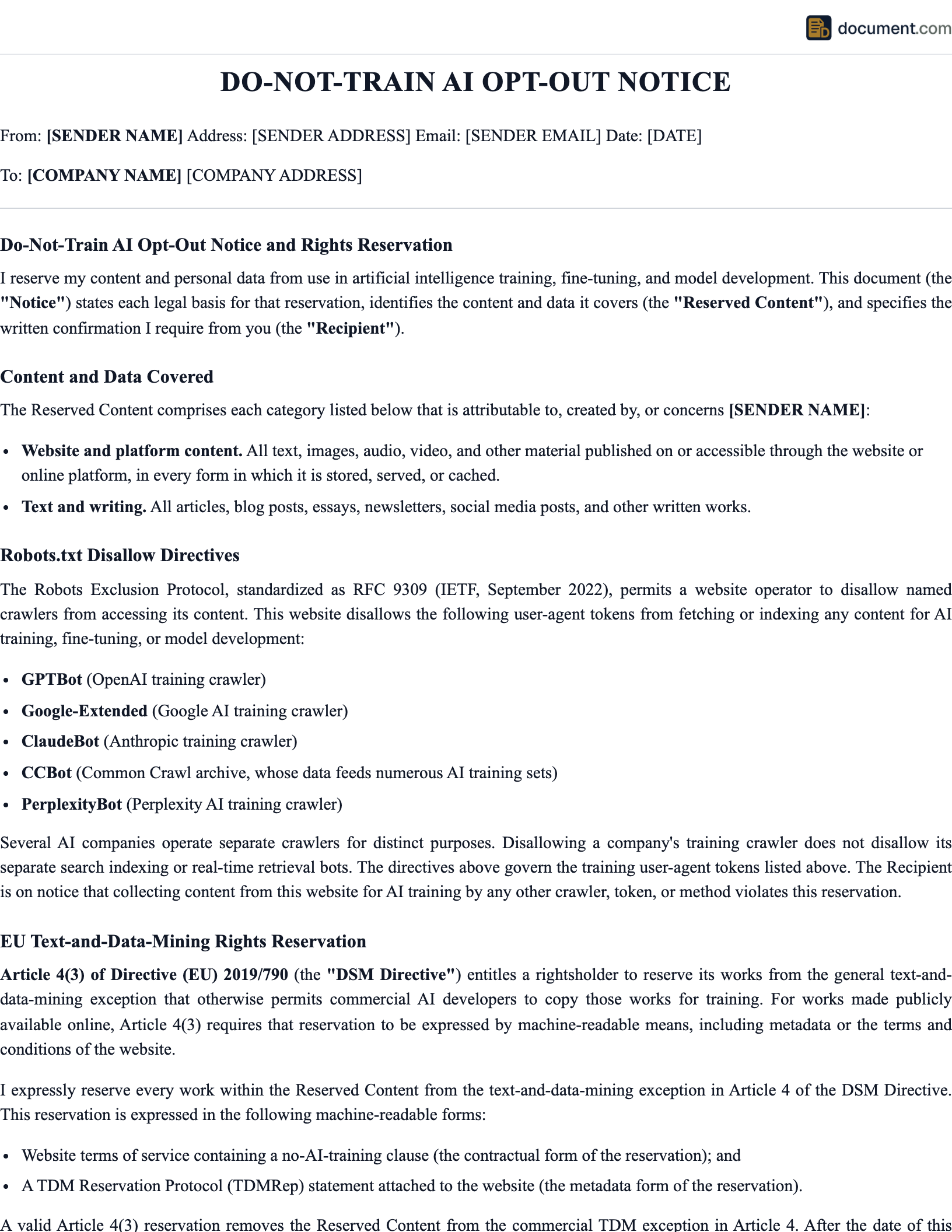
Where you can name the AI company collecting your work, send a written do-not-train notice citing your reservation, your robots.txt directives, and, for personal data, the applicable privacy statute. Keep it specific: identify the assets, state the basis, and request confirmation. This converts a passive signal into an addressed demand and strengthens any later claim that the use continued after notice.
8. Date, archive, and re-check on a schedule
Save timestamped copies of your robots.txt, your terms reservation, your tagged files, and every opt-out request and response. Re-verify the crawler token list and your CDN settings on a recurring basis because the user-agents and the standards keep changing. The archive is the point: in the US, where the law is unsettled, proof that you reserved your rights on a specific date is often your strongest asset.
Key Terms Defined
- Text and data mining (TDM)
- The automated analysis of large amounts of text, images, or other content to extract patterns and information. Training an AI model on scraped web content is a form of TDM, which is why EU copyright exceptions written for TDM in Articles 3 and 4 of Directive (EU) 2019/790 now govern AI training in Europe.
- Rights reservation (Article 4(3) opt-out)
- A rightsholder's express statement, required to be machine-readable for online content, that reserves their works from the general text-and-data-mining exception. Under EU DSM Directive Article 4(3) a valid reservation removes the commercial TDM exception for that work, and the AI Act obliges general-purpose AI providers to respect it.
- robots.txt and user-agent
- A file at a website's root, standardized as RFC 9309, that lists which automated crawlers may access which paths. A user-agent is the identifying token a crawler sends, such as GPTBot or ClaudeBot. Disallowing a user-agent in robots.txt requests that the crawler stay out, though compliance is voluntary.
- plus:DataMining (IPTC property)
- A machine-readable metadata field introduced in the IPTC Photo Metadata Standard 2023.1 in October 2023, embedded in a file's XMP, whose controlled values can signal that data mining is prohibited, prohibited except for search indexing, or prohibited except for AI and ML training. It keeps the opt-out attached to the image itself.
- Global Privacy Control (GPC)
- A browser-level signal that automatically tells every website you visit that you opt out of the sale and sharing of your personal data. Several US state privacy laws, including those in California, Colorado, Connecticut, and Texas, require covered businesses to honor it as a universal opt-out mechanism.
- Algorithmic disgorgement
- An FTC enforcement remedy, grounded in Section 5 of the FTC Act, ordering a company to delete AI models or algorithms developed from improperly collected data. The agency has imposed it in matters including Cambridge Analytica, Everalbum, Kurbo, and Rite Aid. It is a government remedy, not a consumer self-service right.
Related Documents
Do-Not-Train Opt-Out vs. AI Likeness Takedown Notice
A do-not-train opt-out is forward-looking and preventive: it reserves your content and data from being ingested into a model in the first place, through robots.txt, rights reservations, metadata, and privacy opt-outs. An AI likeness takedown notice is reactive and removal-focused: it forces a platform to pull down a specific deepfake or synthetic depiction already published, often within 48 hours under laws like the TAKE IT DOWN Act. Use the opt-out to keep your material out of training sets; use the takedown when a harmful synthetic output already exists. They address different stages of the same problem.
Do-Not-Train Opt-Out vs. Website Terms of Use
A do-not-train opt-out is a layered package of technical and legal signals, while website terms of use are a single contract governing how visitors and bots may use your site. The two overlap and reinforce each other: a no-AI-training clause in your terms supplies the contractual and machine-readable rights-reservation layer of a complete opt-out, which is exactly the form Article 4(3) of the EU DSM Directive contemplates. Terms of use alone do not block a crawler at the network level, and a robots.txt block alone is not a contract. Put the reservation in your terms and back it with the technical layers.
Do-Not-Train Opt-Out vs. Privacy Opt-Out Request
A privacy opt-out request, such as a CCPA do-not-sell-or-share demand, is one layer inside a full do-not-train opt-out, the layer that covers personal data rather than copyrighted works. It is the layer with the most reliable US teeth, because state statutes require covered businesses to honor it and, in several states, to respect a Global Privacy Control signal. The broader do-not-train opt-out adds copyright reservations, robots.txt blocking, and embedded metadata for creative works that a privacy statute does not reach. Match the privacy request to personal data and the copyright layers to your creative output.
Legal Authorities & Sources
This page is grounded in primary law. The statutes and official resources below are the authorities behind the guidance above. Verify the current text of any statute before relying on it.
- EU DSM Directive (EU) 2019/790, full text (EUR-Lex)
- EU AI Act, Regulation (EU) 2024/1689, Article 53 (artificialintelligenceact.eu)
- IETF AIPREF Working Group, Progress on AI Preferences
- IETF draft, Indicating Preferences regarding content usage (aipref-attach)
- IPTC Photo Metadata Standard (Data Mining property)
- C2PA Clarification: No TDM Assertions in the Standard (22 Jan 2026)
- EDPB Opinion 28/2024 on AI models and personal data
- California Attorney General, CCPA consumer rights
- Cloudflare, Content Independence Day: no AI crawl without compensation
Frequently Asked Questions
Create your Do Not Train AI Opt-Out Notice in minutes.
Answer a few questions and download a clear, attorney-drafted document that cites the controlling law and is ready to sign.