



Key Takeaways
- •A corporate indemnification agreement is a contract between the company and an individual director or officer. It converts the corporation's discretionary power to indemnify under Delaware DGCL Section 145 into a binding personal obligation the director can enforce in court.
- •Delaware Section 145 has a permissive track (subsections (a) and (b)) and a mandatory track (subsection (c)). The permissive track requires the corporation to make a case-by-case determination that the director acted in good faith and in a manner reasonably believed to be in the best interests of the corporation. The mandatory track kicks in automatically when the director succeeds on the merits or otherwise in defense.
- •Advancement of expenses is the more immediately valuable protection. Under Section 145(e) and most indemnification agreements, the corporation pays defense costs as they accrue, before the case ends, conditioned on the director's written undertaking to repay if it is ultimately determined that indemnification is not available.
- •D&O insurance and corporate indemnification are complementary, not interchangeable. Side B D&O covers the company when it indemnifies; Side A covers the director directly when the company cannot or will not indemnify. An indemnification agreement that is poorly drafted can impair how the insurance responds.
- •The standard-of-conduct exclusions in Section 145 are not waivable by agreement. A director adjudged liable for breach of the duty of loyalty, for acts or omissions not in good faith, or for conduct involving intentional misconduct or knowing violation of law cannot be indemnified for a resulting judgment, regardless of what the agreement says.
- •This page and its template are general educational information, not legal advice. Indemnification law is shaped by Delaware case law that continues to develop; have qualified counsel review any agreement before it is signed.
Reviewed for accuracy by the document.com legal team. Educational information, not legal advice.
What Is Corporate Indemnification Agreement?
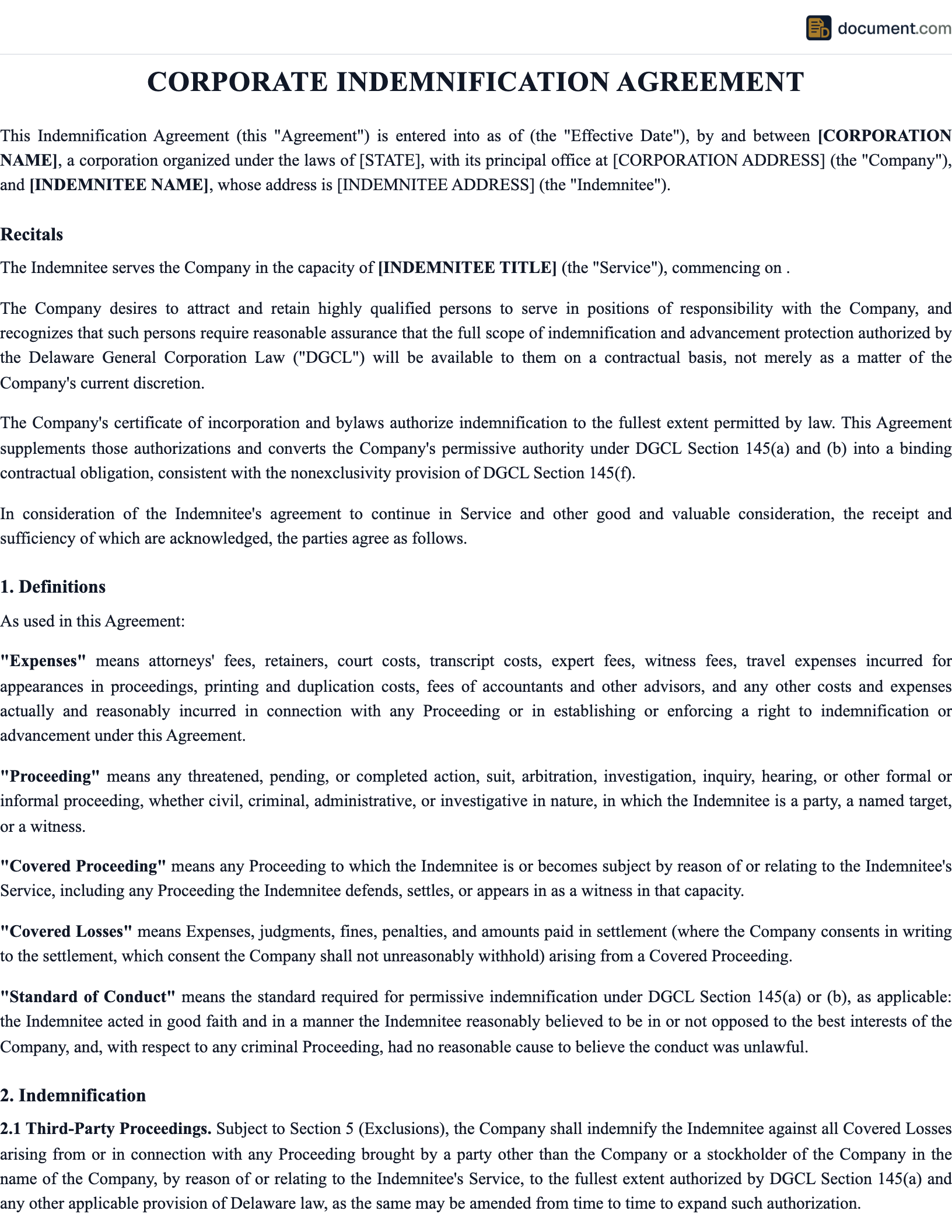
A corporate indemnification agreement is a bilateral contract between the corporation and a director, officer, or other covered person, committing the company to pay that individual's defense costs, judgments, settlements, fines, and related expenses arising from their service to the corporation, subject to the standards and exclusions the law allows. Most publicly traded and venture-backed companies sign these agreements with each director and named officer at the time of appointment. The agreement supplements whatever rights the corporation's charter and bylaws already provide, and it fills gaps that generic bylaw language often leaves open.
The instrument matters because it makes indemnification personal and contractually enforceable. A bylaw provision can be amended by stockholder vote or, in some circumstances, by the board. An individual indemnification agreement cannot be changed unilaterally once it is signed, and it typically locks in the version of the law that applied when the person accepted the role. If the legislature later narrows the statute or the board votes to amend the bylaws, the agreement preserves what the director was promised when they joined.
The agreement also converts permissive rights into mandatory ones. Under Delaware General Corporation Law Section 145(a) and (b), a corporation is authorized, but not required, to indemnify a director who meets the statutory standard of conduct. The corporation has discretion; it makes a determination case by case through disinterested directors, a committee, independent counsel, or stockholders. An indemnification agreement replaces that discretion with an obligation: if the director meets the standard, the company must pay. The director does not have to persuade a board that may be hostile or conflicted.
The document typically covers three categories of loss. First, defense costs, meaning attorneys' fees, expert fees, and other litigation expenses. Second, amounts paid to resolve claims, meaning judgments entered against the director and settlements the company approves. Third, in the case of criminal or regulatory proceedings where the law permits, fines and penalties. The agreement carves out everything the statute prohibits, specifically losses arising from conduct the director knew was wrongful, claims where the director has already been made whole by insurance, and amounts representing profits the director was not legally entitled to keep.
Why This Matters Now
Derivative litigation targeting directors and officers has grown steadily over the past decade, and the personal financial exposure from a prolonged defense, even a successful one, is substantial. A multi-year securities class action or a merger-challenge suit can generate millions in attorneys' fees before a single ruling on the merits. Without an advancement obligation in place, a director defending that kind of case is funding it out of pocket while waiting for the company to decide whether it feels like paying. The indemnification agreement eliminates that waiting.
The December 2020 amendments to Delaware General Corporation Law changed the landscape for officer indemnification specifically. Before those amendments, the statute treated officers and directors identically for indemnification purposes. The 2020 changes added a definition of officer that, for acts or omissions occurring after December 31, 2020, limits mandatory indemnification under Section 145(c) to officers who consented to Delaware service of process under Title 10, Section 3114(b). Companies that signed broad indemnification agreements with their officers before that change should review whether those agreements need to be updated or confirmed to remain enforceable on their original terms.
Delaware's Court of Chancery issued a significant ruling in Gilbert v. Unisys Corp. in 2024 clarifying when advancement rights attach to employees with vice president titles. The court held that ambiguity about who qualifies as an officer is resolved in favor of the person seeking advancement. That ruling reinforced why companies benefit from explicit, well-defined indemnification agreements rather than relying on the statutory defaults and hoping for favorable interpretations later.
Insolvency cuts deeper than most directors anticipate. Courts have held that indemnification and advancement obligations are general unsecured debts in bankruptcy. If a company files for Chapter 11 the day after a director submits a demand for advancement, that director may receive cents on the dollar, or nothing. Side A D&O insurance addresses this gap, but only if the underlying indemnification agreement is clearly drafted. Carriers have denied Side A coverage by arguing that, because the company's charter does not clearly obligate indemnification, Side A's trigger condition was never met.
Venture-capital backed companies and newly public companies face a specific recruitment challenge. Senior directors and executives who have served on multiple boards know what protections standard market practice delivers. Offering a position without an indemnification agreement is a red flag that experienced candidates notice. The NVCA model indemnification agreement, which is widely used in the startup ecosystem, sets a floor that most candidates expect as a condition of joining.
The Legal Framework
Delaware DGCL Section 145: the statutory foundation
Section 145 of the Delaware General Corporation Law is the primary statutory authority for corporate indemnification. Subsection (a) authorizes a corporation to indemnify a director, officer, employee, or agent in any third-party action if the person acted in good faith and in a manner the person reasonably believed to be in or not opposed to the best interests of the corporation, and, with respect to any criminal action or proceeding, had no reasonable cause to believe the person's conduct was unlawful. Subsection (b) extends similar permissive authority to derivative suits, but limits the remedy to expenses only, not judgments or settlements, and requires that the person not have been adjudged liable to the corporation except on a showing of fairness approved by the Court of Chancery. Subsection (c) creates the mandatory track: a person who has been successful on the merits or otherwise in defense of any covered proceeding shall be indemnified against expenses, including attorneys' fees, actually and reasonably incurred. Subsection (d) sets out the determination procedures for the permissive track: majority vote of disinterested directors, a committee thereof, independent legal counsel, or stockholders. Subsection (e) permits advancement of expenses in advance of a final disposition, conditioned on the person's undertaking to repay if it is ultimately determined that indemnification is unavailable. Subsection (f) is the nonexclusivity clause: the rights granted by the statute are not exclusive of any other rights to which a director may be entitled under any bylaw, agreement, vote of stockholders, or disinterested directors. That clause is what makes the individual indemnification agreement possible and legally secure.
The 2020 amendment and officer-specific rules
Before 2020, Section 145 treated officers and directors identically. The 2020 amendments to the DGCL narrowed mandatory indemnification under subsection (c) for officers. For acts or omissions occurring after December 31, 2020, mandatory indemnification under Section 145(c) applies to an officer only if that officer is one deemed to have consented to service of process in Delaware under Title 10, Section 3114(b) of the Delaware Code. The practical effect is that the category of officers entitled to mandatory, automatic indemnification on success is more precisely defined. The permissive authority under subsections (a) and (b) remains broad and unchanged, but the 2020 amendment means companies should verify that officer-level indemnification agreements explicitly address the post-2020 landscape and, where appropriate, convert what would otherwise be permissive coverage into a contractual obligation.
Standard of conduct: what disqualifies a director
The good faith and best interests standard in subsections (a) and (b) is not merely aspirational language; it is a substantive gate. A director who has been found to have acted in bad faith, in breach of the duty of loyalty, or in a manner involving intentional misconduct or a knowing violation of law cannot be indemnified under the statute for the resulting judgment. Section 145(b) also makes clear that in a derivative suit, indemnification for expenses is available only if the Court of Chancery determines on the facts that it is fair and proper even where the director was adjudged liable. These limits cannot be contracted away. An indemnification agreement cannot promise indemnification that the statute prohibits; such a promise would be void as against public policy under Delaware case law. The agreement can, however, establish the procedure for making the standard-of-conduct determination, appoint the mechanism (independent counsel, disinterested directors), set the burden of proof, and specify the consequences of a denial so that the director knows exactly where to go to challenge it.
The advancement mechanism and the undertaking to repay
Advancement is legally and practically distinct from indemnification. Indemnification is a reimbursement that happens after the proceeding ends. Advancement is a payment obligation that runs as the expenses accrue, while litigation is ongoing, before any determination of entitlement. Under Section 145(e), a corporation may advance expenses to a current director or officer upon receipt of an undertaking by or on behalf of the director or officer to repay such amount if it shall ultimately be determined that such person is not entitled to be indemnified. The statute does not require that the undertaking be secured or that the director demonstrate financial ability to repay. Most indemnification agreements make advancement mandatory and set a response window, typically 20 to 30 days, for the corporation to pay after receiving a statement of expenses. If the corporation refuses to advance, the director can seek a summary judgment in the Delaware Court of Chancery under expedited procedures. The Delaware Supreme Court affirmed in Citadel Holding Corp. v. Roven that advancement and indemnification are separate and distinct rights; a corporation cannot refuse to advance by arguing that it may ultimately deny indemnification.
The nonexclusivity provision and the agreement's relationship to bylaws
Section 145(f) provides that the rights created by the statute are not exclusive of any other rights to which a director may be entitled under any bylaw, agreement, vote of stockholders or disinterested directors, or otherwise. Delaware courts have interpreted this to mean that a corporation, a director, and a bylaw provision are each independent and nonexclusive sources of rights, absent specific agreement to the contrary. An indemnification agreement therefore stacks on top of whatever the bylaws say, and the director is entitled to the most favorable combination, unless the agreement says otherwise. This also means a later amendment to the bylaws that narrows coverage does not affect a director who holds a pre-existing indemnification agreement. The agreement is a separate contract, not a derivative of the bylaw, and the corporation cannot impair it unilaterally.
D&O insurance: Side A, Side B, and the gap the agreement must address
D&O insurance and the indemnification agreement work in tandem. Side B coverage reimburses the corporation for amounts it pays out under indemnification obligations, after a self-insured retention. Side A coverage protects the individual director directly when the corporation cannot or will not indemnify, with no retention. Side A is the critical safety net for insolvency scenarios: because Side A proceeds are generally not treated as property of the bankruptcy estate, directors can receive those payments even after the company files for Chapter 11. The relationship between the agreement and the policy matters operationally. Insurance carriers have successfully argued that if the company's governing documents do not clearly obligate indemnification, Side A's trigger condition, which requires that indemnification be owed but unavailable, is not met, and the policy does not respond. A well-drafted indemnification agreement closes that gap by making the obligation explicit and contractual, so both the agreement and the insurance work as intended. The agreement should also address who controls the defense, which is important if the carrier and the director prefer different counsel.
What the agreement actually commits the corporation to pay
The core economic promise in an indemnification agreement is broader than most people expect, and the carve-outs are narrower than most corporations wish they were.
Covered losses in a typical agreement include expenses, broadly defined to mean attorneys' fees, retainers, court costs, transcript costs, expert fees, and any other costs of participating in any proceeding. Most agreements also cover judgments entered against the director in a proceeding, amounts paid in settlement with the corporation's written consent, and fines and penalties imposed in criminal or regulatory matters where the director is entitled to indemnification under the statutory standard. If a director is called to testify as a witness, not a defendant, a good agreement covers those expenses too, because witnesses in corporate investigations often need counsel of their own.
Advancement is the part with the most immediate cash-flow consequence. A director under investigation or named in litigation is billing attorneys by the hour from day one. The agreement should specify the payment window: a common formulation requires the corporation to advance expenses within 30 days of receiving a written statement and reasonable documentation. The director's only obligation at the outset is the undertaking, a written promise to repay if a final determination is made that the director is not entitled to indemnification. The undertaking is unsecured and imposes no current financial burden; it is a contingent obligation that most directors never have to satisfy because they either win the underlying case or the corporation decides it does not want to pursue repayment.
Three categories of loss are excluded as a matter of law. First, amounts attributable to the director having obtained an improper personal benefit, such as a short-swing profit under Section 16(b) of the Securities Exchange Act of 1934. Second, losses arising from a proceeding initiated by the director against the corporation, except where the board authorized the proceeding or the director is asserting indemnification or advancement rights. Third, and most significantly, any claim for which a final adjudication establishes that the director acted in bad faith, breached the duty of loyalty, engaged in intentional misconduct, knowingly violated law, or received an improper personal benefit. These exclusions are embedded in the statute and cannot be overridden by agreement; an indemnification agreement that purports to cover them is unenforceable on those terms.
The agreement should also address what happens when the same proceeding produces some covered claims and some excluded claims. Most well-drafted agreements allocate indemnification proportionally, paying the covered portion and requiring repayment for the excluded portion, and they specify how that allocation is made.
One clause that companies sometimes overlook is the contribution provision. If indemnification is ultimately unavailable for a portion of the loss and insurance does not cover it either, a contribution provision obliges the corporation to share that loss with the director in proportion to their relative fault and benefit from the underlying transaction. Without such a provision, the director bears the entire uncovered loss alone.
When a company needs this document
At the time any director or executive officer accepts appointment, whether to the board, a board committee, or an officer role such as CEO, CFO, or general counsel. Signing the agreement at appointment is standard market practice for Delaware corporations and is what experienced directors expect before accepting a seat.
When onboarding a director who will also serve on the board of a subsidiary or an affiliated entity at the corporation's request. An agreement at the parent level should extend to subsidiary service, and confirming that in writing avoids disputes later about which entity is obligated.
When a corporation is preparing for an IPO or a significant financing round. Investors and underwriters will ask to see form indemnification agreements as part of due diligence, and having them in place before the process begins, rather than rushing to execute them during the road show, avoids unnecessary friction.
When an existing director or officer received only bylaw coverage and the company wants to give them a contractual right that cannot be altered by a later bylaw amendment. This conversion from bylaw-only to contractual protection is worth doing whenever a director or officer faces meaningful personal exposure from their corporate role.
When a company is restructuring its governance documents, refreshing its equity plans, or updating its D&O insurance program. That review is a natural point to audit whether indemnification agreements are current, cover the right people, and align with the latest insurance policy terms.
When a director or officer has been named in a proceeding and the company wants to confirm the contractual basis for advancing expenses before disbursing funds. Having a signed agreement in place converts what would be a discretionary board vote into an automatic obligation, which saves time and eliminates governance risk in an already stressed situation.
How to Fill Out Corporate Indemnification Agreement
1. Confirm the corporate authority to indemnify
Before drafting, verify that the corporation's certificate of incorporation and bylaws contain provisions that authorize indemnification to the fullest extent permitted by Delaware law, or whatever state governs the entity. Many form certificates and bylaws include this language, but confirm it. If it is missing or narrower than the statute permits, fix the governing documents first, then sign the agreement against that foundation. A contract that promises broader indemnification than the charter permits may be enforceable as a contractual matter, but it creates ambiguity that carriers exploit when Side B claims arise.
2. Define who is covered and for what service
Identify exactly who signs the agreement: each director by name, each named executive officer, and any employee who serves as an officer or director of a subsidiary or affiliated entity at the corporation's request. Define the service covered, meaning service as a director, officer, member of a committee, or fiduciary to an employee benefit plan. Be explicit about subsidiary service: if a director also sits on a wholly owned subsidiary board at the request of the parent, the parent's agreement should cover that service. The 2024 Chancery Court decision in Gilbert v. Unisys Corp. illustrates that ambiguity about who qualifies as an officer is resolved against the company; define the covered persons precisely.
3. Set out the scope of covered expenses and losses
Define expenses broadly: attorneys' fees, retainers, court costs, expert fees, witness preparation costs, travel expenses incurred for court appearances, and any other expenses actually and reasonably incurred. Cover judgments entered against the director, settlement amounts approved in writing by the corporation, and fines and penalties in criminal and regulatory matters where the statutory standard is met. Add a witness expense provision so that a director subpoenaed to testify in a proceeding where they are not the named defendant can retain counsel at the company's expense. Include a contribution clause allocating any uncovered portion of loss proportionally between the company and the director.
4. Draft the advancement clause with a fixed payment window
State that the corporation shall, not may, advance expenses. Set a specific window, commonly 20 to 30 days, from the date the director submits a written request and reasonable supporting documentation. Provide that the only condition to advancement is the delivery of the undertaking to repay. State that the undertaking need not be secured and need not demonstrate financial ability to repay. Specify that if the corporation fails to advance within the required window, the director may seek a summary determination from the Delaware Court of Chancery without waiting for a full trial on indemnification entitlement. That last point turns the advancement promise from a suggestion into an enforceable obligation.
5. Address the determination procedure for permissive indemnification
Specify which body makes the standard-of-conduct determination: disinterested directors by majority vote, a designated committee, independent legal counsel, or stockholders, consistent with Section 145(d). Many agreements appoint independent counsel as the preferred mechanism when the board is conflicted, which is often the case when the director being indemnified has a dispute with the corporation. Set the time limit for the determination: 90 days from the director's written request is a common formulation. If the determination is not made within that window, the agreement typically deems the director to have met the standard of conduct, placing the burden on the corporation to challenge indemnification rather than on the director to prove entitlement.
6. Carve out excluded losses and coordinate with D&O insurance
State clearly that the agreement does not cover: losses arising from intentional misconduct, knowing violation of law, bad faith, breach of the duty of loyalty, or receipt of an improper personal benefit; amounts for which the director has already been made whole by insurance, another indemnification agreement, or any other source; Section 16(b) short-swing profit disgorgements; and proceedings initiated by the director against the corporation, except for proceedings to enforce indemnification or advancement rights. Separately, add a coordination clause specifying that coverage under this agreement is primary and the corporation's D&O insurance is excess, and that the corporation will use commercially reasonable efforts to maintain D&O insurance covering the director for as long as any potential claim period runs.
7. Include an enforcement clause and confirm court jurisdiction
State that the director may bring an action in the Delaware Court of Chancery to enforce advancement or indemnification rights, and that the corporation has consented to expedited proceedings for advancement disputes. Note that Section 145(k) vests the Court of Chancery with exclusive jurisdiction to hear and determine all such actions. Add a provision that the corporation will advance the director's expenses in connection with any enforcement action, even if the director ultimately does not prevail on the underlying indemnification claim, to prevent the corporation from forcing the director to pay for the privilege of suing for reimbursement. Have each party sign and date the agreement and retain copies in the corporation's permanent records.
Key Terms Defined
- Permissive indemnification
- Indemnification the corporation is authorized but not required to provide under Delaware DGCL Section 145(a) and (b). The corporation must make a case-by-case determination that the director met the applicable standard of conduct before it may pay. An indemnification agreement converts this discretionary authority into a binding obligation.
- Mandatory indemnification
- Under Section 145(c), a director or officer who has been successful on the merits or otherwise in defense of a covered proceeding shall be indemnified against expenses actually and reasonably incurred. No determination procedure is required; the right is automatic upon success. The statute does not require moral vindication, only escape from adverse judgment without a personal payment of liability.
- Advancement of expenses
- Payment of defense costs by the corporation as they accrue, before the proceeding ends and before any determination of indemnification entitlement. Under Section 145(e), advancement is permissive under the statute but is routinely made mandatory by indemnification agreements. The only condition is a written undertaking by the director to repay if it is ultimately determined that indemnification is unavailable. The undertaking need not be secured.
- Undertaking to repay
- The written promise a director or officer delivers as the condition of receiving an advancement of expenses. It commits the director to reimburse the corporation for any advanced amounts if a final determination establishes that the director did not meet the standard of conduct and is therefore not entitled to indemnification. The undertaking is unsecured, imposes no present financial burden, and is contingent on an adverse final determination that most directors never face.
- Standard of conduct
- The threshold a director must meet to qualify for permissive indemnification under Delaware law: the director must have acted in good faith and in a manner the director reasonably believed to be in or not opposed to the best interests of the corporation, and, in criminal proceedings, had no reasonable cause to believe the conduct was unlawful. A director adjudged to have acted in bad faith, in breach of the duty of loyalty, or in deliberate violation of law cannot be indemnified for the resulting judgment, by agreement or otherwise.
- Side A D&O coverage
- The portion of a directors and officers insurance policy that pays covered losses directly to the individual director or officer when the corporation cannot or will not indemnify. Side A has no retention, meaning no deductible. Because Side A proceeds flow directly to the individual rather than the corporation, courts have generally held they are not property of the bankruptcy estate, making Side A coverage the most reliable financial protection when the company is insolvent.
- Side B D&O coverage
- The portion of a D&O insurance policy that reimburses the corporation for amounts it paid to indemnify directors and officers, after a self-insured retention. Side B responds when the company has honored its indemnification obligations and seeks reimbursement from the insurer. The policy's response under Side B depends on the indemnification obligation being valid and documented; a poorly drafted indemnification agreement can compromise Side B coverage.
- Nonexclusivity (Section 145(f))
- The DGCL provision stating that the rights granted by Section 145 are not exclusive of any other rights to which a director may be entitled under any bylaw, agreement, vote of stockholders or disinterested directors, or otherwise. This provision is what allows a corporation to stack contractual indemnification rights on top of the statute and to lock them in against later bylaw amendments.
- Section 16(b) short-swing profits
- Under Section 16(b) of the Securities Exchange Act of 1934, corporate insiders, including officers and directors of public companies, must disgorge any profits realized from buying and selling company securities within a six-month period. Because Section 16(b) liability is strict, meaning intent and good faith are not defenses, indemnification agreements uniformly exclude these disgorgements from coverage as a matter of law and public policy.
Related Documents
Corporate indemnification agreement vs. corporate bylaws indemnification provision
Both deliver indemnification, but in different forms. A bylaw provision is part of the corporation's governing documents and can be amended by board or stockholder vote after the director has joined. An individual indemnification agreement is a bilateral contract that cannot be altered unilaterally. Section 145(f) makes the two nonexclusive and independently enforceable, meaning a director with both a bylaw provision and a signed agreement holds whichever is more favorable on any given point. Companies that rely on bylaws alone expose directors to the risk that a hostile board or activist stockholder amends the provision after a claim arises.
Corporate indemnification agreement vs. D&O liability insurance
These are complementary, not competing, mechanisms. The indemnification agreement establishes the primary obligation between the company and the director. D&O insurance is third-party coverage that funds those obligations (Side B) or protects the director when the company cannot (Side A). A director who holds only insurance has no enforceable right against the company if the carrier disputes the claim. A director who holds only an indemnification agreement is exposed if the company becomes insolvent. The two together provide layered protection.
Corporate indemnification agreement vs. hold-harmless and indemnity agreement
A hold-harmless and indemnity agreement is a general commercial instrument used to shift risk between contracting parties in commercial relationships, vendor agreements, construction contracts, and similar contexts. A corporate indemnification agreement is a governance instrument that addresses the specific relationship between a corporation and its directors and officers, governed by the DGCL framework, with its own statutory standards, determination procedures, and enforcement path through the Court of Chancery. They serve different legal purposes and operate under different legal regimes.
Corporate indemnification agreement vs. shareholder agreement
A shareholder agreement governs the relationship among stockholders: transfer restrictions, voting arrangements, tag-along and drag-along rights, preemptive rights, and similar matters. It addresses ownership, not governance liability. A corporate indemnification agreement governs the relationship between the corporation as an entity and the individual serving in a fiduciary capacity. The two documents address entirely different questions and are both present in most institutional-grade corporate structures.
Legal Authorities & Sources
This page is grounded in primary law. The statutes and official resources below are the authorities behind the guidance above. Verify the current text of any statute before relying on it.
- Delaware General Corporation Law, Section 145: Indemnification of officers, directors, employees and agents; insurance (official code text)
- Justia: 8 Delaware Code Section 145 (2025) -- annotated statute text with subsection breakdown
- Mayer Brown: Delaware Law Alert -- Which Officers and Employees Have Advancement Rights? (March 2025)
- Faegre Drinker: What To Do When Your Company Receives a Demand for Indemnification or Advancement
- Faegre Drinker: Am I Covered? Understanding the Scope and Availability of Directors and Officers Indemnification and Advancement Rights
- Potter Anderson: Indemnification and Advancement Provisions -- Balancing the Protection of Directors and Officers With the Best Interests of the Corporation
- Gallagher (formerly Woodruff Sawyer): The Ins and Outs of D&O Indemnification Agreements
- NVCA Model Indemnification Agreement with introduction and commentary
- American Bar Association, Business Law Today: Recent Developments in Director and Officer Indemnification and Advancement Rights (2024)
Frequently Asked Questions
Create your Corporate Indemnification Agreement in minutes.
Answer a few questions and download a clear, attorney-drafted document that cites the controlling law and is ready to sign.