
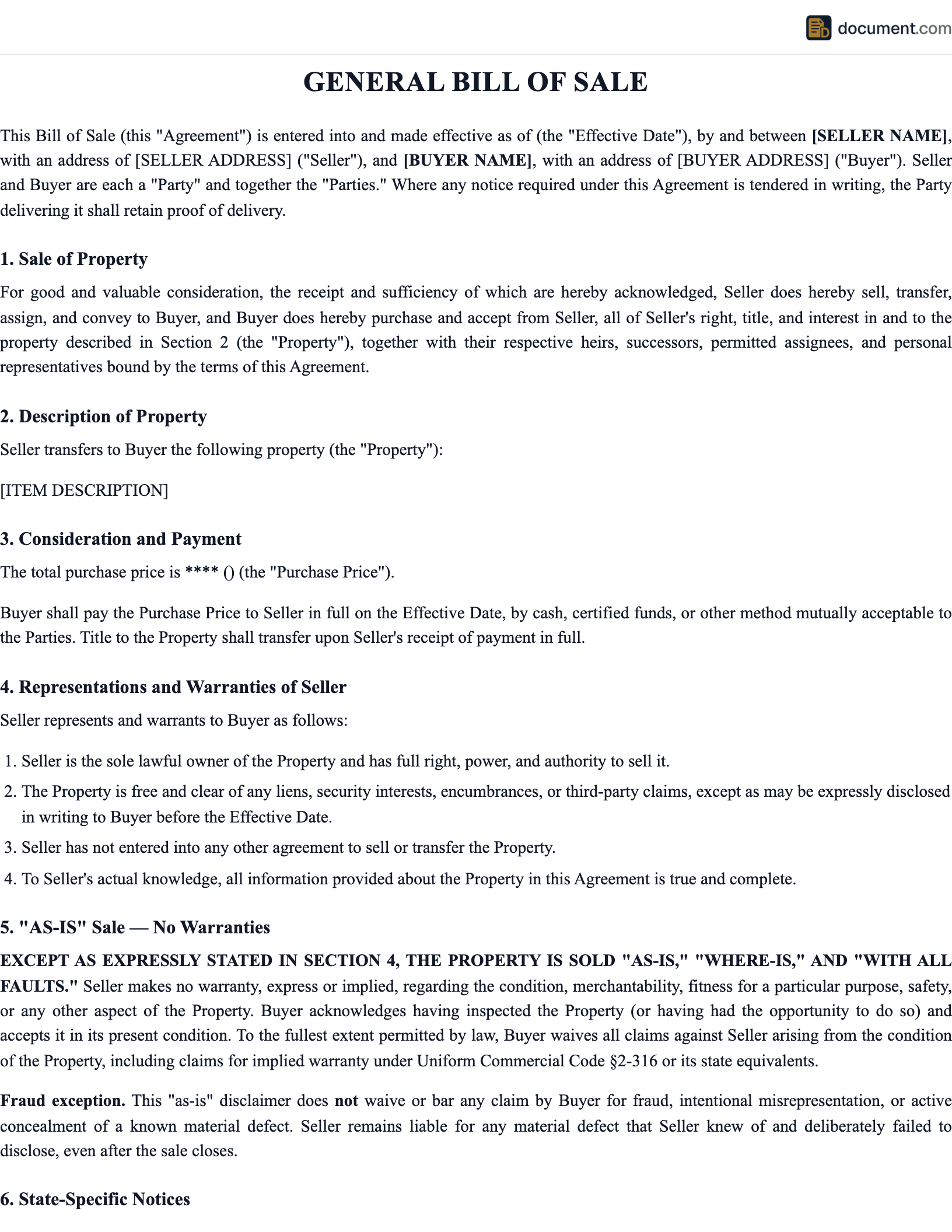



Connecticut General Bill of Sale Overview
Connecticut charges a 6.35% sales tax on most tangible personal property, with a higher 7.75% rate on certain luxury items including jewelry over $5,000. There are no additional local sales taxes, making the tax structure simpler. Clothing under $100 is exempt from Connecticut sales tax.
Connecticut has adopted the UCC under Title 42a for the sale of goods. A bill of sale is a recognized legal document for personal property transfers. Connecticut\'s well-established court system provides strong enforcement of documented property rights.
6.35%
State sales tax
No
Notarization required
$500
UCC writing threshold
Connecticut Requirements for Personal Property Sales
A Connecticut bill of sale should include the names and addresses of both parties, a complete property description, the purchase price, date of sale, condition statement, and signatures. Note the luxury tax rate may apply to certain high-value personal property like expensive jewelry.
Important: Document Everything
For any personal property sale over $500 in Connecticut, a written bill of sale is essential under the UCC Statute of Frauds. Without written documentation, the agreement may not be enforceable in court. Always create a bill of sale for items of significant value.
What to Include in Your Connecticut Bill of Sale
- Party Information: Full legal names and addresses of both buyer and seller
- Property Description: Detailed description including brand, model, serial number, color, and distinguishing features
- Sale Price: Amount in both numbers and words, plus the payment method
- Condition Statement: Current condition, known defects, and as-is or warranty terms
- Ownership Warranty: Seller confirms legal ownership and right to sell
- Date and Signatures: Date of sale with signatures from both buyer and seller
How to Fill Out a Connecticut General Bill of Sale
Follow these steps to complete your Connecticut general bill of sale properly and ensure it meets all state requirements for a legally sound document.
Enter Seller Information
Include the seller's full legal name and current Connecticut mailing address. If the seller is a business, include the business name, entity type, and the name of the authorized representative. Add phone number and email for follow-up communication.
Enter Buyer Information
Include the buyer's full legal name and current address. The buyer's location in Connecticut may affect the applicable use tax rate for the transaction. Include contact information for both parties.
Describe the Property
Provide a thorough description of the item: brand, model, serial number, color, size, and any distinguishing features. The description should be specific enough to uniquely identify the item. Attach photographs if possible for additional documentation.
State the Sale Price
Enter the agreed purchase price in both numbers and words. Note the payment method — cash, check, electronic transfer, or other. If the item is a gift, write "$0 — Gift." The stated price determines any use tax obligation for the buyer under Connecticut law.
Sign and Date
Both the buyer and seller must sign and date the bill of sale. Print two copies — one for each party. Connecticut does not require notarization for general personal property bills of sale. The state has a well-regulated notary system and notarization is widely available at banks and law offices. For items valued over $500, notarization is a practical safeguard.
Connecticut Sales Tax & Use Tax on Personal Property
Connecticut requires buyers to pay use tax at the 6.35% rate (or 7.75% for qualifying luxury items) on purchases where sales tax was not collected. Use tax is reported on the Connecticut income tax return (Form CT-1040, Line 64). Connecticut has been active in use tax enforcement and education.
| Tax / Detail | Rate / Information |
|---|---|
| State Sales Tax | 6.35% |
| Local Taxes | Varies by jurisdiction |
| Use Tax | Same rate as sales tax — applies to private purchases |
| Notarization | No for general personal property |
| UCC Writing Requirement | Sales of $500+ must be in writing to be enforceable |
Sample Connecticut General Bill of Sale
Below is a preview of our Connecticut-specific general bill of sale template. Your customized document will include all fields appropriate for Connecticut personal property transactions.
STATE OF CONNECTICUT
GENERAL BILL OF SALE
Personal Property Transfer Document
SELLER:
Name: [Seller Name]
Address: [Connecticut Address]
BUYER:
Name: [Buyer Name]
Address: [Connecticut Address]
PROPERTY DESCRIPTION
Item: [Detailed Description]
Serial No.: [If applicable]
Condition: [New / Used / As-Is]
Sale Price: $[Amount]
Connecticut General Bill of Sale FAQ
Answers to common questions about Connecticut general bills of sale and personal property transactions.
Official Connecticut Resources
Use these official resources to verify tax requirements and consumer protection laws for personal property transactions in Connecticut.
Connecticut DRS — Sales & Use Tax
Tax rates, filing, and exemptions
Connecticut Department of Revenue Services
General tax information and filing
UCC Article 2 — Sale of Goods
Uniform Commercial Code governing personal property sales
FTC — Warranty Laws & As-Is Sales
Understanding as-is clauses and warranty protections
Other Connecticut Bill of Sale Templates
Need a different type of bill of sale for Connecticut? We offer state-specific templates for every type of property transfer.
Connecticut Vehicle Bill of Sale
Cars, trucks, SUVs, and vans
Connecticut Boat Bill of Sale
Boats, jet skis, and watercraft
Connecticut Motorcycle Bill of Sale
Motorcycles, scooters, and mopeds
Connecticut Trailer Bill of Sale
Utility, travel, and cargo trailers
Connecticut Firearm Bill of Sale
Handguns, rifles, and shotguns
Connecticut ATV Bill of Sale
ATVs, UTVs, and off-road vehicles
Connecticut Horse Bill of Sale
Horses, cattle, and livestock
Connecticut Mobile Home Bill of Sale
Manufactured and mobile homes
Create your Connecticut General Bill of Sale in under 5 minutes.
Answer a few questions and download a Connecticut-compliant document, ready for the state agency.