



Georgia Electronics Bill of Sale Overview
Georgia has a 4% state sales tax rate with local county and municipal taxes adding 3-4%, bringing combined rates to 7-8% in most areas. The Georgia Fair Business Practices Act (OCGA 10-1-390 through 10-1-408) provides consumer protection for private transactions including electronics sales. Georgia's use tax applies to private purchases at the same combined rate as sales tax for the buyer's location.
A bill of sale for electronics in Georgia serves as essential documentation for use tax compliance, consumer protection, and warranty transfer purposes. Georgia's Governor's Office of Consumer Protection actively investigates complaints related to deceptive trade practices. Proper documentation of serial numbers, condition, and sale terms protects both buyers and sellers in Georgia's growing secondary electronics market.
4%
Sales tax rate
Yes
Use tax on private sales
Per manufacturer
Warranty transfer
No statutory period
Return policy
Georgia Electronics Bill of Sale Requirements
While Georgia does not have a state-mandated form specifically for electronics sales, a properly documented bill of sale is essential for consumer protection and tax compliance. Here is what your Georgia electronics bill of sale should include:
Required Information
- Seller Information: Full legal name, Georgia address, phone number, and email
- Buyer Information: Full legal name, address, phone number, and email
- Device Details: Brand, model name, model number, serial number, color, and specifications
- Condition Grade: New, Like New, Good, Fair, or Poor with specific defect notes
- Sale Price: Agreed amount in numerals and words with payment method
- Warranty Status: Active/expired, transferable, expiration date
- Signatures: Both buyer and seller must sign and date
How to Fill Out a Georgia Electronics Bill of Sale
Follow these steps to properly complete your Georgia electronics bill of sale.
Enter Seller Information
Include the seller's full legal name, current Georgia mailing address, phone number, and email address.
Enter Buyer Information
Include the buyer's full legal name and address. For Georgia residents, this determines the applicable local tax rate for use tax purposes.
Describe the Electronic Device
Enter the brand, model name, model number, and serial number. For smartphones, include the IMEI number. For computers, note the processor, RAM, and storage. Record the condition grade and list any specific defects.
List Included Accessories
Document all included accessories: chargers, cables, cases, original box, manuals, extra batteries, memory cards. Note any original accessories that are NOT included.
Record Sale Price and Warranty
Enter the agreed purchase price in both numbers and words. Note the payment method. Document the warranty status and whether it transfers to the new owner.
Sign and Confirm Data Removal
Both parties must sign and date the bill of sale. The seller should confirm the device has been factory reset and all personal accounts removed. Print two copies.
Georgia Sales Tax & Fees for Electronics
Georgia's 4% state rate plus local taxes (3-4% in most counties) results in combined rates of 7-8%. Fulton County (Atlanta) has a combined rate of approximately 8.9%, while other areas range from 7-8.5%. Buyers owe use tax on private electronics purchases at the combined rate for their county. Report on your Georgia income tax return (Form 500, Schedule 4).
| Fee / Tax | Amount |
|---|---|
| State Sales Tax Rate | 4% |
| Local County/City Tax | 3-4.5% additional (varies by county) |
| E-waste Program | No mandatory state fee |
| Private Sale Use Tax | Yes |
Georgia Consumer Protection for Electronics Sales
The Georgia Fair Business Practices Act (FBPA) prohibits unfair or deceptive trade practices in consumer transactions. Georgia courts have held that this includes private sales where misrepresentation occurs. The Act allows consumers to recover actual damages plus attorney fees and costs. The Governor's Office of Consumer Protection can also investigate complaints and pursue enforcement actions against individuals engaged in deceptive practices.
Important: Disclose Known Defects
Under Georgia law, sellers must not misrepresent the condition of electronics. If you know about a defect — battery degradation, screen issues, intermittent problems — you must disclose it. Failure to disclose known defects can be considered fraud, even in an as-is sale.
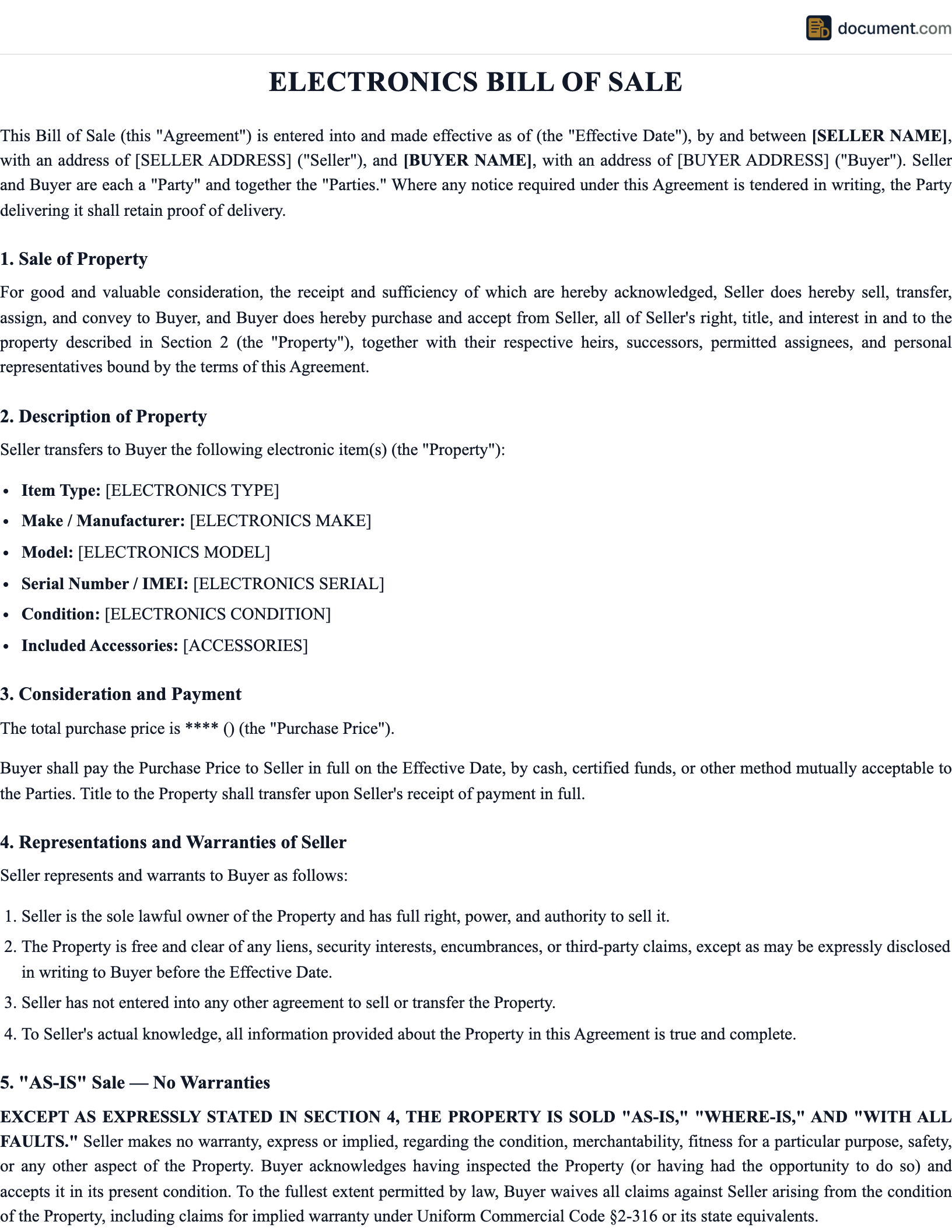
Sample Georgia Electronics Bill of Sale
Below is a preview of our Georgia-specific electronics bill of sale template.
STATE OF GEORGIA
ELECTRONICS BILL OF SALE
Private Party Electronics Transfer
SELLER:
Name: [Seller Name]
Address: [Georgia Address]
BUYER:
Name: [Buyer Name]
Address: [Address]
DEVICE INFORMATION
Brand: [Brand] Model: [Model]
Serial #: [Serial Number]
Condition: [Grade]
Sale Price: $[Amount]
Georgia Electronics Bill of Sale FAQ
Answers to common questions about Georgia electronics bills of sale, consumer protection, and tax requirements.
Official Georgia Resources
Use these official state resources to verify consumer protection rules and tax requirements in Georgia.
Other Georgia Bill of Sale Templates
Need a different type of bill of sale for Georgia? We offer state-specific templates for every type of property transfer.
Georgia Vehicle Bill of Sale
Cars, trucks, SUVs, and vans
Georgia Boat Bill of Sale
Boats, jet skis, and watercraft
Georgia Motorcycle Bill of Sale
Motorcycles, scooters, and mopeds
Georgia Trailer Bill of Sale
Utility, travel, and cargo trailers
Georgia Firearm Bill of Sale
Handguns, rifles, and shotguns
Georgia General Bill of Sale
Furniture, equipment, and personal property
Georgia ATV Bill of Sale
ATVs, UTVs, and off-road vehicles
Georgia Horse Bill of Sale
Horses, cattle, and livestock
Georgia Mobile Home Bill of Sale
Manufactured and mobile homes
Create your Georgia Electronics Bill of Sale in under 5 minutes.
Answer a few questions and download a Georgia-compliant document, ready for the state agency.