



What Is an Auto Repair Contract?
An auto repair contract is a written agreement between an automotive repair shop and a vehicle owner that spells out exactly what work will be performed, how much it will cost, what warranty covers the finished job, and what happens if the repair goes sideways. It sits at the intersection of contract law and consumer protection regulation because auto repair is one of the most heavily regulated service industries in the United States. The Federal Trade Commission, every state attorney general, and most state legislatures have taken an active interest in how repair shops estimate, authorize, perform, and bill for vehicle work, and the auto repair contract is the document that ties all of those requirements together in a single signed form.
For the shop owner, the contract serves three practical purposes. First, it documents the customer's authorization to perform the work, which is a legal prerequisite in almost every state. Second, it creates the basis for enforcing a mechanic's lien if the customer refuses to pay. Third, it limits the shop's liability by setting warranty terms, disclaiming consequential damages, and documenting that the customer was informed about the condition of the vehicle and the proposed repair plan. Without a signed contract, the shop has no reliable proof that the work was authorized, no defined warranty obligation, and a much weaker legal position if the customer disputes the bill or files a complaint with the state regulatory agency.
For the customer, the contract is the single most important consumer protection tool in the repair transaction. It locks in the estimate so the shop cannot inflate the final bill without permission. It documents the warranty so the customer can return if the repair fails within the covered period. It preserves the customer's right to authorize or decline additional work that was not part of the original scope. And it creates a paper trail that is essential if the customer needs to file a complaint with the state attorney general, the Bureau of Automotive Repair (in California), or small claims court.
The regulatory landscape for auto repair varies significantly by state. California has one of the most comprehensive frameworks through the Bureau of Automotive Repair (BAR), which requires shops to register with the state, provide written estimates, obtain written or verbal authorization before beginning work, and comply with detailed invoicing and warranty disclosure requirements. New York requires shops to register with the Department of Motor Vehicles and imposes similar estimate and authorization rules. Connecticut, Massachusetts, Michigan, and several other states have their own motor vehicle repair statutes with varying requirements for licensing, bonding, estimate disclosure, and warranty minimums.
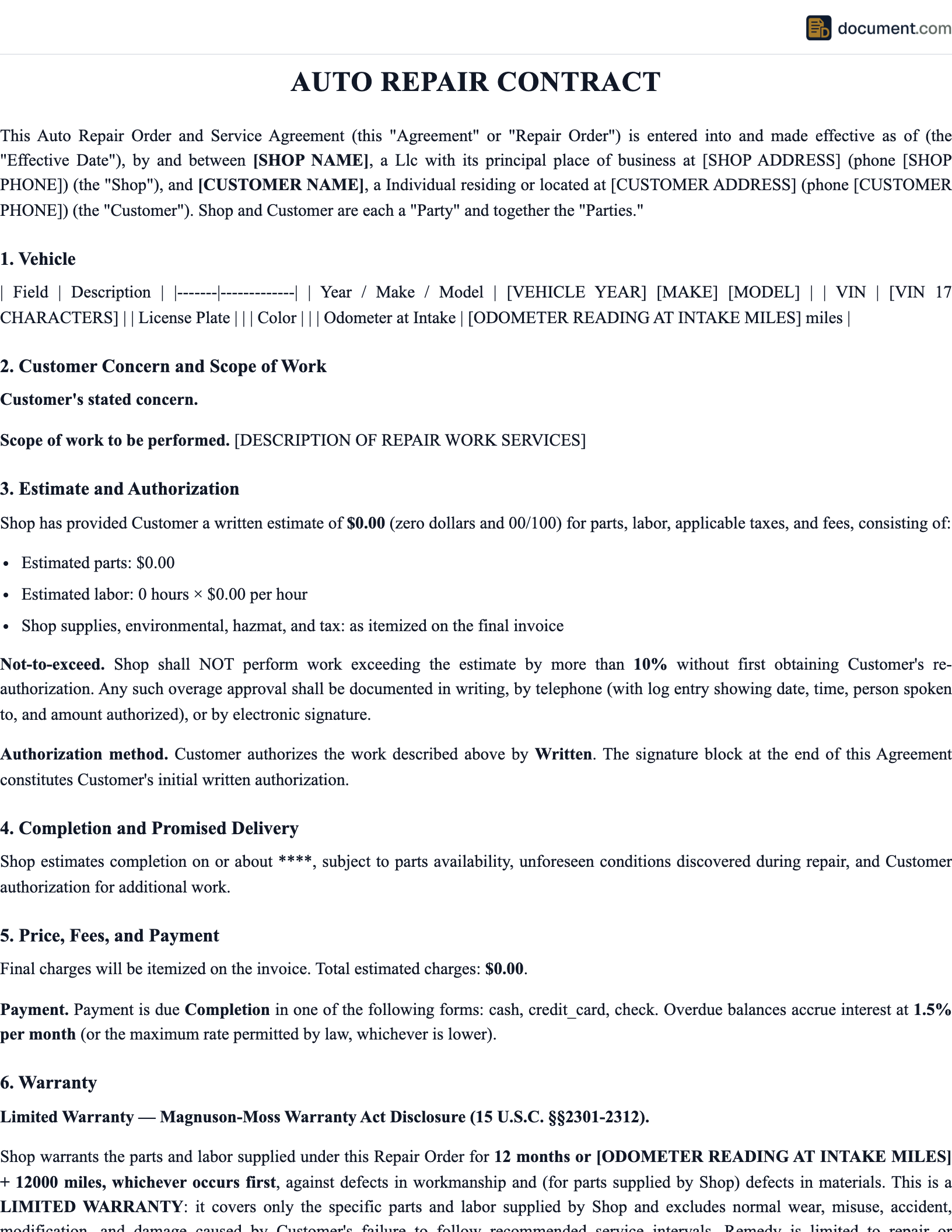
Our attorney-reviewed auto repair contract template covers the complete transaction from initial estimate through final payment, including repair authorization, parts and labor breakdowns, warranty disclosures, supplemental authorization procedures, storage fees, mechanic's lien notices, and liability limitations. It is designed to satisfy the requirements of the strictest state auto repair statutes while remaining practical enough for shops of any size to use on every work order.
Written Estimates
Itemized parts and labor breakdowns before any work begins
Warranty Protection
Clear warranty terms for both parts and labor with defined coverage periods
Regulatory Compliance
Built to satisfy state auto repair statutes and consumer protection laws
Auto Repair Contract Form Preview
Below is a visual preview of the sections and fields included in a standard auto repair contract. Your completed document will be customized for your shop, the vehicle, and your state's regulatory requirements.
Auto Repair Authorization
Vehicle Service Agreement
Section 1: Shop & Customer Information
Section 2: Vehicle Information
Year / Make / Model: 2021 Honda Accord EX
VIN: 1HGCV1F34MA012345
Odometer: 47,218 miles
Section 3: Repair Estimate
Section 4: Authorization & Warranty
Section 5: Signatures
Customer Signature / Date
Service Advisor / Date
How to Create an Auto Repair Contract
Building a solid auto repair contract takes seven steps. Each one adds a layer of protection for both the shop and the vehicle owner, and skipping any of them opens the door to billing disputes, warranty arguments, and regulatory complaints.
Document the vehicle and the customer
Record the customer's full name, contact information, and the vehicle's year, make, model, VIN, license plate, and odometer reading. This information anchors the entire repair record and is required by most state auto repair statutes.
Perform a diagnostic inspection
Inspect the vehicle and identify the specific issue or issues. Document the customer's complaint, your diagnostic findings, and the recommended repair plan. Be specific about what you found and what you plan to do about it.
Prepare a written estimate
Break the estimate into parts and labor with individual line items. Include part numbers, whether parts are new, used, or remanufactured, the labor rate, and the estimated total. Most states require this estimate to be presented to the customer before work begins.
Obtain written authorization
Have the customer sign the estimate to authorize the work. The authorization should state the maximum amount the shop is permitted to charge and describe the procedure for obtaining supplemental authorization if additional work is discovered.
Disclose warranty terms
Specify the warranty period for parts and labor, identify any manufacturer warranties that pass through to the customer, and clearly note any exclusions or limitations. Several states require minimum warranty periods that cannot be disclaimed.
Include payment and lien terms
Specify accepted payment methods, when payment is due, and the shop's right to exercise a mechanic's lien if the bill is not paid. Include any storage fee that will accrue if the customer does not pick up the vehicle promptly after completion.
Finalize and deliver the invoice
Once the repair is complete, prepare a final invoice that itemizes all parts and labor actually performed, compares the final total to the original estimate, and notes any supplemental authorizations. Provide a copy to the customer at pickup.
Key Components
Every auto repair contract should include these core building blocks, regardless of the type of repair or the state where the shop operates.
Vehicle identification
Year, make, model, VIN, license plate, and current odometer reading
Written repair estimate
Itemized parts and labor with individual prices and estimated total
Customer authorization
Signed approval with maximum charge limit and supplemental authorization procedure
Parts disclosure
Whether parts are new, used, remanufactured, or aftermarket, with part numbers
Warranty terms
Coverage period for parts and labor, manufacturer pass-through warranties, and exclusions
Payment terms
Accepted payment methods, due date, late fees, and storage charges
Mechanic's lien notice
Notice that the shop may retain the vehicle until all authorized charges are paid
Liability limitations
Cap on consequential damages and disclaimer of implied warranties where permitted
Supplemental authorization
Procedure for approving additional work that exceeds the original estimate
Final invoice requirements
Itemized accounting of all work performed compared to the original estimate
Legal Requirements
Auto repair is governed by a patchwork of state statutes, consumer protection laws, and industry regulations. The requirements below apply in most jurisdictions, though the specific thresholds and penalties vary by state.
- Written estimate required before beginning work in most states (California BAR, New York DMV, Connecticut, Massachusetts, and others)
- Customer authorization required before performing any repair work
- Supplemental authorization required before exceeding the estimate by more than the state threshold (commonly 10%)
- Itemized invoice with parts and labor breakdown required at completion
- Warranty disclosure required, with statutory minimums in CA (30 days), MA (90 days / 3,750 miles), and CT (60 days)
- Shop registration or licensing required in CA, NY, CT, MA, MI, HI, and several other states
- Return of replaced parts to customer upon request (required in CA, NY, MA, and others)
- Mechanic’s lien rights require prior authorization and proper documentation to enforce
Sample Auto Repair Contract
Below is a condensed preview of our standard auto repair contract template. Your final document will be customized for your shop, the vehicle being serviced, and your state's regulatory requirements.
AUTO REPAIR AUTHORIZATION AND AGREEMENT
Vehicle Service Contract
This Auto Repair Authorization and Agreement ("Agreement") is entered into as of[Date]between [Shop Name]("Shop") and [Customer Name]("Customer").
1. VEHICLE
Customer delivers to Shop the following vehicle:[Year][Make][Model], VIN [VIN], odometer reading [Miles].
2. ESTIMATE AND AUTHORIZATION
Shop shall perform the repairs described in the attached estimate, which is incorporated by reference. Customer authorizes a maximum charge of $[Amount]. Shop shall not exceed this amount by more than 10% without obtaining Customer's prior written or verbal authorization.
3. PARTS
Unless otherwise specified, Shop may use new, remanufactured, or aftermarket parts of equivalent quality. Customer may request return of replaced parts at the time of authorization, except core exchange parts.
4. WARRANTY
Shop warrants all repairs for[months] months or[miles] miles, whichever comes first. Warranty covers defects in parts and workmanship and does not cover damage caused by accident, misuse, or failure to maintain the vehicle.
5. PAYMENT AND LIEN
Payment is due in full upon completion. Shop reserves the right to retain possession of the vehicle under applicable state mechanic's lien law until all authorized charges are paid. A storage fee of $[amount]per day applies beginning 3 business days after Customer is notified of completion.
6. LIABILITY
Shop's total liability under this Agreement shall not exceed the amount actually paid for the repair. Shop shall not be liable for consequential or incidental damages, including loss of use, loss of income, or towing charges, except where prohibited by law.
Frequently Asked Questions
Answers to common questions about auto repair contracts, estimate requirements, warranty protections, mechanic's liens, and consumer rights when dealing with repair shops.
Official Resources
For additional information on auto repair regulations, consumer rights, and shop licensing requirements, consult these official resources.
California Bureau of Automotive Repair
State licensing, complaint filing, and consumer protection for auto repairs in California
New York DMV - Motor Vehicle Repair
Registration requirements and consumer rights for auto repair shops in New York
FTC Auto Service and Repair
Federal Trade Commission guidance on auto repair rights and common scams
Massachusetts Auto Body Repair
Massachusetts state regulations for auto body and mechanical repair shops
Connecticut DMV - Vehicle Repairers
Connecticut licensing and consumer protection requirements for repair facilities
National Highway Traffic Safety Administration
Federal vehicle safety standards, recall information, and consumer complaints
Create your Auto Repair Contract in under 10 minutes.
Answer a few questions and download a compliant, attorney-drafted document ready for your state.