



What Is an Articles of Incorporation Amendment?
An articles of incorporation amendment is a formal legal document filed with the state that modifies one or more provisions of a corporation's original articles of incorporation. Depending on the state, this filing is variously called a Certificate of Amendment, Articles of Amendment, Amendment to Certificate of Incorporation, or Restated Articles of Incorporation. Whatever the name, its purpose is the same: to formally update the public charter that created the corporation so that the state record accurately reflects the company's current legal identity, share structure, governance, and authorized activities.
The articles of incorporation are the corporation's foundational charter. They were filed with the Secretary of State (or an equivalent state office) when the corporation was first formed, and they establish the corporation's legal existence. Because the articles are a public document that third parties — lenders, investors, vendors, courts, and regulators — rely upon to determine basic facts about the corporation, any material change to the information in those articles must be made through a formal amendment filing. Simply updating internal records or bylaws is not sufficient.
Common reasons to file an amendment include changing the corporation's legal name, updating the registered agent or registered office, increasing or decreasing the number of authorized shares, creating new classes or series of stock, adjusting par value, revising the stated business purpose, adopting indemnification provisions for directors and officers, changing the number of directors (when fixed in the articles), and adopting anti-takeover provisions. A restatement combines multiple amendments into a single consolidated document and is typically used after a corporation has accumulated several amendments over the years.
Most amendments require both board of directors approval and shareholder approval. The board first adopts a resolution recommending the amendment and directing it to a vote of shareholders. Notice of the proposed amendment is then sent to shareholders, followed by a vote at a meeting (or by written consent if permitted). Once the required vote is obtained — typically a majority of outstanding shares, though some states and some amendments require a two-thirds or higher supermajority — an authorized officer executes the Certificate of Amendment and files it with the state. The amendment becomes legally effective on the date accepted by the state or on a specified later effective date.
Our attorney-reviewed templates provide the exact statutory language required for each type of amendment in each state, along with the required approval statements, execution blocks, and filing instructions. Whether you are making a simple name change or a complex recapitalization, the template ensures your filing is compliant with your state's business corporation act and will be accepted on the first submission.
Official Record Update
Ensure the state charter reflects the corporation's current legal identity and structure
Statutory Compliance
Meet state requirements for approval, execution, and filing of corporate changes
Third-Party Reliance
Allow banks, investors, and counterparties to rely on the public corporate record
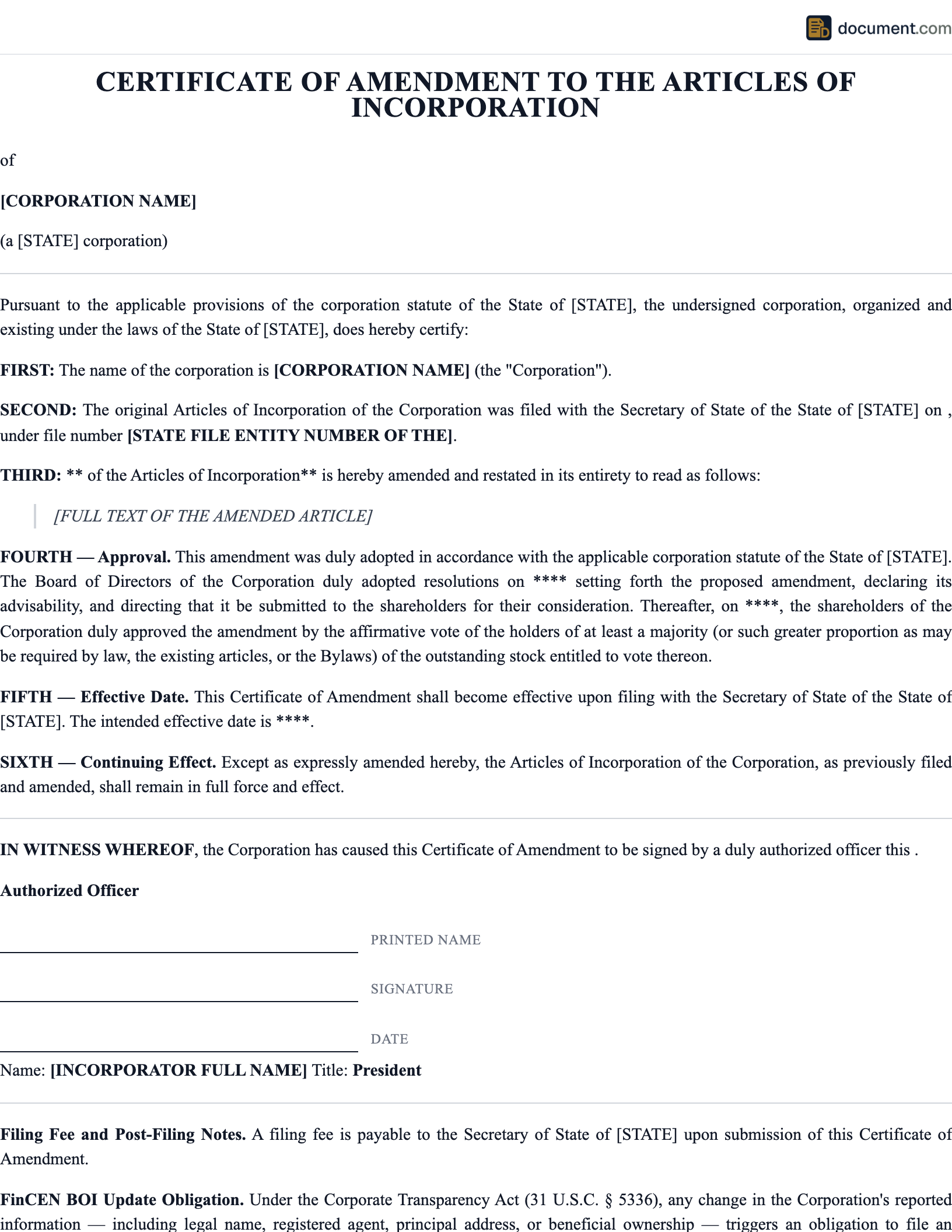
Certificate of Amendment Form Preview
Below is a visual preview of the sections and fields included in a standard Certificate of Amendment to the articles of incorporation. This mockup illustrates the structure of our templates. Your completed document will be fully formatted and customized for your state's specific statutory form requirements.
Certificate of Amendment
to the Articles of Incorporation
Article 1: Corporation Information
Article 2: Amendment Adopted
Article 3: Text of the Amendment
Article 4: Approval
Article 5: Execution
Authorized Officer Signature
Date
Types of Articles of Incorporation Amendments
Corporations file amendments for many different reasons. The right template depends on which provision of the articles you need to change. Below are the most common amendment types and the situations that typically trigger each one.
Name Change Amendment
Changes the official legal name of the corporation on the articles of incorporation
Registered Agent Amendment
Updates the registered agent or registered office address on file with the Secretary of State
Purpose Clause Amendment
Revises the stated business purpose or expands the corporation's lawful activities
Authorized Shares Amendment
Increases, decreases, or reclassifies the number of authorized shares of stock
Stock Class Amendment
Creates new classes or series of stock, or modifies rights and preferences of existing classes
Director Structure Amendment
Changes the number, term, or qualifications of directors on the board
Indemnification Amendment
Adds or modifies indemnification provisions for directors, officers, and agents
Dissolution Provisions Amendment
Updates how the corporation may be dissolved or how assets are distributed upon dissolution
Restated Articles
Consolidates all previous amendments into a single restated document for clarity
When You Need an Amendment
Not every corporate change requires an articles amendment. The key question is whether the change touches information that appears in the articles of incorporation itself. Use the scenarios below to identify whether an amendment is required.
"We want to rebrand under a new corporate name."
You need a Name Change Amendment. The corporate name is always listed in the articles, so any change requires a formal filing with the state. Check name availability with the Secretary of State before filing to avoid rejection.
"Our registered agent is resigning or we want to change providers."
You need a Registered Agent Amendment. In most states, this can also be filed as a standalone Statement of Change of Registered Agent — a simpler, cheaper filing that does not require board or shareholder approval.
"We need to issue more shares to new investors."
If your current authorized share count is not enough to cover the new issuance, you need an Authorized Shares Amendment to increase the total. Watch for franchise tax implications in Delaware and a handful of other states that calculate tax on authorized shares.
"Investors want preferred stock with dividend and liquidation preferences."
You need a Stock Class Amendment (often called a Certificate of Designation or Series Amendment) to create a new class or series of preferred stock with its specific rights, preferences, and privileges. This is standard in priced equity financings.
"Our articles have been amended many times — we want one clean document."
You need Restated Articles of Incorporation. Restatement consolidates all prior amendments into one integrated document and is common after 3 or more separate amendments have accumulated.
Amendment vs Restatement vs Bylaw Change
It is easy to confuse a Certificate of Amendment with a bylaw amendment or a restatement. The three documents serve different legal purposes and follow different approval processes.
| Feature | Amendment | Restatement | Bylaw Change |
|---|---|---|---|
| What it changes | One or more articles provisions | Consolidates all articles into one document | Internal governance rules only |
| State filing required | Yes | Yes | No (internal record) |
| Board approval | Required | Required | Usually sufficient alone |
| Shareholder approval | Usually required | Required if substantive changes | Typically not required |
| Typical state fee | $20 - $200 | $50 - $300 | $0 |
| Effective when | State accepts filing | State accepts filing | Board adopts |
How to File an Articles Amendment
Filing an amendment involves internal approvals followed by a state filing. Follow these steps in order to avoid a rejected filing or a defective corporate record.
Identify the Exact Provision to Change
Pull your current articles of incorporation and any prior amendments. Identify the specific article, section, and language you need to revise. The amendment must quote the existing text and show the new text in full.
Board of Directors Resolution
The board adopts a written resolution recommending the amendment. The resolution must state the reason for the amendment and direct that it be submitted to the shareholders for approval.
Notice to Shareholders
Send written notice of the special or annual meeting to all shareholders entitled to vote. The notice must include the full text (or a summary) of the proposed amendment and meet the state's minimum notice period — typically 10 to 60 days.
Shareholder Vote
Hold the meeting or obtain written consents. Approval typically requires a majority of outstanding shares, though some states and some amendments (particularly those affecting class rights) require two-thirds or a supermajority.
Prepare the Certificate of Amendment
Use your state's statutory form or an attorney-reviewed template. Include the corporate name, state file number, text of the amendment, approval statement, and signature of an authorized officer.
File with the Secretary of State
Submit the Certificate of Amendment to the state filing office with the required fee. Most states offer online, mail, and in-person filing. Expedited processing is usually available for an additional fee.
Update Internal Records and Notify Stakeholders
Once the state accepts the amendment, update the corporate minute book, notify the IRS (Form 8822-B if applicable), update banking records, and notify any state where the corporation is registered as a foreign entity.
Key Components of a Certificate of Amendment
Every state accepts amendments in slightly different formats, but certain components are universal. Our templates include each of these components in the order required by your state.
Corporate Identification
Exact legal name as currently on file, state file number, and date of original incorporation.
Authority to Amend
Statement that the amendment was adopted in accordance with the state business corporation act and the articles.
Text of the Amendment
The exact article being amended quoted in full, followed by the exact new language replacing it.
Approval Statement
Statement of the dates of board and shareholder approval and the vote tally required by statute.
Effective Date
Either the filing date or a specified future effective date (up to 90 days later in most states).
Officer Execution
Signature of an authorized corporate officer (typically the president, CEO, or secretary) with title.
Board and Shareholder Approval
The Model Business Corporation Act (MBCA) and most state corporation statutes follow a two-step approval process for articles amendments: first the board recommends, then shareholders vote. However, the specific vote thresholds, notice periods, and exceptions vary considerably by state and by the type of amendment.
Board-Only Amendments
Some narrow amendments can be made by the board alone, without a shareholder vote. These typically include: changing the registered agent or office; changing the corporate address; deleting names and addresses of initial directors once the corporation is operating; changing each share of a class into a greater number of whole shares (stock splits under certain limits); and similar housekeeping items. The MBCA §10.05 lists these exceptions, and most states follow a similar approach.
Standard Vote Thresholds
- Majority of Outstanding Shares: In MBCA states, approval requires a majority of votes entitled to be cast on the amendment by each voting group. This is the default for most amendments in most states.
- Two-Thirds Requirement: Some states (including New York for pre-1998 corporations) require a two-thirds vote of outstanding shares for any articles amendment. Other states require a two-thirds vote only for certain amendments.
- Class Voting: If an amendment would adversely affect the rights of a particular class of stock — such as changing par value, reducing dividend rights, or creating a new senior class — that class is entitled to vote as a separate voting group, even if the class is normally non-voting.
- Supermajority Provisions: The articles themselves may require a higher vote (e.g., 75% or 80%) for certain amendments. These supermajority provisions must be met in addition to any statutory minimum.
- Written Consent in Lieu of Meeting: Most states allow shareholders to approve an amendment by written consent without a meeting, provided the consent is signed by the number of holders needed to approve at a meeting (or by unanimous consent, depending on the state).
Filing Fees and Processing Timelines
Each state charges its own filing fee for a Certificate of Amendment, and processing times vary from same-day online filing to several weeks for paper filings. Below is a comparison of fees and processing options in common incorporation states.
| State | Standard Fee | Expedited | Typical Turnaround |
|---|---|---|---|
| Delaware | $194 | $50 - $1,000 | 2 - 3 weeks / 24 hr |
| California | $30 | $350 - $750 | 3 weeks / 24 hr |
| Texas | $150 | +$25 | 5 - 7 business days |
| New York | $60 | $25 - $150 | 2 - 6 weeks / 2 hr |
| Florida | $35 | N/A (online) | 3 - 5 business days |
| Nevada | $175 | $125 - $1,000 | 1 - 3 weeks |
| Wyoming | $60 | N/A | 3 - 5 business days |
Legal Requirements for Amendments
Articles of incorporation amendments are governed by each state's business corporation act. Most states have adopted some version of the Model Business Corporation Act, but Delaware, California, New York, and several others have their own distinct statutory frameworks. Key requirements include statutory form content, approval procedures, and filing formalities.
Franchise Tax Implications
In Delaware, increasing authorized shares directly increases the corporation's annual franchise tax under the authorized shares method. A corporation with 10 million authorized shares pays substantially more than one with 1 million. Before filing an amendment to increase authorized shares, calculate the franchise tax impact under both the authorized shares method and the assumed par value capital method to determine which is more favorable. Similar rules apply in a handful of other states.
State-Specific Variations
- Delaware General Corporation Law §242: Governs amendments in the most popular state of incorporation for public companies and venture-backed startups. Requires board resolution, shareholder approval, and a Certificate of Amendment signed by an authorized officer.
- California Corporations Code §900-910: Requires both board and shareholder approval for most amendments. California also imposes specific fairness protections when the amendment would reclassify outstanding shares.
- New York Business Corporation Law §801-807: Contains detailed procedures for class voting when amendments affect outstanding shares. New York requires a two-thirds vote for corporations formed before February 22, 1998.
- Texas Business Organizations Code §21.051-21.057: Requires a Certificate of Amendment filed with the Texas Secretary of State, executed by an officer, with specific statutory content including the amendment text and approval statement.
- MBCA §10.01-10.09: The Model Business Corporation Act, adopted in whole or in part by more than 30 states, provides the default framework for board-only amendments, shareholder-approved amendments, class voting rights, and restatements.
Sample Certificate of Amendment
Below is a condensed preview of our Certificate of Amendment template. This sample shows the structure and language used in our attorney-reviewed documents. Your completed amendment will be customized for your corporation, state, and specific change.
CERTIFICATE OF AMENDMENT
To the Articles of Incorporation
Pursuant to the provisions of the [State] Business Corporation Act, the undersigned corporation hereby certifies:
FIRST: Corporate Information
The name of the corporation is [Corporate Name], and its state file number is [File No.]. The corporation was originally incorporated on [Date].
SECOND: Amendment
Article [##] of the Articles of Incorporation is hereby amended to read in its entirety as follows:
"[New text of the amended article]"
THIRD: Adoption by the Board of Directors
The foregoing amendment was duly adopted by resolution of the board of directors on[Date], and directed to be submitted to the shareholders for approval.
FOURTH: Adoption by Shareholders
The amendment was duly approved by the shareholders entitled to vote thereon on[Date]. The number of shares entitled to vote was [###], and the number of shares voted in favor was [###], which is sufficient for approval under applicable state law and the corporation's articles of incorporation.
FIFTH: Effective Date
This Certificate of Amendment shall be effective upon filing with the Secretary of State.
EXECUTION
IN WITNESS WHEREOF, the undersigned, being an authorized officer of the corporation, has executed this Certificate of Amendment on [Date].
Frequently Asked Questions
Answers to the most common questions about articles of incorporation amendments, filing procedures, fees, and approval requirements.
Official Resources
Authoritative government and legal resources for corporate filings, amendments, and business entity compliance.
IRS - Business Name Change
How to notify the IRS of a corporate name change after filing an amendment
Delaware Division of Corporations - Amendments
Delaware Certificate of Amendment forms, fees, and filing instructions
California Secretary of State - Forms
California business entity filing forms including amendment templates
New York Department of State - Corporations
New York Certificate of Amendment filing information and forms
Texas Secretary of State - Business Forms
Texas Certificate of Amendment (Form 424) and filing instructions
SBA - Stay Legally Compliant
Small Business Administration guide to ongoing corporate compliance
ABA Committee on Corporate Laws
Model Business Corporation Act committee and related resources
Uniform Law Commission
Model corporate statutes and state adoption information
Create your Amendment Articles of Incorporation in under 10 minutes.
Answer a few questions and download a compliant, attorney-drafted document ready for your state.