



What Is a Dental Insurance Verification Form?
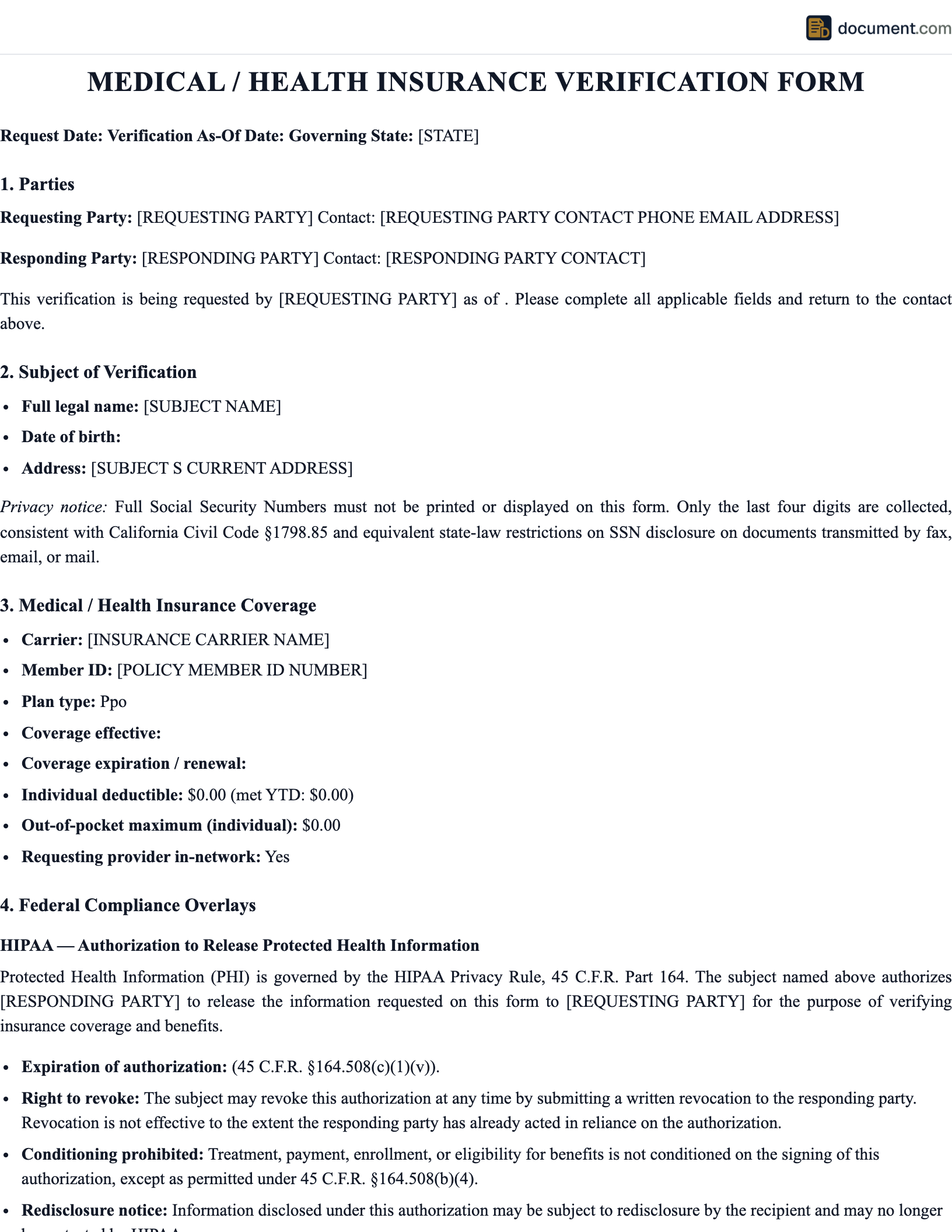
A dental insurance verification form is a structured document that dental practices use to confirm and record a patient's insurance coverage details before providing treatment. The form serves as the dental office's primary tool for determining what a patient's insurance plan covers, what the patient will owe out of pocket, and whether any procedures require advance approval from the carrier. Without thorough verification, dental practices risk providing services that the insurance will not reimburse, leading to billing disputes with patients and revenue losses for the practice.
The verification process involves contacting the dental insurance carrier — either by phone, through the carrier's online provider portal, or via electronic eligibility verification systems — and systematically recording the patient's plan details on the verification form. The information captured includes the subscriber's name and identification number, the group number, the plan effective date, the annual benefit maximum and how much has been used, the deductible amount and how much has been met, co-payment percentages for each category of dental procedures (preventive, basic, major, orthodontic), waiting period status for each category, frequency limitations on specific procedures, and any pre-authorization requirements.
Insurance verification is distinct from eligibility verification, though the terms are sometimes used interchangeably. Eligibility verification confirms only that the patient has an active dental insurance policy — a simple yes or no determination. Insurance verification goes much deeper, capturing the specific benefit details, limitations, and exclusions that determine what the plan will actually pay for a particular patient's treatment. A patient may be eligible (have active coverage) but still face denials for specific procedures due to waiting periods, benefit exhaustion, frequency limitations, or plan exclusions. Thorough verification identifies these issues before the patient sits in the treatment chair.
Benefit Maximums
Tracks annual and lifetime benefit limits and remaining balance available.
Waiting Periods
Identifies procedure-specific waiting periods and eligibility dates.
Pre-Authorization
Flags procedures requiring carrier approval before treatment.
Dental Insurance Verification Form Preview
Dental Insurance Verification
Patient Coverage Confirmation
1. SUBSCRIBER INFORMATION
Patient: Subscriber: Group #:
2. BENEFIT SUMMARY
Annual Maximum: $ Remaining: $ Deductible: $
3. COVERAGE PERCENTAGES
Preventive: % Basic: % Major: %
VERIFIED BY
DATE VERIFIED
Key Components
A thorough dental insurance verification form must capture these critical elements to ensure accurate patient billing and treatment planning:
| Component | Purpose | Key Details |
|---|---|---|
| Subscriber Details | Identifies the policy holder | Subscriber name, member ID, group number, employer, relationship to patient |
| Plan Information | Identifies the coverage plan | Carrier name, plan name/type (DHMO, DPPO, indemnity), effective date, plan year dates |
| Benefit Maximums | Tracks available benefits | Annual maximum, amount used YTD, remaining balance, orthodontic lifetime maximum |
| Deductibles | Calculates patient responsibility | Individual deductible, family deductible, amount met YTD, which categories apply |
| Coverage Percentages | Determines co-payment splits | Preventive (typically 100%), basic (70-80%), major (50-60%), orthodontic (50%) |
| Frequency Limitations | Prevents claim denials | Prophylaxis frequency, x-ray intervals, crown replacement periods, last dates of service |
How to Verify Dental Insurance
Collect Patient Insurance Information
Obtain a copy of the patient's dental insurance card (front and back), noting the carrier name, subscriber name, member ID, group number, and the carrier's provider services phone number. If the patient has dual coverage, collect information for both plans. Enter the patient's demographic information and insurance details into your practice management system before initiating verification.
Contact the Insurance Carrier
Call the provider services number on the insurance card or access the carrier's online provider portal. Identify your dental practice with your NPI number and Tax ID. Verify the patient's eligibility status, confirm the plan's effective date, and request the plan's benefit booklet or summary of benefits if available. Record the carrier representative's name and reference number for your records.
Record Benefit Maximums and Deductibles
Document the annual benefit maximum, how much has been used year-to-date, and the remaining balance. Record the individual and family deductible amounts, how much has been met, and which procedure categories the deductible applies to — many plans waive the deductible for preventive services. Note whether the plan year follows the calendar year or an employer-set anniversary date, as this affects when maximums and deductibles reset.
Document Coverage Percentages and Waiting Periods
Record the co-payment percentage for each procedure category: preventive/diagnostic, basic restorative, major restorative, endodontic, periodontic, oral surgery, orthodontic, and prosthodontic. For each category, also record any applicable waiting periods and whether the patient has satisfied them. Note any alternative benefit provisions where the carrier pays based on a less expensive treatment option.
Check Frequency Limitations and Exclusions
Verify the plan's frequency limitations on common procedures: prophylaxis (cleanings — usually limited to two per year), bitewing x-rays (usually once per year), full-mouth x-rays or panoramic (usually once every 3-5 years), fluoride treatments (age and frequency limits), sealants (age limits and tooth-specific restrictions), and crown replacements (usually once every 5-10 years per tooth). Record any plan exclusions — procedures the plan does not cover under any circumstances, such as cosmetic procedures, implants, or TMJ treatment.
Verify Pre-Authorization Requirements
Determine which procedures require pre-authorization (pre-determination) before treatment. Record the dollar threshold above which pre-authorization is required, the specific procedure codes that always require pre-authorization regardless of cost, the pre-authorization submission process (electronic, fax, mail), and the typical turnaround time for pre-authorization decisions. Note that most carriers require pre-authorization for crowns, bridges, dentures, implants, periodontal surgery, and orthodontics.
Dental Insurance Coverage Categories
Dental insurance plans organize covered procedures into categories, each with its own co-payment percentage, waiting period, and deductible applicability. Understanding these categories is essential for accurate verification and patient cost estimates. The standard categorization used by most carriers follows the American Dental Association's CDT code structure.
Preventive and diagnostic services — including periodic exams, prophylaxis (cleanings), bitewing x-rays, fluoride treatments, and sealants — are typically covered at 100% with no deductible and no waiting period, as insurers recognize that preventive care reduces the need for more expensive restorative treatment. Basic services — including simple extractions, fillings (amalgam and composite), periodontal scaling and root planing, and emergency palliative treatment — are typically covered at 70% to 80% after the deductible, with waiting periods of 3 to 6 months on new policies. Major services — including crowns, bridges, dentures, implants, root canals, and periodontal surgery — are typically covered at 50% to 60% after the deductible, with waiting periods of 6 to 12 months.
Alternative Benefit Provisions
Many dental plans include "alternative benefit" or "least expensive alternative treatment" (LEAT) provisions. Under these provisions, the carrier pays its percentage based on the cost of the least expensive clinically acceptable treatment, even if the dentist performs a more expensive option. For example, if a patient needs a crown but the plan determines that a large filling would be a clinically acceptable alternative, the carrier pays its percentage based on the filling cost, and the patient pays the difference plus their co-payment. This distinction must be captured during verification and communicated clearly to the patient before treatment.
Frequently Asked Questions
Official Resources
Authoritative resources for dental insurance verification, coding, and dental practice management.
ADA - Dental Insurance Resources
American Dental Association guidance on dental insurance processing, CDT coding, claim submission, and insurance dispute resolution for dental practices.
National Association of Dental Plans
Industry organization representing dental benefit companies with resources on dental plan design, consumer education, and industry statistics.
CMS - Dental Coverage
Centers for Medicare & Medicaid Services information on dental coverage under Medicare Advantage, Medicaid, and CHIP programs.
National Association of Insurance Commissioners
NAIC resources on insurance regulation, coordination of benefits model acts, and state insurance department contact information.
ADA CDT Code Resources
Current Dental Terminology (CDT) coding manual and resources for accurate procedure coding in dental insurance claims.
HealthCare.gov - Dental Coverage
Federal marketplace information on dental insurance options, children's dental coverage requirements, and standalone dental plans.
Create Your Dental Insurance Verification Form
Streamline patient insurance verification with a comprehensive form covering benefits, deductibles, co-payments, and pre-authorization requirements.
Create DocumentNo account required. Free to create and preview.