



What Are Verification Forms?
Verification forms are written documents used to confirm specific facts about a person — such as employment, income, residence, insurance coverage, wages, or other circumstances — that a third party has a legitimate need to verify before making a credit, housing, employment, or benefit decision. The form is completed and signed by an authoritative source, such as an employer, landlord, insurance carrier, physician, payroll service, or government agency, and returned to the requesting party as independent confirmation of the information the applicant has provided. They are a routine part of mortgage underwriting, rental application screening, government benefit administration, and many other processes that depend on accurate, verifiable information.
The two parties to a verification form are the requester — typically a lender, landlord, employer, screening company, or government agency — and the source, which is the person or organization with first-hand knowledge of the facts being verified. The applicant who is the subject of the verification is not technically a party to the form, but they must authorize the release of the information in advance under the Fair Credit Reporting Act and most state privacy laws. Without proper written authorization, the source cannot legally release information to the requester, and any unauthorized disclosure can expose the source to civil liability and statutory damages.
Verification forms vary in scope from very narrow — such as a VIN verification that confirms a single number on a vehicle — to broad — such as an employment verification that includes job title, hire date, current status, hours worked, hourly or salary rate, year-to-date earnings, bonuses, commissions, and probability of continued employment. The level of detail depends on the purpose of the verification and the specific requirements of the relying party. Mortgage lenders following Fannie Mae, Freddie Mac, FHA, VA, or USDA guidelines have detailed verification requirements that dictate exactly what information must be confirmed and how recently. Tenant screening, by contrast, generally requires only basic confirmation of employment and income.
Most verifications are not legally binding contracts, but they are formal representations of fact that the signer is making to the relying party, and material misrepresentations can result in fraud, defamation, or negligent misrepresentation claims. An applicant who submits a falsified verification in connection with a mortgage or federally backed loan may be guilty of bank fraud — a federal felony punishable by up to thirty years in prison and substantial fines. A landlord or employer who provides false information to harm an applicant may be sued by the applicant for damages. For these reasons, verification forms should always be signed in good faith and based on first-hand knowledge of the facts being confirmed.
Whether you are a landlord screening a prospective tenant, an HR professional responding to an employment verification request, an insurance agent confirming coverage, or an applicant gathering documentation for a loan or benefit application, our attorney-reviewed verification templates provide the legal framework you need. Each template includes the appropriate disclosures, FCRA-compliant authorization language, signature blocks, and recordkeeping fields to ensure that your verification will be accepted by lenders, landlords, insurers, and government agencies.
Independent Confirmation
Confirm facts directly with the source of record to satisfy underwriting and compliance requirements
Fraud Prevention
Protect lenders, landlords, and employers from fraudulent applications and identity-based misrepresentation
FCRA Compliance
Document authorized disclosures with the language required by the Fair Credit Reporting Act
Verification Form Preview
Below is a visual preview of a standard employment and income verification form, showing the sections, fields, and signature blocks our templates include. Your completed document will be fully formatted, professionally styled, and customized for the specific verification type you select.
Employment & Income Verification
Confidential — For Underwriting Use Only
Section 1: Employee / Applicant
Section 2: Employer / Source
Section 3: Employment Information
Section 4: Compensation
Section 5: Authorized Signature
Authorized HR Representative
Applicant Authorization
Types of Verification Forms
Verification forms come in many varieties, each tailored to a specific kind of fact and a specific kind of relying party. The right form depends on what is being verified, who is doing the verifying, and the regulatory framework that governs the decision being made. Select the type that fits your situation to get a form with the right disclosures, fields, and signature blocks.
Employment Verification
Confirms a person's job title, dates of employment, and compensation for lenders, landlords, and government agencies
Rental Verification
Confirms tenancy history, monthly rent, payment record, and lease compliance from a current or prior landlord
Wage / Income Verification
Documents hourly rate, weekly hours, and year-to-date income for credit, housing, garnishment, and benefit decisions
Auto Insurance Verification
Confirms an active auto policy, coverage limits, and effective dates for the DMV, lienholders, and law enforcement
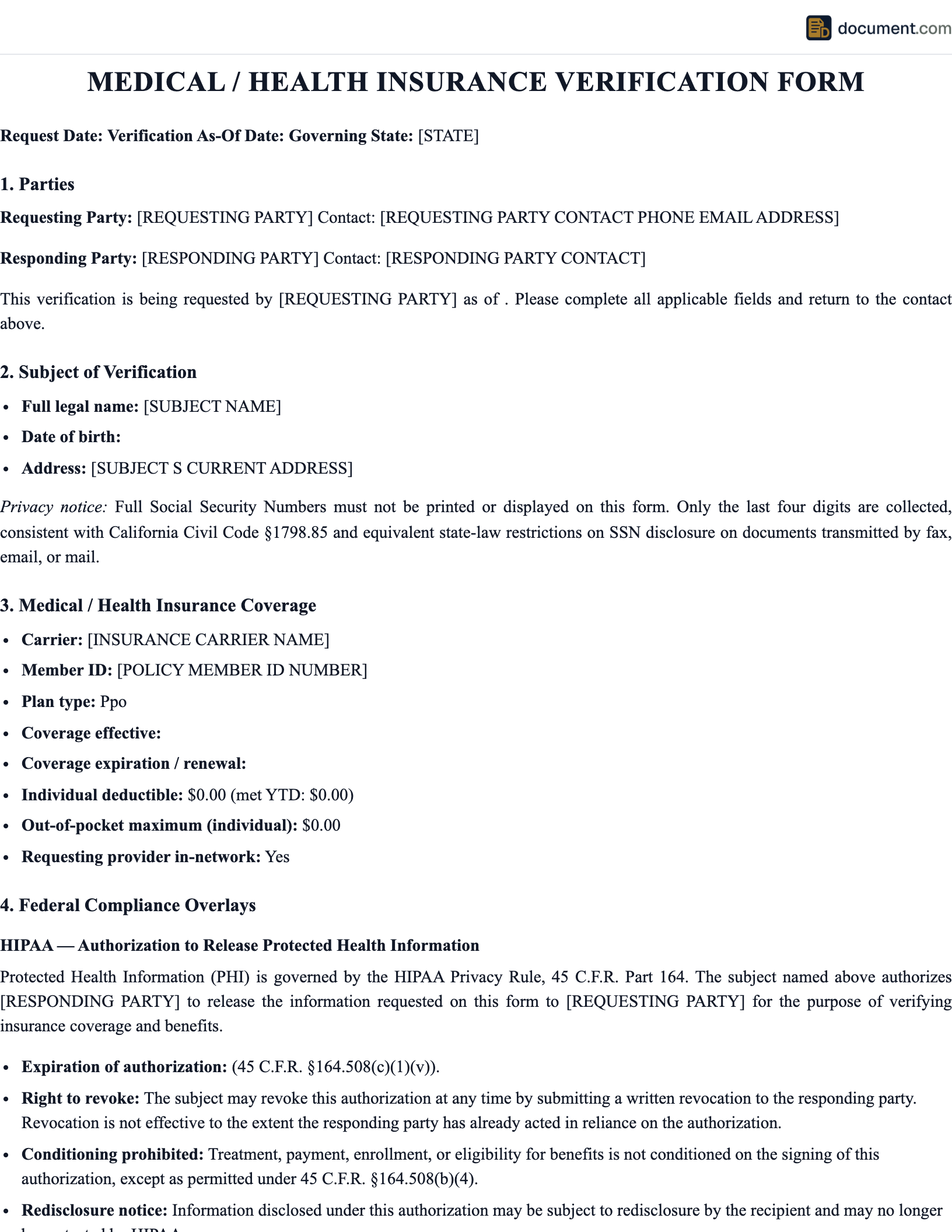
Medical / Health Insurance Verification
Confirms active medical coverage, plan details, and effective dates for providers, employers, and schools
Mortgage Verification
Confirms an active mortgage account, balance, payment status, and terms for refinancing or new loan underwriting
Pregnancy Verification
Medical confirmation of pregnancy and estimated due date for employer leave, school accommodations, or government benefits
VIN Verification
Physical inspection and confirmation of a vehicle identification number for out-of-state titling and DMV registration
Community Service Verification
Documents volunteer hours completed for court-ordered service, school requirements, or scholarship applications
Dental Insurance Verification
Confirms active dental coverage, plan benefits, and remaining annual maximums for providers and patients
Medical Health
Confirms a person's medical condition, treatment, or fitness status for employers, schools, or insurers
Choosing the Right Verification Form
With eleven distinct verification types in our library, picking the right one comes down to the question you need answered and who is in the best position to answer it. Use the guide below to identify the verification type that fits your situation.
"I need to confirm someone is employed and how much they earn."
Use an Employment Verification for confirmation of job title, dates, and current status, or an Income Verificationwhen the focus is the dollar amount of earnings. Mortgage and auto lenders often require both, sometimes paired with a verbal verification within ten business days of closing.
"I need a former landlord to confirm an applicant's rental history."
Use a Rental Verification. The form documents tenancy dates, monthly rent, payment history, lease compliance, notice of any violations, and whether the landlord would rent to the tenant again.
"I need to confirm an active insurance policy."
Use an Auto Insurance Verification, a Health Insurance Verification, or a Dental Insurance Verification depending on the coverage type. These confirm policy number, carrier, named insured, coverage limits, and effective dates.
"I need to verify a vehicle identification number for the DMV."
Use a VIN Verification, which must be completed by an authorized inspector — usually a law enforcement officer, licensed dealer, or DMV employee — who physically inspects the vehicle and confirms the VIN on the chassis matches the title and registration.
"I need to document court-ordered or required volunteer hours."
Use a Community Service Verification. The form is completed by the supervising organization and lists hours worked, dates, tasks performed, and the supervisor's signature. Most courts and schools will only accept verifications signed by a designated supervisor on organizational letterhead.
"I need a doctor to confirm pregnancy for leave or benefits."
Use a Pregnancy Verification, completed and signed by a licensed medical provider. The form confirms the pregnancy and the estimated due date and is commonly required for FMLA, short-term disability, school accommodations, and government benefit programs.
Verification vs Other Documents
Verification forms are sometimes confused with other documentation that confirms or records information about a person. Understanding the differences helps you choose the right document for your situation.
| Document | Purpose | Source |
|---|---|---|
| Verification Form | Independently confirm a single specific fact (employment, income, residence, coverage) | Authoritative third-party source (employer, landlord, insurer) |
| Background Check | Aggregate criminal, credit, and identity history into a single report | Consumer reporting agency or screening company |
| Reference Letter | Provide a subjective opinion or recommendation about a person | Personal or professional acquaintance |
| Affidavit | Make a sworn written statement under oath for legal proceedings | The affiant, sworn before a notary |
| Pay Stub / W-2 | Show actual payroll records as supporting income documentation | Employer payroll system |
How to Create a Verification Form
Creating a legally sound verification form is a simple, structured process. Follow these steps to ensure your form is complete, compliant, and acceptable to lenders, landlords, employers, and government agencies.
Identify the fact to be verified
Define the specific question you need answered — employment dates, current income, rent payment history, insurance coverage limits, or whatever else the relying party requires. The narrower the scope, the easier it will be for the source to respond accurately.
Identify the authoritative source
Determine who has first-hand knowledge of the fact. Employment is verified by HR or payroll, income by payroll or a payroll service, rental history by current or former landlords, insurance by the carrier, pregnancy by a licensed medical provider.
Obtain written authorization from the subject
Before sending a verification request to a third party, get the subject's signed authorization. The authorization should identify the requester, the source, the information being released, and the purpose. FCRA requires this for credit, employment, housing, and insurance decisions.
Complete the requester section
Fill in the requester's name, organization, address, phone, file or loan number, and the purpose of the verification. This tells the source who is asking and why.
Send the form with the authorization attached
Transmit the form to the source by secure email, fax, encrypted portal, or mail. Always include a copy of the signed authorization so the source can confirm release is permitted.
Source completes the verification
The source fills in the requested information based on first-hand records, signs and dates the form, and returns it to the requester. The source should not release information beyond what is authorized or required.
Review and follow up
Review the completed form for accuracy and completeness. If anything is missing or unclear, contact the source for clarification. Keep the verification with the underlying file for the required retention period.
Provide adverse action notice if applicable
If the verification leads to an adverse decision (denial of credit, housing, employment, or benefits), provide the applicant with a written adverse action notice explaining the decision, the right to obtain a copy of the verification, and the right to dispute inaccurate information.
Key Components of a Verification Form
Every effective verification form contains the same core building blocks. Missing any of these elements can result in the relying party rejecting the form and requiring a corrected version.
Subject Identification
Full legal name, last four of SSN, date of birth, and current address of the person being verified.
Source Identification
Name, address, phone, and contact person of the organization providing the verification.
Information Being Verified
Specific facts requested — employment status, income, rent, coverage, or other details.
Authorization Statement
Reference to the subject's signed authorization releasing the information to the requester.
Purpose of Verification
Brief statement of why the information is being requested (mortgage, lease, benefit application).
Authorized Signature
Signature, printed name, title, and date of the source's authorized representative.
FCRA & Privacy Compliance
The Fair Credit Reporting Act (FCRA), enforced by the Federal Trade Commission and the Consumer Financial Protection Bureau, sets the federal baseline for how consumer information may be collected, shared, and used in credit, employment, housing, and insurance decisions. Whenever a verification is obtained through a consumer reporting agency — or used to make a covered decision — FCRA's notice, authorization, accuracy, adverse action, and dispute requirements apply.
At a minimum, every verification form used in a credit, employment, housing, or insurance decision should reference the subject's signed authorization, limit disclosure to information reasonably necessary for the stated purpose, and include a notice of the subject's right to dispute the information if used to make an adverse decision. State privacy laws — including the California Consumer Privacy Act (CCPA), the California Investigative Consumer Reporting Agencies Act (ICRAA), and similar laws in New York, Illinois, Texas, and other states — may impose additional notice, consent, and access requirements.
Important Compliance Note
Releasing verification information without a valid signed authorization can expose the source to civil liability, statutory damages of up to $1,000 per violation under the FCRA, and potential state law claims. Always confirm authorization is on file before responding.
Legal Requirements
Most verification forms do not require notarization or witnesses to be valid, but certain types — such as VIN verifications, pregnancy verifications used in legal proceedings, and community service verifications submitted to a court — may require completion by a designated official or notarization. The relying party will dictate the form requirements: lenders typically require an authorized HR or payroll signature, courts typically require notarization or a designated official, and government benefit programs typically require completion on agency-specific forms.
At the federal level, verification practices in mortgage lending are governed by Fannie Mae, Freddie Mac, FHA, VA, and USDA underwriting guidelines, which dictate what must be verified, by whom, and how recently. Verifications used for federal benefit programs are governed by the program's regulations and the Privacy Act. Verifications used in employment decisions are governed by Title VII of the Civil Rights Act, the Americans with Disabilities Act, the Age Discrimination in Employment Act, and the Equal Employment Opportunity Commission's enforcement guidance.
Sample Verification Form
Below is a condensed preview of our employment and income verification template. Your completed form will be fully customized for your specific verification type, fields, and signature requirements.
EMPLOYMENT & INCOME VERIFICATION
Confidential — For Authorized Use Only
TO: [Source / Employer Name]
FROM: [Requester / Lender Name]
RE: [Applicant Full Legal Name]
1. AUTHORIZATION
The applicant named above has signed an authorization, attached, releasing the information requested below to the requester for the purpose of[Mortgage / Lease / Benefit / Other].
2. INFORMATION REQUESTED
- Job title and dates of employment
- Current employment status (full-time, part-time, temporary)
- Average hours worked per week
- Base hourly rate or annual salary
- Year-to-date and prior-year gross earnings
- Bonuses, commissions, and overtime, if applicable
- Probability of continued employment
3. CERTIFICATION
The undersigned certifies that the information provided above is true, complete, and based on the records of[Source Organization]as of the date signed below. The undersigned is authorized to release this information on behalf of the source.
4. PRIVACY NOTICE
This information is provided in confidence pursuant to the Fair Credit Reporting Act and applicable state privacy laws. It may not be used for any purpose other than the authorized purpose stated above and must be retained and disposed of in accordance with applicable record retention laws.
Frequently Asked Questions
Find answers to common questions about verification forms, FCRA compliance, authorized disclosures, and how verifications work in practice.
Official Resources
For additional information on verification practices, FCRA compliance, employer obligations, and consumer rights, consult these official and reputable resources.
CFPB - Regulation V (FCRA)
Consumer Financial Protection Bureau guidance on the Fair Credit Reporting Act
FTC - Fair Credit Reporting Act
Full text and FTC enforcement resources for the FCRA
DOL - Fair Labor Standards Act
Department of Labor guidance on wage and hour recordkeeping
EEOC - Background Checks Guidance
Equal Employment Opportunity Commission rules on employment verifications and screenings
HHS - HIPAA for Professionals
U.S. Department of Health and Human Services HIPAA Privacy Rule guidance
USCIS - Form I-9
Employment eligibility verification requirements for U.S. employers
Fannie Mae - Underwriting
Fannie Mae verification and documentation requirements for mortgage loans
The Work Number
Equifax employment and income verification service for employers and verifiers
Create your Verification in under 10 minutes.
Answer a few questions and download a compliant, attorney-drafted document ready for your state.