



What Is a Tolling Agreement?
A tolling agreement is a contract between parties to a potential lawsuit in which they agree to pause — or "toll" — the running of the statute of limitations for a defined period of time. The word "toll" here is borrowed from older usage meaning to suspend or stop, and the device gives both sides breathing room to investigate, negotiate, or evaluate claims without the artificial pressure of an impending filing deadline. Tolling agreements are particularly valuable when a limitations period is about to expire but the underlying dispute is not yet ripe for litigation.
At its core, a tolling agreement is a private bargain. The plaintiff (or potential plaintiff) gives up the immediate right to file suit, and in exchange the defendant gives up the affirmative defense that the claim is barred by the statute of limitations during the tolled period. Both parties benefit: the plaintiff preserves the claim without the cost and rigidity of a complaint, and the defendant avoids being sued unnecessarily — and the resulting reputational, financial, and discovery burdens — while a resolution is being explored.
Tolling agreements show up in a wide range of legal contexts. They are common in commercial litigation, mass tort claims (especially pharmaceutical and product liability cases), insurance coverage disputes, construction defect investigations, employment matters, and M&A indemnification claims discovered during or after closing. They are also used by prosecutors and regulators in white-collar investigations, where the government wants more time to assemble evidence before filing charges and the target prefers to delay charging decisions while cooperation discussions continue.
A well-drafted tolling agreement specifies which claims are tolled (and which are not), the start and end dates of the tolled period, the procedure for terminating the agreement early, and how the limitations period will be calculated when tolling ends. It should also include a clear no-admission clause confirming that signing the agreement does not constitute an admission of liability, an acknowledgment of the validity of any claim, or a waiver of any defense other than the limitations defense for the tolled period. Most agreements also include a confidentiality provision and a no-publicity clause.
Whether you are responding to a demand letter, coordinating a multi-party investigation, or preserving indemnification rights after closing on an acquisition, our attorney-reviewed tolling agreement templates provide the legal framework you need. Each template includes the key provisions courts look for when enforcing these agreements and is customizable for the specific limitations period, claims, and jurisdiction at issue in your matter.
Pause the Clock
Suspend the statute of limitations while you investigate or negotiate
Avoid Premature Suits
Eliminate filing pressure so settlement discussions can mature
Preserve Defenses
Maintain all substantive defenses while removing the limitations bar
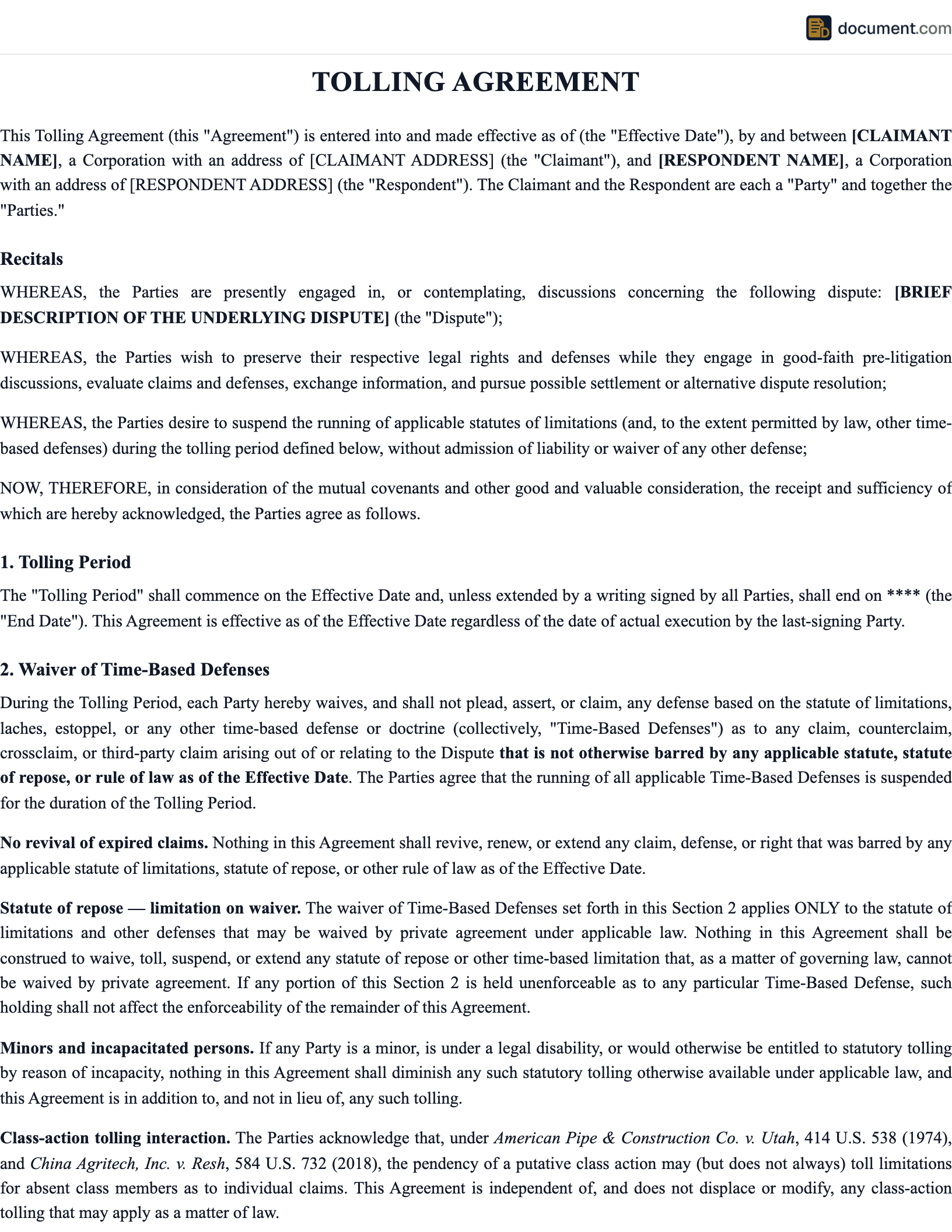
Tolling Agreement Form Preview
The preview below shows the structure and core fields included in our tolling agreement template. Your finished document will be fully formatted and customized to the specific parties, claims, and jurisdiction involved in your matter.
Tolling Agreement
Suspension of Statute of Limitations
Section 1: Parties
Section 2: Claims Subject to Tolling
Section 3: Tolling Period
Section 4: Termination & Notice
Section 5: Execution
Counsel for Claimant
Counsel for Respondent
Tolling Agreement vs Other Pre-Litigation Tools
Tolling agreements are one of several tools lawyers use to manage limitations risk and pre-litigation conduct. Understanding how they differ from related instruments helps you choose the right approach for your situation.
| Tool | Effect on Limitations | Resolves Dispute? | Typical Use |
|---|---|---|---|
| Tolling Agreement | Pauses the clock | No | Investigation, negotiation |
| Standstill Agreement | May toll plus action freeze | No | M&A, creditor matters |
| Settlement Agreement | Releases claims entirely | Yes | Final resolution |
| Mediation Agreement | Often includes tolling | If successful | Facilitated negotiation |
| Demand Letter | No effect | Sometimes | Opening communication |
How to Draft a Tolling Agreement
A tolling agreement should be drafted carefully — small ambiguities in scope or duration can create major problems if litigation eventually does occur. Follow these steps to produce a reliable, enforceable document.
- 1
Identify the underlying claims
Specify exactly which causes of action are subject to tolling. Vague references to 'all claims between the parties' invite later disputes about whether a particular theory was covered.
- 2
Calculate the original limitations period
Determine when the statute of limitations would otherwise expire under applicable law, and document that calculation in the recitals so both sides are working from the same baseline.
- 3
Set start and end dates
Use specific calendar dates rather than relative phrases like 'sixty days from now.' Ambiguous dates are the most common source of tolling-agreement litigation.
- 4
Add a termination provision
Include a notice procedure (typically 30 days' written notice) so either side can exit the agreement if circumstances change without waiting for the full tolling period to expire.
- 5
Include a no-admission clause
Confirm that nothing in the agreement constitutes an admission of liability, an acknowledgment of any claim's merit, or a waiver of any defense other than the limitations defense for the tolled period.
- 6
Add choice of law and venue
Specify which jurisdiction's law governs interpretation of the agreement and where any enforcement action will be brought.
- 7
Have both parties' counsel sign
Although not strictly required, signatures from counsel of record provide evidence that the agreement was reviewed and authorized at a senior level.
- 8
Distribute and calendar
Send executed copies to all parties, file in the matter file, and calendar the termination date with appropriate buffers so no one is caught off guard when tolling ends.
Key Components of a Tolling Agreement
Every tolling agreement should include the following provisions to be enforceable and useful in practice. Missing any one of them can leave the parties exposed when the underlying claims ripen.
Identification of parties
Full legal names and addresses of the claimant and respondent, including any related entities or affiliates that should be bound.
Scope of claims
A clear description of which claims, theories, and causes of action are tolled — and which are expressly excluded.
Tolling period
Specific start and end dates, with clear language about whether the limitations clock pauses or restarts when tolling ends.
Termination procedure
Notice requirements and effective dates for early termination by either side.
No-admission clause
Express disclaimer that the agreement is not evidence of liability or claim validity.
Reservation of defenses
Confirmation that all substantive defenses other than limitations remain fully available.
Confidentiality
A no-publicity provision and confidentiality of negotiations conducted under the agreement.
Choice of law and venue
Governing law and forum for any dispute over the agreement itself.
Signature blocks
Lines for both parties (and counsel) with date, printed name, and title.
Legal Requirements
Tolling agreements are generally enforceable as ordinary contracts, but several legal considerations affect their validity. Most jurisdictions require that the agreement be in writing, signed by both parties, and supported by consideration (the mutual exchange of rights typically satisfies this). The agreement must be entered into voluntarily and not under duress. Both parties should have capacity to contract and, in the case of corporate parties, the signatory should have authority to bind the entity.
A critical legal nuance is the distinction between statutes of limitations (which can usually be tolled by agreement) and statutes of repose (which often cannot). Statutes of repose are considered substantive in many jurisdictions because they extinguish the underlying right, not just the remedy. If your potential claim is governed by a statute of repose — common in construction defect, product liability, and securities cases — consult counsel before relying on a tolling agreement. Some jurisdictions also impose limits on how far in advance a limitations period can be waived or extended.
Public policy considerations occasionally come into play. Courts have refused to enforce tolling agreements that they view as effectively waiving a party's right to a remedy, and some courts scrutinize agreements between parties of unequal bargaining power. Tolling agreements involving consumers, employees, or other potentially vulnerable parties should be drafted with particular care to ensure they are conscionable and supported by valid consideration.
Sample Tolling Agreement
Below is an example of typical tolling agreement language. Your final document will be customized to the specific facts, parties, and jurisdiction of your matter.
Tolling Agreement
This Tolling Agreement (the "Agreement") is entered into as of [DATE] between [CLAIMANT] ("Claimant") and [RESPONDENT] ("Respondent"), collectively the "Parties."
Recitals. Claimant has asserted, or may assert, certain claims against Respondent arising out of [DESCRIBE UNDERLYING DISPUTE]. The Parties wish to engage in good-faith discussions to evaluate and potentially resolve those claims without the immediate need for litigation.
1. Tolling. The applicable statute of limitations, statute of repose, laches, and any other time-based defense to the claims described above shall be tolled from the Effective Date through and including the Termination Date.
2. Termination. Either Party may terminate this Agreement upon thirty (30) days' prior written notice to opposing counsel.
3. No Admission. Nothing in this Agreement shall constitute an admission of liability or fault by either Party, and all Parties expressly reserve all substantive defenses other than the time-based defenses tolled hereby.
4. Governing Law. This Agreement shall be governed by the laws of [STATE] without regard to its conflict-of-laws principles.
Frequently Asked Questions
Official Resources
The following authoritative sources provide additional information on statutes of limitations, tolling doctrines, and related procedural rules.
Ready to Create Your Tolling Agreement?
Generate an attorney-reviewed tolling agreement in minutes.
Create Document