



What Is a Telecommuting Agreement?
A telecommuting agreement — sometimes called a remote work agreement or work-from-home agreement — is a written contract between an employer and an employee that documents the terms under which the employee will perform some or all of their job duties from a location other than the employer's office. The agreement typically supplements rather than replaces the underlying employment contract, addressing the unique issues that arise when work moves out of a traditional office environment.
The reason a separate written agreement matters is that remote work introduces obligations and risks that an ordinary employment contract does not anticipate. Equipment ownership, reimbursement for home office expenses, cybersecurity expectations, working-hours tracking for non-exempt employees, multi-state tax registration, workers' compensation coverage, and the right to revoke remote-work privileges all need to be addressed before an employee begins working from home. Without a written agreement, both employer and employee are exposed to disputes about what was actually agreed.
The legal landscape has shifted dramatically since 2020. What was once an occasional perk has become a permanent fixture of the American workforce, and state legislatures and courts have begun applying labor laws — wage payment, expense reimbursement, paid leave, and workplace safety — to remote workers in new ways. California, Illinois, and Massachusetts in particular have aggressive expense-reimbursement rules that can create substantial back-pay liability when remote employees are not properly compensated for required home-office expenses.
A well-drafted telecommuting agreement allocates these risks clearly. It identifies the employee's designated work location, lists the equipment provided by the employer (or allowed under a BYOD policy), specifies which expenses are reimbursable and how often, sets expectations for availability and response times, addresses confidentiality and cybersecurity, requires advance notice of any change in work location, and reserves the employer's right to revoke or modify the arrangement when business needs change.
Whether you are an HR leader rolling out a company-wide remote work program or a small business owner formalizing an arrangement with a single employee, our attorney-reviewed telecommuting agreement templates give you the legal foundation you need. Each template is customizable for the employee's state, the type of arrangement (full-time, hybrid, temporary), and the equipment and expense model you want to use.
Clear Work Location
Document where the employee will work and any approval process for changes
Expense Compliance
Meet state expense reimbursement laws like California Labor Code 2802
Risk Allocation
Address cybersecurity, confidentiality, and workers' compensation
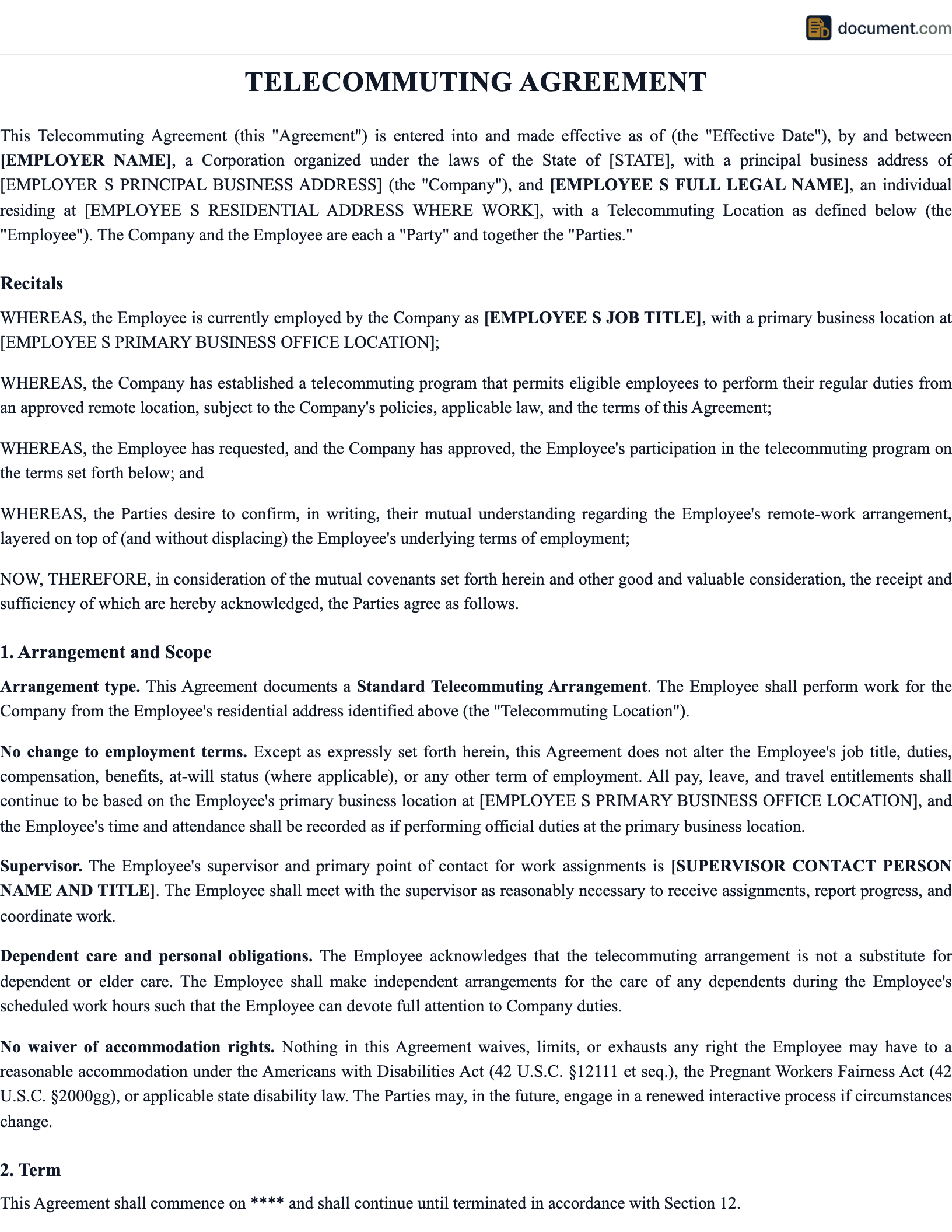
Telecommuting Agreement Form Preview
The mockup below shows the structure of our telecommuting agreement template, including the primary fields and sections you will complete to generate a final document.
Telecommuting Agreement
Remote Work Arrangement
Section 1: Employer & Employee
Section 2: Schedule & Hours
Section 3: Equipment
Section 4: Expense Reimbursement
Section 5: Signatures
Employee Signature
Employer Representative
Telecommuting Agreement vs Other Work Arrangements
A telecommuting agreement is one of several documents that govern non-traditional work arrangements. Knowing the differences helps you pick the right tool.
| Document | Worker Status | Work Location | Best For |
|---|---|---|---|
| Telecommuting Agreement | W-2 employee | Home or hybrid | Remote employees |
| Employment Contract | W-2 employee | Employer office | Standard hires |
| Independent Contractor | 1099 contractor | Anywhere | Project work |
| Remote Work Policy | All employees | Varies | Company-wide rules |
| Hybrid Schedule | W-2 employee | Mix | Split arrangements |
How to Create a Telecommuting Agreement
Follow these steps to produce a comprehensive, compliant agreement.
- 1
Confirm employee classification
Verify whether the employee is exempt or non-exempt under the FLSA, because the answer drives time-tracking and overtime obligations.
- 2
Identify the work location
Get the employee's full home address and confirm any state-specific compliance issues, including payroll tax registration and workers' compensation coverage.
- 3
Decide the equipment model
Choose between employer-provided equipment, BYOD with reimbursement, or a one-time stipend, and list specific items to be provided.
- 4
Set the expense reimbursement structure
Determine which expenses are reimbursable, the monthly amount or actual-cost basis, and the documentation employees must submit.
- 5
Define schedule and availability
Document core working hours, time zone, response time expectations, and any required overlap with team or customer-facing hours.
- 6
Address cybersecurity and confidentiality
Reference existing IT policies, require VPN and MFA, and prohibit work in public spaces with confidential materials visible.
- 7
Include revocation and notice provisions
State that the arrangement is at the employer's discretion and may be modified or revoked with reasonable notice.
- 8
Have both parties sign
Obtain employee signature before remote work begins; store the executed agreement in the employee's HR file.
Key Components
Designated work location
Specific home address where the employee will perform work.
Schedule and hours
Core hours, time zone, lunch periods, and time-tracking requirements.
Equipment list
Itemized list of company-provided hardware and software, with ownership and return obligations.
Expense reimbursement
Categories, amounts, frequency, and documentation requirements.
Confidentiality and security
VPN, MFA, document handling, and data storage requirements.
Performance expectations
Productivity, deliverables, communication cadence, and review process.
Revocation and notice
Employer's right to modify or end the arrangement and notice procedure.
Workers' compensation
Statement that workplace injuries during work hours may be covered.
Signature blocks
Employee and employer signatures with date.
Legal Requirements
Telecommuting agreements must comply with a mosaic of federal and state employment laws. Federally, the Fair Labor Standards Act (FLSA) requires accurate timekeeping for non-exempt workers, the Occupational Safety and Health Act imposes general safety obligations, and the Americans with Disabilities Act may require remote work as a reasonable accommodation in certain cases. Federal tax law requires proper payroll tax withholding based on the employee's work location.
State laws vary widely. California, Illinois, Massachusetts, Montana, New Hampshire, North Dakota, Pennsylvania, South Dakota, Iowa, and the District of Columbia all have expense reimbursement statutes that apply to remote workers. New York's "convenience of the employer" rule taxes remote workers of New York-based employers regardless of where the employee actually works. Several states have enacted specific remote-work registration and notice requirements.
Employers should also be mindful of paid sick leave laws (which typically follow the work location), state minimum wage requirements (the higher of federal, state, or local applies), and unemployment insurance registration in the employee's state of work. The agreement should reference these obligations explicitly so both parties understand their respective responsibilities.
Sample Telecommuting Agreement
Sample language from a typical telecommuting agreement.
Telecommuting Agreement
This Telecommuting Agreement (the "Agreement") is entered into between [EMPLOYER] ("Company") and [EMPLOYEE] ("Employee") and supplements the parties' existing employment relationship.
1. Work Location.Employee is approved to perform work from [ADDRESS] ("Designated Workspace"). Employee shall not perform Company work from any other location without prior written approval.
2. Equipment. Company will provide the equipment listed in Exhibit A, which remains Company property and must be returned upon termination of employment or this Agreement.
3. Expense Reimbursement. Company will reimburse Employee for necessary business expenses as set forth in Exhibit B, in compliance with applicable state law.
4. Working Hours. Employee shall maintain core working hours of [HOURS] in [TIME ZONE]. Non-exempt employees must accurately record all hours worked.
5. Revocation. Company reserves the right to modify or terminate this Agreement at any time upon reasonable written notice.
Frequently Asked Questions
Official Resources
Ready to Create Your Telecommuting Agreement?
Generate an attorney-reviewed remote-work agreement in minutes.
Create Document