
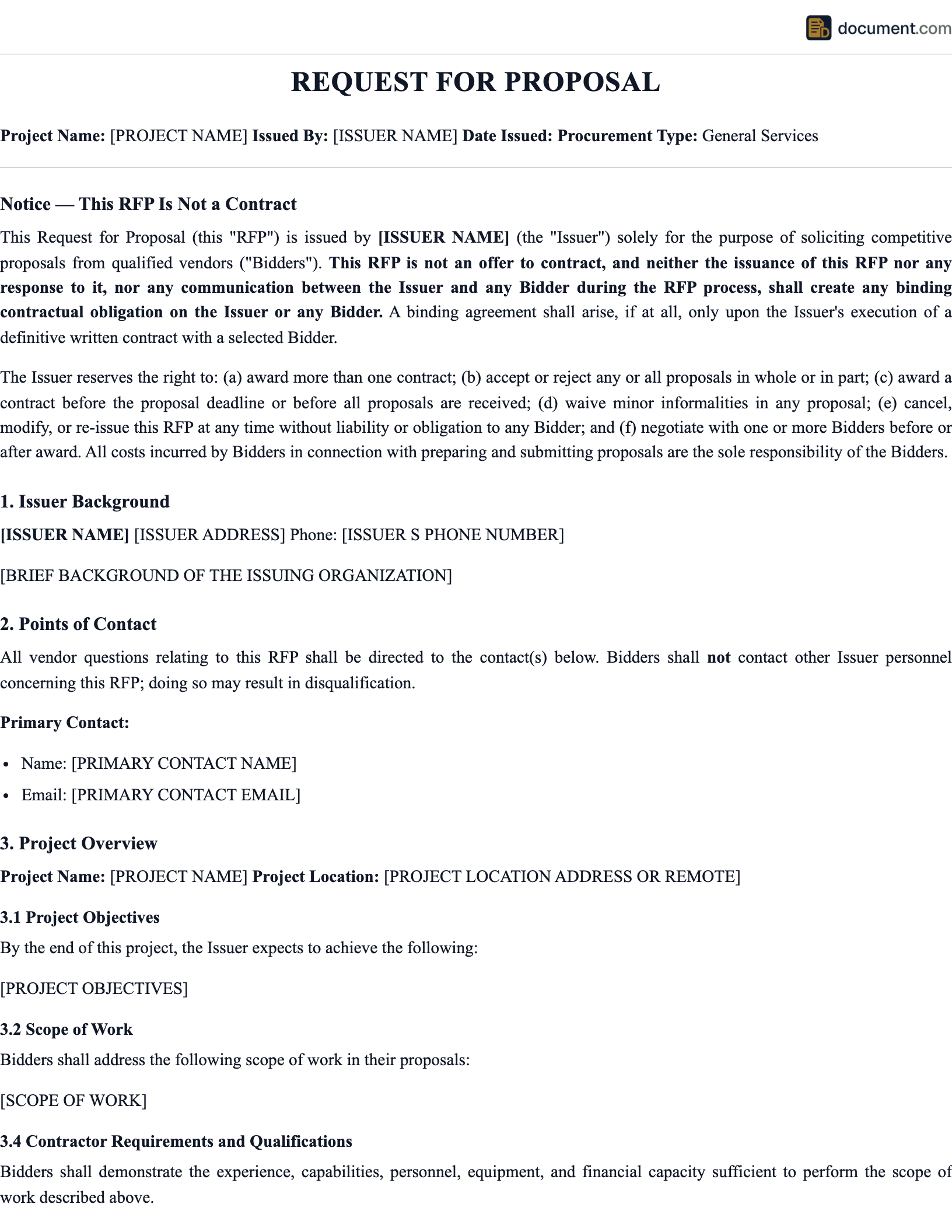



What Is a Request for Proposal?
A request for proposal (RFP) is a formal document that a buyer issues to solicit competitive written proposals from qualified vendors for the supply of goods, services, or a project. Unlike an invitation to bid — which is focused on price for a tightly defined scope — an RFP asks vendors to propose both an approach and a price, giving the buyer the ability to compare solutions on technical merit as well as cost. RFPs are the standard procurement method in federal, state, and local government, in higher education and healthcare, and in most large private organizations for professional services, technology platforms, and complex projects.
A well-crafted RFP benefits both sides of the transaction. For the buyer, it creates a structured process for identifying the best vendor, documents the procurement for audit and compliance purposes, protects against favoritism and challenges, and usually produces better pricing through competition. For vendors, a clear RFP signals that the buyer is serious, defines the rules of engagement, and provides the information needed to put together a competitive response without wasting effort. A poorly written RFP — one with vague scope, unrealistic timelines, or contradictory requirements — discourages good vendors from responding and leaves the buyer with weaker options.
Our attorney-reviewed RFP templates provide the structure, required sections, and boilerplate language needed to issue a professional solicitation. Each template includes sections for buyer background, scope of work, required deliverables, evaluation criteria, submission instructions, timeline, Q&A procedures, and contract terms. Customize the template for your specific procurement or use it as a checklist for your own RFP drafting process.
Fair Competition
Structured process that compares vendors on an equal footing
Clear Criteria
Published evaluation criteria protect against bias and post-award challenges
Better Pricing
Competition among qualified vendors typically drives 10-25% in savings
RFP Form Preview
A visual preview of the core sections in a standard request for proposal.
Request for Proposal
Enterprise Data Platform Services
1. Issuing Organization
2. Background & Purpose
3. Scope of Work
4. Evaluation Criteria
5. Key Dates
How to Write an RFP
A strong RFP starts with clarity about what you need and ends with a process that qualified vendors can actually respond to.
Define the Business Need
Start by clearly articulating the problem the procurement will solve, the outcomes you expect, and the constraints (budget, timeline, must-have requirements). Involve the end users, technical staff, finance, and legal teams early so that the RFP reflects real needs rather than assumptions.
Write the Scope of Work
Draft a detailed scope of work that describes the required deliverables, tasks, standards, and acceptance criteria. Be specific enough for accurate pricing but flexible enough to invite vendor creativity. Include any background information vendors need to understand the environment.
Set Evaluation Criteria
Publish the criteria that will be used to evaluate responses, with weightings or point values for each category. Clearly state what success looks like — what makes one proposal better than another. Assemble your evaluation team and agree on scoring rubrics before responses are received.
Build the Timeline
Give vendors enough time to prepare thoughtful responses — typically 3-6 weeks from RFP issuance to proposal due date. Include a question period, a written Q&A response date, and time for evaluation, shortlisting, interviews, and negotiation. Aggressive timelines produce rushed responses and lower win rates.
Issue, Evaluate, and Award
Publish the RFP to your target vendor list (or public bidding portal for government work), answer questions consistently, evaluate responses against the published criteria, interview shortlisted vendors, negotiate final terms, and award the contract. Debrief unsuccessful bidders professionally — they may be your vendors on a future procurement.
Key Components of an RFP
A complete RFP gives vendors everything they need to submit a competitive response — and gives the buyer everything it needs to evaluate fairly.
Introduction
- - Organization background
- - Purpose of the RFP
- - Procurement authority
- - Point of contact
Scope of Work
- - Required deliverables
- - Detailed task descriptions
- - Performance standards
- - Schedule and milestones
Evaluation & Process
- - Weighted evaluation criteria
- - Submission format and requirements
- - Timeline and key dates
- - Q&A procedures
Legal Terms
- - Buyer reservations of rights
- - Proposal validity period
- - Confidentiality
- - Form of contract to be signed
Sample RFP
A condensed example of an RFP for professional services.
REQUEST FOR PROPOSAL
For [Services]
1. INTRODUCTION
[Organization]("Owner") invites qualified vendors to submit proposals for[Services]in accordance with the requirements set forth in this RFP.
2. SCOPE OF WORK
The selected vendor will be responsible for [Scope]. Deliverables include: [Deliverables].
3. EVALUATION CRITERIA
Proposals will be evaluated on: technical approach ([%]), qualifications ([%]), and cost ([%]).
4. SUBMISSION REQUIREMENTS
Proposals must be submitted by [Date]at [Time]via [Method]. Late submissions will not be considered.
5. RESERVATION OF RIGHTS
The Owner reserves the right to reject any or all proposals, to waive minor irregularities, and to award the contract to the vendor whose proposal is most advantageous.
Frequently Asked Questions
Answers to common questions about RFP versus RFQ versus RFI, vendor selection, evaluation criteria, and government RFPs.
Official Resources
Authoritative resources on procurement, contracting, and RFP best practices.
Federal Acquisition Regulation
FAR rules governing federal procurement and RFP issuance
SAM.gov
Federal contracting portal for RFPs and contract opportunities
NIGP - Public Procurement
Institute for Public Procurement standards and best practices
SBA - Federal Contracting
Small business set-aside and RFP response resources
GAO - Bid Protest Decisions
Government Accountability Office rulings on RFP protests
Institute for Supply Management
Procurement and supply management standards and certification
Create your Request for Proposal in under 10 minutes.
Answer a few questions and download a compliant, attorney-drafted document ready for your state.