
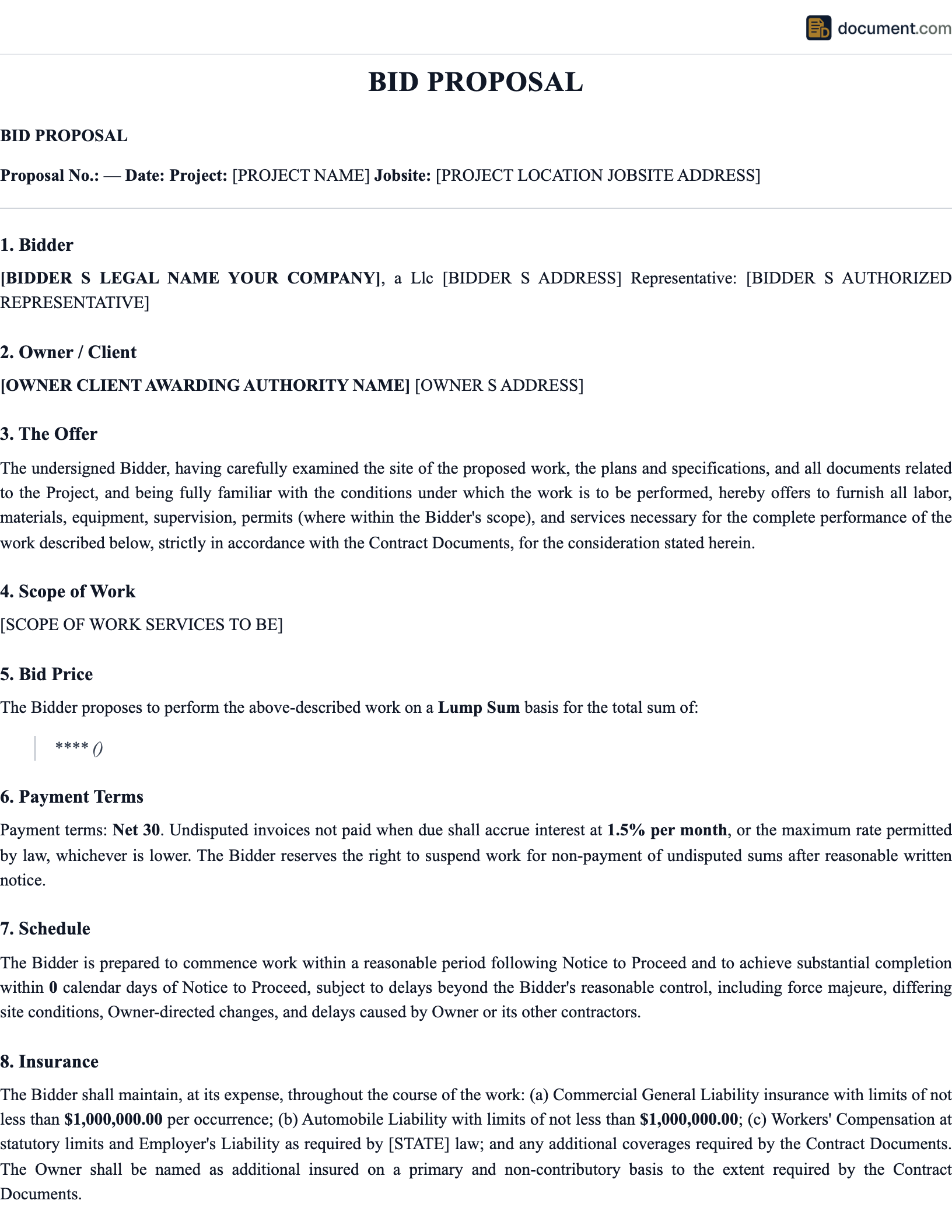



What Is a Bid Proposal?
A bid proposal is a written offer submitted by a contractor or service provider in response to an invitation to bid, offering to perform a defined scope of work for a stated price. Bids are the primary mechanism by which construction, manufacturing, public works, and many service contracts are awarded. Whether the project is a public highway paving contract, a commercial tenant improvement, a janitorial service agreement, or a fabrication order, the bid proposal is how contractors compete for the work and how owners compare offers on a level playing field.
A bid proposal differs from a general business proposal in three important ways. First, the scope of work is defined by the owner (in plans and specifications), not by the contractor — bidders compete on price and approach, not on what to build. Second, bids are typically submitted on the owner's prescribed forms and evaluated against the owner's stated criteria. Third, bids are usually selected primarily on price (for public work, the lowest responsive and responsible bidder must win by law), while business proposals are more often judged on qualifications and fit.
Our attorney-reviewed templates cover the major bid structures — fixed-price, time-and-materials, unit-price, cost-plus, and full construction bids — with sections for scope, schedule, pricing, assumptions, exclusions, bid bond information, and signature blocks. Use them as a starting point for private bids or supplement them with the owner's required forms for public procurement.
Clear Pricing
Transparent breakdown by trade, category, or unit for easy comparison
Scope Protection
Explicit assumptions and exclusions to prevent scope-creep disputes
Responsive Bids
Structured to meet public works bidding and licensing requirements
Bid Proposal Form Preview
A visual preview of the sections included in a standard bid proposal form.
Bid Proposal
Fixed-Price Construction Bid
1. Project Information
2. Bidder Information
3. Pricing Breakdown
4. Schedule
5. Exclusions
6. Signature
Authorized Signature / Date
Types of Bid Proposals
The right bid structure depends on how well the scope is defined and which party will bear cost-overrun risk.
How to Write a Bid Proposal
A winning bid is built on an accurate takeoff, realistic pricing, and clear scope protection.
Review the Bid Documents
Read the entire invitation to bid, plans, specifications, and addenda. Identify bonding requirements, licensing requirements, insurance requirements, DBE goals, liquidated damages, and the bid submission format. Note the bid opening date, time, and location, and calendar a submission cutoff at least two hours earlier to allow for problems.
Perform the Takeoff
Measure quantities directly from the plans — square footage, linear footage, cubic yards, each — and build a detailed quantity list. Solicit supplier quotes for materials and subcontractor bids for trades you will not self-perform. Double-check your arithmetic; a single transcription error can turn a winning bid into a loss.
Price Labor, Overhead, and Profit
Apply labor rates (including burden), add equipment costs, mark up subcontractors appropriately, and allocate project overhead (supervision, insurance, bonds, mobilization). Add general overhead and profit percentages based on your business's financial needs and the risk of the project. Do not cut profit to win — if the project goes poorly, there must be enough margin to absorb the loss.
Document Assumptions and Exclusions
List the conditions you assumed when preparing the bid (access, working hours, subgrade conditions, owner-supplied materials) and the scope items you are explicitly not including. Be specific — the bid documents will control any disputes. On public bids, be careful not to take exceptions that would make your bid non-responsive.
Sign, Bond, and Submit
Complete all required forms, attach the bid bond (if required), sign and date the bid, and submit before the deadline by the method specified. Keep a complete copy of what you submitted, including every attachment and exhibit. After bid opening, follow up promptly with any clarifications the owner requests.
Key Components of a Bid Proposal
Every bid proposal combines project information, pricing detail, schedule commitments, and legal terms.
Project & Bidder Info
- - Project name and location
- - Bidder name, address, license number
- - Contact person and phone
- - Bid number and submission date
Pricing
- - Itemized pricing by division or trade
- - Unit prices for added/deducted work
- - Allowances for uncertain items
- - Total base bid and alternates
Schedule
- - Mobilization and start date
- - Key milestones
- - Substantial completion
- - Bid validity period
Terms & Exhibits
- - Assumptions and exclusions
- - Bid bond (if required)
- - Change order procedure
- - Signature and date
Sample Bid Proposal
A condensed example of a fixed-price bid for a small commercial project.
BID PROPOSAL
For [Project Name]
1. BIDDER
[Contractor Name], a duly licensed contractor under License No. [Number], submits this bid to [Owner].
2. SCOPE
The bidder will furnish all labor, materials, equipment, and supervision required to complete [Scope Description]in accordance with the plans and specifications dated [Date].
3. TOTAL BID PRICE
The total lump-sum price for the work described above is $[Amount]([Written Amount] dollars).
4. TIME OF PERFORMANCE
The bidder will commence work within [Days]of notice to proceed and complete the work within [Days]calendar days thereafter.
5. BID VALIDITY
This bid shall remain open for acceptance for [Days]days from the bid opening date.
Frequently Asked Questions
Answers to common questions about competitive bidding, pricing models, change orders, and bid bonds.
Official Resources
Authoritative resources on bidding, construction contracting, and public works procurement.
SBA - Federal Contracting
Resources for small business federal bidding and contracting
DOL - Davis-Bacon & Prevailing Wages
Federal prevailing wage requirements for public works bids
SAM.gov - Contract Opportunities
Federal bidding opportunities and contractor registration
Associated General Contractors
Industry association with bidding and contracting resources
Surety & Fidelity Association
Bid bond, performance bond, and payment bond information
AIA Contract Documents
Industry-standard construction bid and contract forms
Create your Bid Proposal in under 10 minutes.
Answer a few questions and download a compliant, attorney-drafted document ready for your state.