
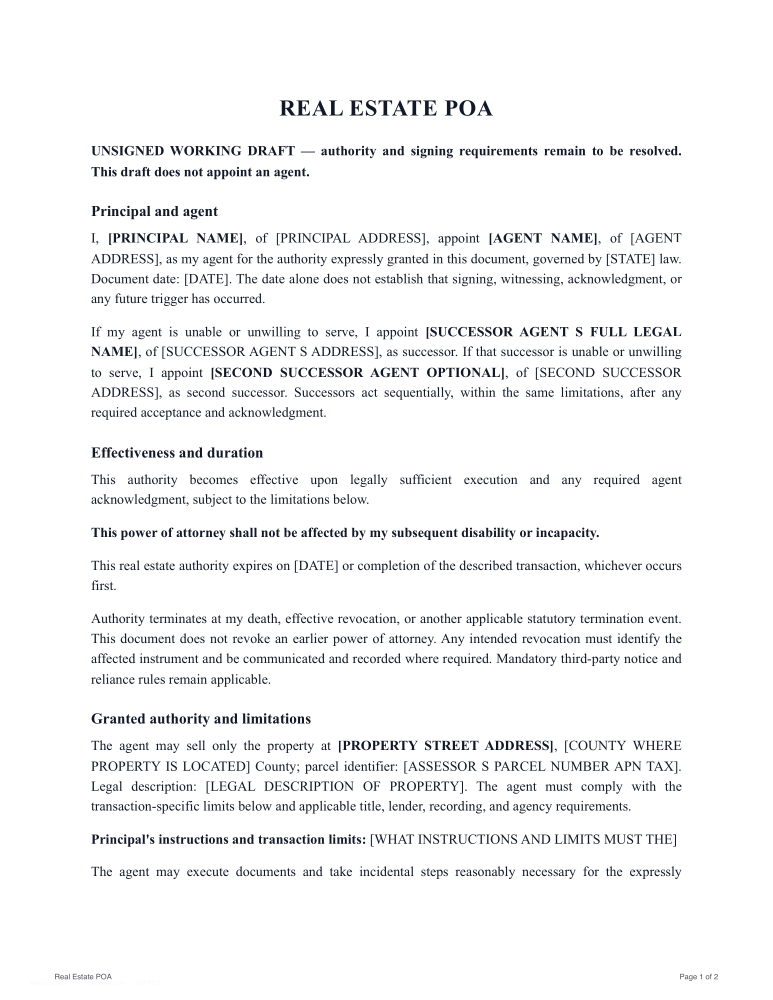



New Jersey Real Estate Power of Attorney
New Jersey real estate powers must match the authority the principal actually intends.
A real-estate power authorizes the specified property transaction. This builder requires an express durability choice and a property description, permitted acts and limits. It does not transfer title or itself create a mortgage.
Identify the property precisely, including the legal description when needed. Distinguish sale, purchase, lease, management and borrowing authority; one transaction is not permission to perform all of them. Give the proposed instrument to the closing professional before the scheduled closing.
New Jersey Execution Requirements
New Jersey N.J.S.A. §46:2B-8.9 requires the written power to be signed, dated and acknowledged in the manner prescribed by §46:14-2.1. Witnesses alone do not replace acknowledgment. This custom power must also satisfy the requirements of the intended transaction and receiving institution.
Signing rules are distinct from durability, activation and acceptance. Confirm the principal’s capacity, agent and witness eligibility, any mandatory notices, agent acceptance, special initials and transaction-specific requirements before use. A questionnaire selection describes the intended ceremony; it does not witness, notarize, record or deliver the instrument.
This is a custom power, not a claim that every optional statutory short form has been reproduced. Where a transaction needs a prescribed form, additional certificate or special act, resolve it before signing. Keep an unresolved document as a draft.
Recording a New Jersey Property Power
For a New Jersey property transaction, confirm the recording office, certificate wording, document format, property description and timing with the closing professional before signing. The requirements can depend on the act to be performed and the jurisdiction where the property lies.
New Jersey N.J.S.A. §46:2B-8.9 requires the written power to be signed, dated and acknowledged in the manner prescribed by §46:14-2.1. Witnesses alone do not replace acknowledgment. This custom power must also satisfy the requirements of the intended transaction and receiving institution.
Do not assume a fixed recording fee, a universal six-month expiration, or that recording cures a missing grant or defective execution. Retain a copy of the recorded instrument and the recording reference. A revocation may need to be recorded and delivered separately.
Prepare Your New Jersey Real Estate Power
Identify the principal and a willing, eligible agent using accurate names, addresses and contact details. Name successors in the intended order and discuss how they would obtain the document and relevant records.
Identify the property precisely, including the legal description when needed. Distinguish sale, purchase, lease, management and borrowing authority; one transaction is not permission to perform all of them. Give the proposed instrument to the closing professional before the scheduled closing.
Select only the powers needed. Gifts, self-benefiting transactions, trust changes, beneficiary changes, survivorship changes and delegation require separate decisions and applicable formalities. This builder does not grant these merely because an ordinary financial subject was selected.
Review the actual signing and use requirements above. Complete required notices, signatures, initials, witness acts and acknowledgments, then any required agent acceptance. An online signature is not by itself a notarial act or a substitute for required witnesses.
Provide completed copies to the intended recipients and preserve the original and any attached certificates. Coordinate existing powers and tell agents and recipients about an effective revocation; creating a new file does not notify them.
Coordinate Lender and Closing Requirements
Send the proposed power to the actual lender, title insurer and closing professional early. Their review should identify the intended transaction, the agent’s authority, any prohibited conflicts, certificate requirements and conditions for use.
Different loan programs and recipients can impose different conditions. The document does not guarantee acceptance, waive lawful verification or direct a lender to fund a loan. Obtain and follow the requirements for the actual transaction.
New Jersey Real Estate POA FAQ
Answers to common questions about New Jersey real estate powers of attorney, recording requirements, and title company acceptance.
Official New Jersey Resources
Use these official resources for your New Jersey real estate power of attorney.
Other New Jersey Power of Attorney Types
Need a different type of power of attorney for New Jersey?
New Jersey General POA
Broad authority for financial and legal matters
New Jersey Durable POA
Remains valid if you become incapacitated
New Jersey Medical POA
Healthcare decisions and HIPAA authorization
New Jersey Financial POA
Banking, investments, and financial management
New Jersey Limited POA
Specific transactions or time-limited authority
New Jersey Springing POA
Activates upon a specific event or condition
New Jersey Minor Child POA
Temporary guardianship for children
New Jersey Vehicle POA
DMV transactions and vehicle transfers
Create your New Jersey Real Estate Power of Attorney in under 5 minutes.
Answer a few questions and download a New Jersey-compliant document, ready for the state agency.