



Mississippi's Chancery-Based POA Framework
Walk into a county courthouse anywhere else in America and you will likely find a county recorder or register of deeds handling land records. Walk into a Mississippi courthouse and you will find a chancery clerk — the official custodian of real property records who also serves as clerk of the chancery court. This dual role is central to understanding how powers of attorney work in Mississippi, because the chancery system touches everything from recording a POA for real estate transactions to resolving disputes about an agent's conduct.
Mississippi's financial POA law lives in the Uniform Durable Power of Attorney Act at MS Code Title 87, Chapter 3 — Sections 87-3-1 through 87-3-19. Despite the word "Uniform" in the title, this is not the same as the Uniform Power of Attorney Act (UPOAA) adopted by many states. Mississippi's version is an older framework with fewer built-in protections and less detailed agent-duty provisions. Healthcare decisions are governed by a completely separate statute: the Uniform Health-Care Decisions Act at Section 41-41-201 and following.
Mississippi's economy shapes how POAs get used here in ways that differ markedly from northern states. The state's agricultural sector — cotton in the Delta, catfish in the western counties, poultry in the east, timber across the Piney Woods — generates POA needs around commodity contracts, USDA programs, and natural resource management. Oil and gas production in southern Mississippi adds mineral rights to the picture. And the prevalence of heirs' property, particularly in rural counties, makes precise POA drafting essential for avoiding title complications.
Required
Notarization
Not Required
Witnesses (Financial)
Title 87 Ch. 3
Governing Statute
Chancery Clerk
Recording Office
The Chancery Court and Clerk: Mississippi's Unique Legal Infrastructure
Mississippi's chancery court system dates to the state's earliest days and remains one of its most distinctive legal features. Chancery courts have jurisdiction over equity matters — property disputes, guardianships, conservatorships, estate administration, and the enforcement of fiduciary obligations. When a dispute arises over a POA agent's conduct, it goes to chancery court, not circuit court. This means the judge deciding whether your agent breached their fiduciary duty is the same type of judge who handles guardianship appointments, property partitions, and will contests.
The chancery clerk, who is elected in each of Mississippi's 82 counties, wears two hats: they serve as clerk of the chancery court and as the county's official keeper of land records. When you record a power of attorney for real estate purposes, you are filing it with the same office that processes deeds, mortgages, liens, and lis pendens. The chancery clerk also maintains the county's land rolls and issues marriage licenses — it is a far broader role than the county recorder or register of deeds found in other states.
For POA purposes, this means that disputes about agent authority, accountings, and removal flow through a court system that specializes in equitable remedies and fiduciary relationships. Mississippi chancery judges are accustomed to evaluating whether agents acted in good faith, and they have broad discretion to impose constructive trusts, order disgorgement of improperly taken assets, and surcharge agents for losses caused by breach of duty. This judicial oversight is a meaningful protection, though accessing it can be expensive — chancery court litigation in Mississippi typically requires hiring a local attorney familiar with the specific chancellor who sits in that district.
Land and Natural Resource Management in Mississippi
Mississippi's land-based economy creates POA planning needs that simply do not arise in more urbanized states. A POA that works for a Boston professional or a Chicago business owner may be woefully inadequate for a Mississippi landowner whose assets include 500 acres of timberland, mineral rights under a producing oil well, and 200 acres of catfish ponds.
Timber is one of Mississippi's most valuable natural resources, with over 19 million acres of forestland generating billions in annual economic impact. A POA agent managing timberland needs authority to execute timber sale contracts, negotiate stumpage rates, supervise harvesting operations, manage reforestation programs, handle burn permits through the Mississippi Forestry Commission, and maintain compliance with the state's best management practices for water quality. The agent should also be authorized to deal with the USDA Farm Service Agency for CRP enrollments and the Natural Resources Conservation Service for EQIP contracts.
Mineral rights add another dimension. In southern Mississippi, oil and gas production generates royalty income that flows through division orders and requires ongoing management. The Mississippi State Oil and Gas Board (part of the Department of Environmental Quality) regulates production, and your agent may need to attend hearings, respond to pooling orders, or negotiate lease renewals with exploration companies. A well-drafted Mississippi POA should separately address surface rights, mineral rights, and timber rights — treating them as distinct asset categories because Mississippi law allows all three to be severed and owned independently.
Power of Attorney Types Available in Mississippi
Mississippi's Title 87 framework supports all standard POA types. Because the state's version of the Uniform Durable POA Act does not enumerate default powers the way UPOAA states do, each power must be explicitly granted in the document.
General Power of Attorney
Sweeping financial and legal authority under Title 87 — suitable for Mississippi residents who need broad agent powers across multiple asset types
Durable Power of Attorney
Survives incapacity under MS Code Section 87-3-13 — critical for elder care planning in a state with limited access to guardianship attorneys in rural counties
Limited/Special Power of Attorney
Confined to a specific task or time period — often used for timber sale closings, mineral lease signings, or single property transactions
Medical/Healthcare Power of Attorney
Governed by the separate Healthcare Power of Attorney Act at MS Code Section 41-41-201 — not the same statute as the financial POA
Financial Power of Attorney
Covers banking, investment management, and farm income — essential for managing Mississippi agricultural revenue and catfish farming operations
Springing Power of Attorney
Takes effect only upon a triggering event like physician-certified incapacity — recognized under Mississippi common law and the Durable POA Act
Minor Child Power of Attorney
Temporary caregiving authority for Mississippi parents — commonly used during military deployments from Keesler AFB, Columbus AFB, or Camp Shelby
Real Estate Power of Attorney
Must be recorded with the chancery clerk in the county where property sits — Mississippi's chancery system handles all real property recording
Vehicle Power of Attorney
Handles DOR title transfers, registration renewals, and tag transactions through Mississippi Department of Revenue county tax collectors
Mississippi Execution Requirements
Getting a Mississippi POA accepted by chancery clerks, banks, title companies, and government agencies requires meeting these Title 87 formalities.
- Principal must be at least 18 years old and of sound mind when executing the document
- Financial POA must be acknowledged before a Mississippi notary public — notarization is the sole formality
- Healthcare advance directive under Section 41-41-201 requires two witnesses — separate from the financial POA
- Durability language per Section 87-3-13 must track the statutory formulation exactly
- Real estate POA must be recorded with the chancery clerk in the county where the property is situated
- Mineral rights, timber rights, and surface rights should be addressed separately if severed from each other
- Agent's authority continues until the agent receives actual notice of revocation per Section 87-3-15
- Agent owes fiduciary duties enforceable through chancery court — good faith, loyalty, and accounting
Creating a Mississippi Power of Attorney: A Ground-Level Guide
Building a POA that functions across Mississippi's 82 counties — from DeSoto County in the north to Harrison County on the Gulf Coast — requires navigating the chancery system and addressing the state's land-based economy.
Inventory Your Mississippi Assets and Authority Needs
Map out every asset that requires agent authority: bank accounts, real property (with separate consideration for surface, mineral, and timber rights), agricultural operations, vehicles, retirement plans, and any business interests. If you own property in multiple Mississippi counties, note which chancery clerk office handles each parcel. Also determine whether you need a healthcare advance directive under Section 41-41-201 — most people do.
Draft with Mississippi's Title 87 Requirements and Local Economy in Mind
Include the exact durability language from Section 87-3-13. Spell out each power the agent can exercise — Mississippi's statute does not provide default powers. For landowners, separately authorize management of timber contracts, mineral leases, agricultural programs, and water rights. For heirs' property situations, authorize the agent to participate in partition actions and negotiate with co-heirs. Name a successor agent who understands your Mississippi holdings.
Notarize, Record with the Chancery Clerk, and Distribute
Sign before a Mississippi notary public. Record the POA with the chancery clerk in every county where you own real property — call ahead for office hours in rural counties. Deliver copies to your agent, your bank, the local Farm Service Agency office if applicable, any oil or gas companies sending royalty checks, and your healthcare providers. For the healthcare advance directive, file copies with your primary care physician and any hospital where you receive regular care.
Sample Mississippi Power of Attorney
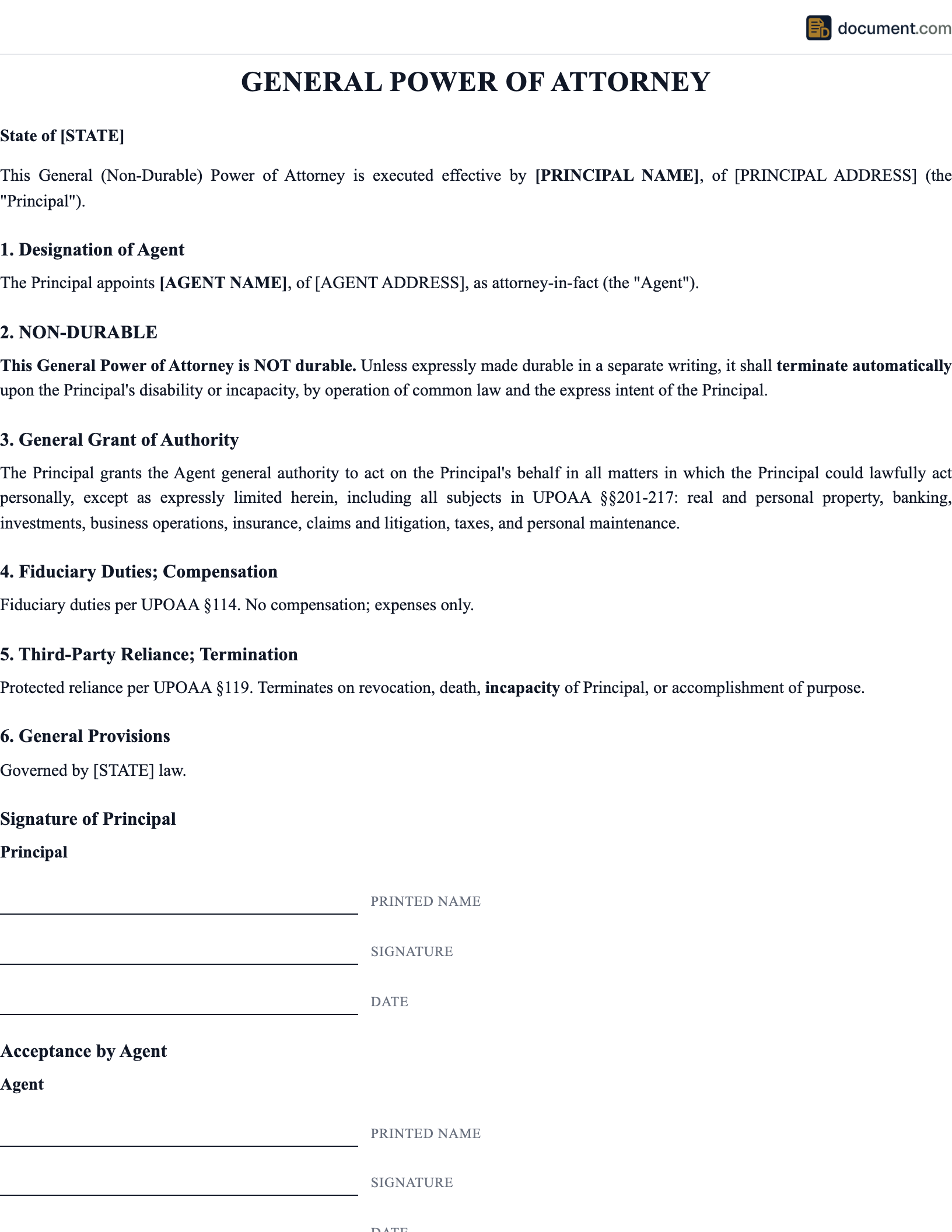
This preview shows the framework of a Mississippi durable POA under Title 87, Chapter 3. The completed document addresses chancery clerk recording format, durability provisions, and Mississippi-specific property categories.
STATE OF MISSISSIPPI
DURABLE POWER OF ATTORNEY
Under MS Code Title 87, Chapter 3, Section 87-3-13
PRINCIPAL:
Name: [Full Legal Name]
Address: [Mississippi Address]
County: [Mississippi County]
AGENT (ATTORNEY-IN-FACT):
Name: [Agent's Full Legal Name]
Address: [Agent's Address]
Successor: [Successor Agent Name]
DURABILITY AND GOVERNING LAW
This power of attorney shall not be affected by subsequent disability or incapacity of the principal, per MS Code Section 87-3-13.
Effective Date: [Date]
Governing Law: State of Mississippi — Title 87, Chapter 3
Mississippi Power of Attorney: Frequently Asked Questions
Practical answers covering Mississippi's chancery clerk system, healthcare POA statute, timberland and mineral rights management, catfish farming, land title complexity, and cross-border considerations.
Official Mississippi Resources
Access the statutory text and Mississippi state agencies relevant to POA creation, recording, and natural resource management.
MS Code Title 87, Chapter 3
Uniform Durable Power of Attorney Act text
MS Code Section 41-41-201
Healthcare Decisions Act and advance directive statute
Mississippi Forestry Commission
Timber management, burn permits, and forestland resources
MS Dept. of Environmental Quality
Oil and Gas Board, mineral rights, and environmental permits
Create your Mississippi Power of Attorney in under 5 minutes.
Answer a few questions and download a Mississippi-compliant document, ready for the state agency.